
Match the following : Codes :List – I List – II a. LED i. Heavily doped b. Avalanche Photodiode ii. Coherent radiation c. Tunnel diode iii. Spontaneous emission d. LASER iv. Current gain
a-iii, b-ii, c-i, d-iv
a-iii, b-ii, c-i, d-iv — option (D), as recorded in the supplied key.
This item must be flagged. On the device physics the keyed pairing attaches coherent radiation to the avalanche photodiode and current gain to the LASER, which reverses the two properties; a candidate reasoning correctly would answer option (C). The keyed option is recorded because it is the key, and the correct matching follows so the devices are not learnt wrongly.
| Device | Its defining property | Explanation |
|---|---|---|
| a. LED | iii. Spontaneous emission | Electrons injected across a forward-biased junction recombine independently of one another, each emitting a photon at a random time and phase. The output is therefore incoherent and spectrally broad — typically 30 to 50 nm wide. Both key and physics agree here |
| b. Avalanche photodiode | iv. Current gain | Operated at high reverse bias, a photogenerated carrier gains enough energy between collisions to ionise further pairs, which ionise more again. The device therefore has an internal multiplication factor M of 10 to 100 — it is the only photodiode with built-in gain, which is exactly why it is used for weak optical signals |
| c. Tunnel diode | i. Heavily doped | Doped so heavily that both sides are degenerate and the junction is only about 10 nm wide. Carriers tunnel straight through the barrier at low forward bias, producing the negative-resistance region. Both key and physics agree here |
| d. LASER | ii. Coherent radiation | Stimulated emission: an incident photon triggers an identical one, matched in frequency, phase, polarisation and direction. That is what coherence means, and it is what separates a laser from an LED |
The contrast the item is built around is LED against LASER, and it is the one to hold :
| LED | LASER diode | |
|---|---|---|
| Emission | Spontaneous | Stimulated |
| Coherence | Incoherent | Coherent |
| Spectral width | 30 to 50 nm | Under 1 nm |
| Requires | Forward bias only | Population inversion and an optical cavity, above a threshold current |
| Fibre-optic use | Short-haul multimode | Long-haul single-mode |
Why coherence cannot belong to a photodiode. Coherence is a property of emitted light. An avalanche photodiode is a detector — it absorbs photons and produces current, and emits nothing at all. Likewise current gain is a property of a device that multiplies carriers, which a laser diode does not do. That asymmetry is what makes the correct matching unambiguous.
Note on the recorded answer. The answer stored here follows the supplied key. On the device physics the defensible matching is a-iii, b-iv, c-i, d-ii, which is option (C).
Similar Questions
Match the following :
List – I List – II a. LASER i. Emits monochromatic light of low intensity b. Solar cell ii. Consumes electrical power due to tHe incident light c. Photo diode iii. Delivers power to load d. LED iv. Emits monochromatic light of high intensity Codes :
Which one of the following is not LED material ?
1. Ga As
2. Ga P
3. Si
4. SiO2
When atoms in Direct bandgap semiconductors move from higher energy state (E2) to lower energy state (E1) and emission of light takes place, the energy of emitted photon is given as
Match List I with List II
LIST I LIST II A. LED I. Photo resistive effect B. LCD II. Photo conductive effect C. LDR III. dynamic scattering of light D. Photo Diode IV. electro - luminescence Choose the correct answer from the options given below:
Match the following lists :
List - I List - II a) 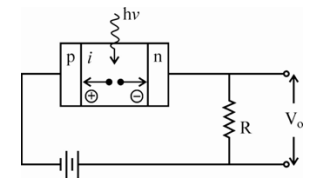
i) Solar cell b) 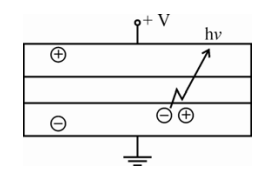
ii) Pn-photodiode c) 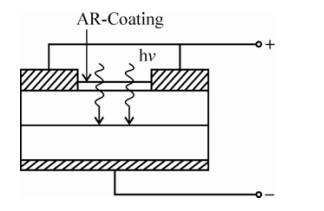
iii) Pin photodiode d) 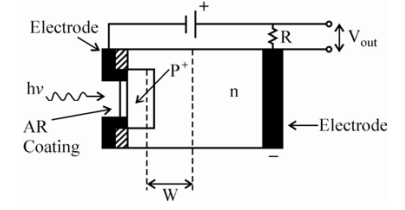
iv) Light emitting diode Choose the correct answer from the codes given below:
Which of the following statements are correct in case of Light Emitting Diodes ?
(a) Homojunctions LEDs are often surface emitters.
(b) Heterojunctions LEDs are Edge emitters.
(c) Heterojunction LEDs are often surface emitters.
(d) LEDs provide monochromatic & coherent radiations.
Options :
Arrange the below mentioned III-V materials to produce LEDs in order of their increasing emission wavelengths :
(a) In AS (b) Si C (c) Ga P (d) Ga AS
Codes :
The material LiNbO3 is used in the manufacturing of the following device :
Light emitting diodes fabricated from Ga, As emit radiations in the :
Important Questions from Optical Devices
An LCD requires a power of __________.
- The slope efficiency of a laser diode is 0.5 W/A, and the output optical power at a current of 100 mA is 30 mW. Assuming piece-wise linear characteristics of the laser diode, the threshold current of the laser is ________ mA.
- TV remote controls commonly use _____ to communicate with the TV.
- A DVD uses the _____ method to store and read data.
- The basic components of an optocoupler are _____.



