
Match List I with List II Choose the correct answer from the options given below:LIST I LIST II A. LED I. Photo resistive effect B. LCD II. Photo conductive effect C. LDR III. dynamic scattering of light D. Photo Diode IV. electro - luminescence
A-IV, B-III, C-I, D-II
Match each optoelectronic device to the effect that makes it work — note that two devices emit or control light and two detect it.
A → IV, LED: electroluminescence. Under forward bias, electrons and holes are injected across the junction and recombine radiatively, each recombination releasing a photon of energy roughly equal to the bandgap:
\(h\nu \approx E_g \Rightarrow \lambda(\mu m)\approx\dfrac{1.24}{E_g(eV)}\)
Producing light from an electric current is precisely electroluminescence. Direct-bandgap materials such as GaAs, GaAsP and GaN are used because silicon's indirect gap makes radiative recombination very inefficient.
B → III, LCD: dynamic scattering of light. A liquid crystal does not generate light at all; it modulates light that is already there (backlight or ambient). An applied field re-orients the rod-like molecules, changing how they scatter or rotate the polarisation of light passing through, so a pixel appears bright or dark. That is why LCDs consume so little power — they steer light rather than create it.
C → I, LDR: photoresistive effect. A light-dependent resistor is a slab of cadmium sulphide or similar semiconductor whose resistance falls when illuminated, because absorbed photons generate extra electron–hole pairs and raise the conductivity. It has no junction, is non-polar, and is slow (milliseconds), but it is cheap and is used in street-light and camera-exposure controls.
D → II, photodiode: photoconductive effect. A reverse-biased junction operated in photoconductive mode: absorbed photons create carriers in the depletion region, and the reverse current becomes proportional to the incident optical power. Compared with an LDR it is far faster and highly linear. (The same device with zero bias works in photovoltaic mode, which is how a solar cell operates.)
Note the neat contrast being tested: LED converts electricity to light; LCD merely modulates existing light; LDR and photodiode convert light to an electrical quantity, the first as a resistance change without a junction, the second as a current through a junction.
Hence, the correct matching is A-IV, B-III, C-I, D-II.
Similar Questions
Match the following :
List – I List – II a. LASER i. Emits monochromatic light of low intensity b. Solar cell ii. Consumes electrical power due to tHe incident light c. Photo diode iii. Delivers power to load d. LED iv. Emits monochromatic light of high intensity Codes :
Which one of the following is not LED material ?
1. Ga As
2. Ga P
3. Si
4. SiO2
When atoms in Direct bandgap semiconductors move from higher energy state (E2) to lower energy state (E1) and emission of light takes place, the energy of emitted photon is given as
Match the following :
List – I List – II a. LED i. Heavily doped b. Avalanche Photodiode ii. Coherent radiation c. Tunnel diode iii. Spontaneous emission d. LASER iv. Current gain Codes :
Match the following lists :
List - I List - II a) 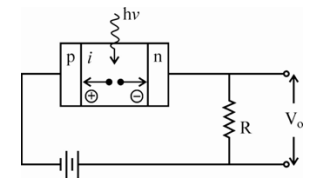
i) Solar cell b) 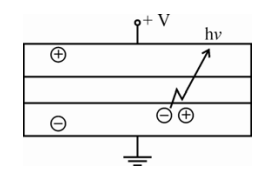
ii) Pn-photodiode c) 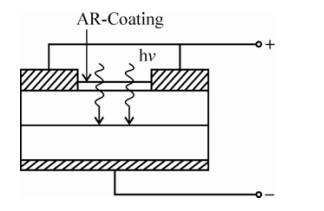
iii) Pin photodiode d) 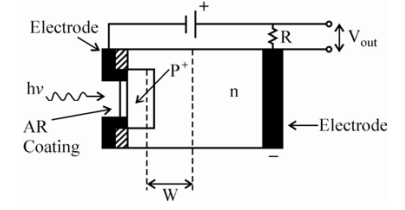
iv) Light emitting diode Choose the correct answer from the codes given below:
Which of the following statements are correct in case of Light Emitting Diodes ?
(a) Homojunctions LEDs are often surface emitters.
(b) Heterojunctions LEDs are Edge emitters.
(c) Heterojunction LEDs are often surface emitters.
(d) LEDs provide monochromatic & coherent radiations.
Options :
Arrange the below mentioned III-V materials to produce LEDs in order of their increasing emission wavelengths :
(a) In AS (b) Si C (c) Ga P (d) Ga AS
Codes :
The material LiNbO3 is used in the manufacturing of the following device :
Light emitting diodes fabricated from Ga, As emit radiations in the :
Important Questions from Optical Devices
An LCD requires a power of __________.
- The slope efficiency of a laser diode is 0.5 W/A, and the output optical power at a current of 100 mA is 30 mW. Assuming piece-wise linear characteristics of the laser diode, the threshold current of the laser is ________ mA.
- TV remote controls commonly use _____ to communicate with the TV.
- A DVD uses the _____ method to store and read data.
- The basic components of an optocoupler are _____.



