
Which one of the following is not LED material ? 1. Ga As 2. Ga P 3. Si 4. SiO2
3 & 4
Silicon and silicon dioxide are the two that cannot make an LED — and each fails for a different reason. The answer is 3 & 4, option 3.
| Material | Type | LED? |
|---|---|---|
| GaAs | Direct bandgap, 1.42 eV | ✓ Infrared |
| GaP | Indirect, but doped with N or ZnO | ✓ Red, green |
| Si | Indirect bandgap, 1.12 eV | ✗ |
| SiO2 | Insulator, 9 eV | ✗ |
Why silicon fails — the direct against indirect distinction. In a direct-gap material such as GaAs the conduction-band minimum lies at the same crystal momentum as the valence-band maximum, so an electron can drop across the gap and emit a photon while conserving both energy and momentum. In an indirect-gap material such as silicon the two extrema are at different momenta, so recombination additionally requires a phonon to carry off the momentum difference. Needing three particles to meet at once makes the process improbable; recombination in silicon proceeds instead through non-radiative traps, releasing the energy as heat. Silicon is an excellent photodetector and a hopeless emitter.
Why SiO2 fails more fundamentally. It is an insulator with a band gap of about 9 eV. No current can flow through it in the first place, so there is nothing to recombine; and a 9 eV transition would in any case lie far in the ultraviolet, well outside the visible. Its role in electronics is precisely the opposite — as the gate oxide and the isolation layer, valued for not conducting.
Why GaP is on the list despite being indirect. Pure GaP is an indirect-gap semiconductor and would be a poor emitter, but doping it with nitrogen or zinc-oxygen pairs introduces isoelectronic traps that localise an exciton. Localising the carrier in space spreads it out in momentum — a direct consequence of the uncertainty principle — which relaxes the momentum-conservation requirement and makes radiative recombination efficient. This is how the early red and green LEDs were made.
The wider pattern : LED materials are drawn from the III-V compounds and their alloys — GaAs, GaP, GaAsP, AlGaAs, InGaN — because the alloy composition can be adjusted to tune the gap, and hence the emission wavelength, across the spectrum.
Hence, the materials that are not LED materials are Si and SiO2.
Similar Questions
Match the following :
List – I List – II a. LASER i. Emits monochromatic light of low intensity b. Solar cell ii. Consumes electrical power due to tHe incident light c. Photo diode iii. Delivers power to load d. LED iv. Emits monochromatic light of high intensity Codes :
When atoms in Direct bandgap semiconductors move from higher energy state (E2) to lower energy state (E1) and emission of light takes place, the energy of emitted photon is given as
Match the following :
List – I List – II a. LED i. Heavily doped b. Avalanche Photodiode ii. Coherent radiation c. Tunnel diode iii. Spontaneous emission d. LASER iv. Current gain Codes :
Match List I with List II
LIST I LIST II A. LED I. Photo resistive effect B. LCD II. Photo conductive effect C. LDR III. dynamic scattering of light D. Photo Diode IV. electro - luminescence Choose the correct answer from the options given below:
Match the following lists :
List - I List - II a) 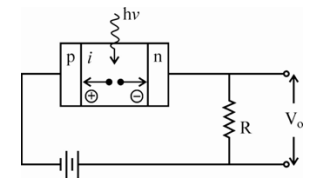
i) Solar cell b) 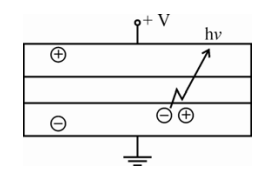
ii) Pn-photodiode c) 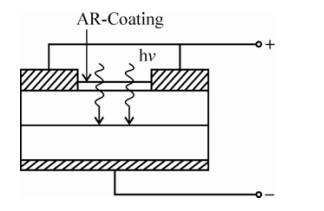
iii) Pin photodiode d) 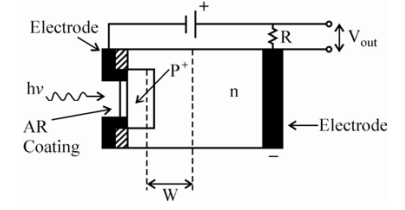
iv) Light emitting diode Choose the correct answer from the codes given below:
Which of the following statements are correct in case of Light Emitting Diodes ?
(a) Homojunctions LEDs are often surface emitters.
(b) Heterojunctions LEDs are Edge emitters.
(c) Heterojunction LEDs are often surface emitters.
(d) LEDs provide monochromatic & coherent radiations.
Options :
Arrange the below mentioned III-V materials to produce LEDs in order of their increasing emission wavelengths :
(a) In AS (b) Si C (c) Ga P (d) Ga AS
Codes :
The material LiNbO3 is used in the manufacturing of the following device :
Light emitting diodes fabricated from Ga, As emit radiations in the :
Important Questions from Optical Devices
An LCD requires a power of __________.
- The slope efficiency of a laser diode is 0.5 W/A, and the output optical power at a current of 100 mA is 30 mW. Assuming piece-wise linear characteristics of the laser diode, the threshold current of the laser is ________ mA.
- TV remote controls commonly use _____ to communicate with the TV.
- A DVD uses the _____ method to store and read data.
- The basic components of an optocoupler are _____.



