
Arrange the below mentioned III-V materials to produce LEDs in order of their increasing emission wavelengths : (a) In AS (b) Si C (c) Ga P (d) Ga AS Codes :
(b) (c) (d) (a)
To arrange the given III-V materials in order of their increasing emission wavelengths for producing LEDs, we need to consider the bandgap energies of these materials. The emission wavelength is inversely proportional to the bandgap energy. Mathematically, this relationship is given by:
\(\lambda = \frac{hc}{E_g}\)
where \(\lambda\) is the emission wavelength, \(h\) is Planck's constant, \(c\) is the speed of light, and \(E_g\) is the bandgap energy.
Materials with larger bandgap energies emit light at shorter wavelengths (higher energy), and materials with smaller bandgap energies emit light at longer wavelengths (lower energy).
Let's examine the bandgap energies for the materials in question:
- InAs: Bandgap energy = 0.354 eV
- SiC: Bandgap energy = 2.36 eV
- GaP: Bandgap energy = 2.24 eV
- GaAs: Bandgap energy = 1.42 eV
Now, we arrange them in order of increasing emission wavelengths, which is equivalent to decreasing bandgap energy:
- SiC (emits shortest wavelength due to highest bandgap energy)
- GaP
- GaAs
- InAs (emits longest wavelength due to lowest bandgap energy)
Therefore, the correct arrangement in order of increasing emission wavelengths is:
Correct Answer: (b) (c) (d) (a)
This order implies that SiC has the shortest wavelength emission, followed by GaP, then GaAs, and finally InAs with the longest wavelength emission.
Similar Questions
Match the following :
List – I List – II a. LASER i. Emits monochromatic light of low intensity b. Solar cell ii. Consumes electrical power due to tHe incident light c. Photo diode iii. Delivers power to load d. LED iv. Emits monochromatic light of high intensity Codes :
Which one of the following is not LED material ?
1. Ga As
2. Ga P
3. Si
4. SiO2
When atoms in Direct bandgap semiconductors move from higher energy state (E2) to lower energy state (E1) and emission of light takes place, the energy of emitted photon is given as
Match the following :
List – I List – II a. LED i. Heavily doped b. Avalanche Photodiode ii. Coherent radiation c. Tunnel diode iii. Spontaneous emission d. LASER iv. Current gain Codes :
Match List I with List II
LIST I LIST II A. LED I. Photo resistive effect B. LCD II. Photo conductive effect C. LDR III. dynamic scattering of light D. Photo Diode IV. electro - luminescence Choose the correct answer from the options given below:
Match the following lists :
List - I List - II a) 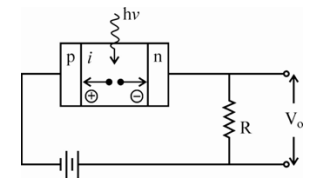
i) Solar cell b) 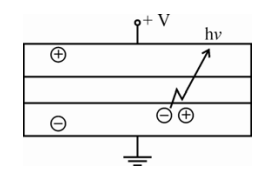
ii) Pn-photodiode c) 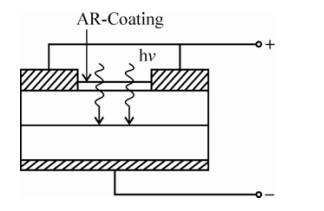
iii) Pin photodiode d) 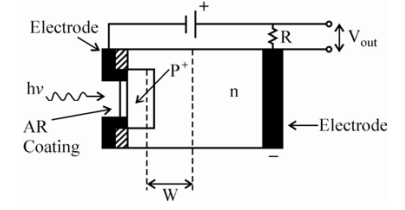
iv) Light emitting diode Choose the correct answer from the codes given below:
Which of the following statements are correct in case of Light Emitting Diodes ?
(a) Homojunctions LEDs are often surface emitters.
(b) Heterojunctions LEDs are Edge emitters.
(c) Heterojunction LEDs are often surface emitters.
(d) LEDs provide monochromatic & coherent radiations.
Options :
The material LiNbO3 is used in the manufacturing of the following device :
Light emitting diodes fabricated from Ga, As emit radiations in the :
Important Questions from Optical Devices
An LCD requires a power of __________.
- The slope efficiency of a laser diode is 0.5 W/A, and the output optical power at a current of 100 mA is 30 mW. Assuming piece-wise linear characteristics of the laser diode, the threshold current of the laser is ________ mA.
- TV remote controls commonly use _____ to communicate with the TV.
- A DVD uses the _____ method to store and read data.
- The basic components of an optocoupler are _____.



