
Read the passage and answer the questions that follow on your understanding of the passage : Optical fibre communication is one among the new techniques have come up and are extensively used for communication purposes. The portion of the e.m. spectrum encompasses the optical region falls in the wavelength of 50 nm (Ultraviolet) to approximately 100 µm (Infrared) which includes visible light spectrum from 400 nm (Violet) to 700 nm (Red). The order of frequency corresponding to these wavelengths falls in the range 1014 to 1018 Hz. There are two types of transmission media used for optical communication i.e., atmospheric channel and guided wave channel. Out of the two, guided wave channel provide much more reliable and versatile medium of communication. The medium used for guided channels in optical range are non-metallic guides popularly known as optical fibre. The optical fibre link used for communication applications has several advantages over conventional copper cable links which makes possible to send much more data over long distances with negligible attenuation. Although some difficulties do exist in the making of optical fibre set and there are some challenges being faced yet this type of communication mechanism has made a great impact in the present scenario.
When atoms in Direct bandgap semiconductors move from higher energy state (E2) to lower energy state (E1) and emission of light takes place, the energy of emitted photon is given as
\(h\nu_{12}=E_{2}-E_{1}\)
Conservation of energy fixes this exactly: the photon carries away precisely the energy the electron loses, so
\(h\nu_{12}=E_{2}-E_{1}\)
option 1.
Why it is an equality and not an inequality. Energy cannot be created or destroyed. The electron falls from \(E_{2}\) to \(E_{1}\), losing exactly \(E_{2}-E_{1}\), and in a direct-bandgap material that entire amount goes into a single photon. A photon of greater energy (option 3) would create energy from nothing; a photon of lesser energy (option 4) would mean part of the energy went elsewhere — which does happen, but then the process is no longer purely radiative. Option 2 is dimensionally impossible: a ratio of two energies is a pure number and cannot equal an energy.
Why "direct bandgap" is stated in the question. In an indirect-gap material the conduction-band minimum and valence-band maximum lie at different crystal momenta, so a phonon must participate to conserve momentum, and it takes a small share of the energy. Radiative recombination then becomes improbable, and most transitions release their energy as heat instead. Only in a direct-gap material does the clean equality above describe the usual outcome — which is why LEDs and laser diodes are made from GaAs, InP and their alloys rather than from silicon.
Turning the relation into a wavelength is the form used in practice. Since \(\nu=c/\lambda\),
\(\lambda=\dfrac{hc}{E_{g}}=\dfrac{1.24}{E_{g}\ \text{(eV)}}\ \mu\text{m}\)
a relation worth memorising. It gives GaAs, with \(E_{g}=1.42\) eV, an emission wavelength of 0.87 µm — in the near infrared. And read backwards, it explains the choice of materials for fibre systems: the 1.31 and 1.55 µm windows require gaps of 0.95 and 0.80 eV, which is why InGaAsP alloys, whose composition can be tuned to those values, are the sources used for long-haul links.
The same equality governs absorption in the reverse direction, which is why a photodetector responds only to photons of energy at least \(E_{g}\) — and why silicon, with its 1.12 eV gap, is blind beyond about 1.1 µm.
Hence, the photon energy is hν12 = E2 – E1.
Similar Questions
Match the following :
List – I List – II a. LASER i. Emits monochromatic light of low intensity b. Solar cell ii. Consumes electrical power due to tHe incident light c. Photo diode iii. Delivers power to load d. LED iv. Emits monochromatic light of high intensity Codes :
Which one of the following is not LED material ?
1. Ga As
2. Ga P
3. Si
4. SiO2
Match the following :
List – I List – II a. LED i. Heavily doped b. Avalanche Photodiode ii. Coherent radiation c. Tunnel diode iii. Spontaneous emission d. LASER iv. Current gain Codes :
Match List I with List II
LIST I LIST II A. LED I. Photo resistive effect B. LCD II. Photo conductive effect C. LDR III. dynamic scattering of light D. Photo Diode IV. electro - luminescence Choose the correct answer from the options given below:
Match the following lists :
List - I List - II a) 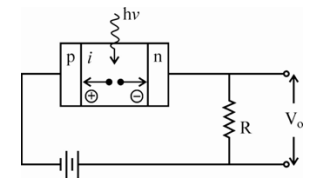
i) Solar cell b) 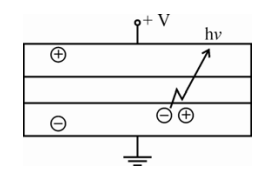
ii) Pn-photodiode c) 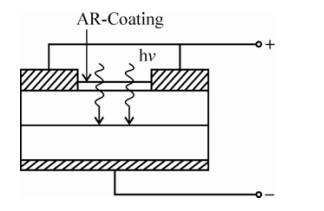
iii) Pin photodiode d) 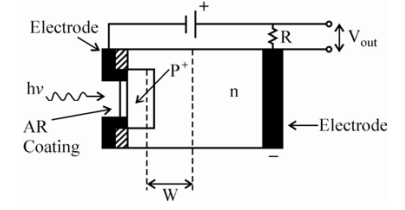
iv) Light emitting diode Choose the correct answer from the codes given below:
Which of the following statements are correct in case of Light Emitting Diodes ?
(a) Homojunctions LEDs are often surface emitters.
(b) Heterojunctions LEDs are Edge emitters.
(c) Heterojunction LEDs are often surface emitters.
(d) LEDs provide monochromatic & coherent radiations.
Options :
Arrange the below mentioned III-V materials to produce LEDs in order of their increasing emission wavelengths :
(a) In AS (b) Si C (c) Ga P (d) Ga AS
Codes :
The material LiNbO3 is used in the manufacturing of the following device :
Light emitting diodes fabricated from Ga, As emit radiations in the :
Important Questions from Optical Devices
An LCD requires a power of __________.
- The slope efficiency of a laser diode is 0.5 W/A, and the output optical power at a current of 100 mA is 30 mW. Assuming piece-wise linear characteristics of the laser diode, the threshold current of the laser is ________ mA.
- TV remote controls commonly use _____ to communicate with the TV.
- A DVD uses the _____ method to store and read data.
- The basic components of an optocoupler are _____.



