
Fourier transform or Fourier integral of a function f(t) is given by
\(\displaystyle\int_{-\infty}^{+\infty}f(t)\,e^{-j\omega t}\,dt\)
Two things define the Fourier transform — limits of −∞ to +∞, and a kernel of \(e^{-j\omega t}\) — and only option 4 has both.
\(F(\omega)=\int_{-\infty}^{+\infty}f(t)\,e^{-j\omega t}\,dt\)
Why the limits must be two-sided. The transform decomposes a signal into everlasting sinusoids, which have no beginning and no end, so the analysis must cover all time. Truncating the lower limit to zero, as options 1 and 2 do, silently assumes the signal is causal — and discards whatever happens for \(t\lt0\). That one-sided integral with the \(e^{-j\omega t}\) kernel is the unilateral transform, a different object.
Why the kernel carries a minus sign. The forward transform correlates \(f(t)\) against \(e^{+j\omega t}\), and correlation takes the complex conjugate — hence \(e^{-j\omega t}\). The positive exponent of option 3 is the kernel of the inverse transform:
\(f(t)=\dfrac{1}{2\pi}\int_{-\infty}^{+\infty}F(\omega)\,e^{+j\omega t}\,d\omega\)
Using the wrong sign yields \(F(-\omega)\) instead of \(F(\omega)\) — harmless for real even signals, wrong in general.
| Option | What it actually is |
|---|---|
| 1 | Laplace transform — kernel \(e^{-st}\) |
| 2 | Unilateral Fourier transform — causal signals only |
| 3 | Inverse transform kernel |
| 4 | Fourier transform |
Option 1 is worth a second look because the two transforms are close relatives. Put \(s=\sigma+j\omega\) and set \(\sigma=0\): the Laplace kernel becomes the Fourier kernel. So the Fourier transform is the Laplace transform evaluated on the imaginary axis — valid whenever that axis lies inside the region of convergence. The extra \(e^{-\sigma t}\) is what lets Laplace handle growing signals that have no Fourier transform at all.
Convergence. The integral exists when \(f(t)\) is absolutely integrable; sinusoids and steps are not, and appear in the transform as impulses, admitted through the generalised-function extension of the theory.
Hence, the correct expression is the two-sided integral with kernel e−jωt.
Similar Questions
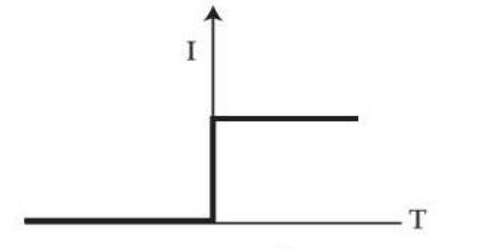
The Fourier transform of the following time domain function is :
Match the following :
List - I List - II (spectrum |G(w)| in the original figure) (a) Rectangular Pulse (i) 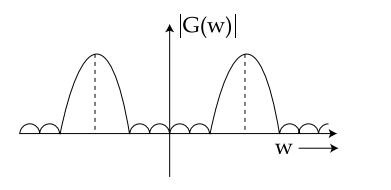
(b) Double-sided Exponential (ii) 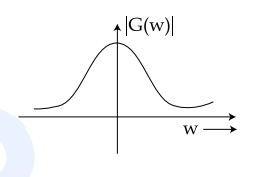
(c) Cosine Pulse (iii) 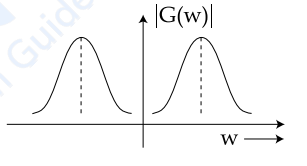
(d) Damped Sine (iv) 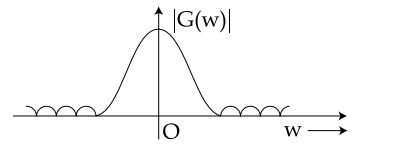
Codes :
Match the following lists :
List – I List – II a. 1 i. \(\pi\delta(\omega)+\dfrac{1}{j\omega}\) b. u(t) ii. 1 c. δ(t) iii. \(\dfrac{-2}{\omega^{2}}\) d. | t | iv. \(2\pi\delta(\omega)\)
Important Questions from Fourier Transform
- The FT of $x(t) = e^{4t} u(-t)$ is:
Fourier transform of the unit impulse δ(t) is
The function f(t) is a periodic function of period 2π. In the range (-π, π), it equals e-t. If f(t) = \(\sum\nolimits_{ - \infty }^\infty {{c_n}{e^{{\mathop{\rm int}} }}}\) denotes its Fourier series expansion, the sum \({\sum\nolimits_{ - \infty }^\infty {\left| {{c_n}} \right|} ^2}\) is
The function f(t) has a Fourier transform F(ω). The Fourier transform of F(t) is
Differentiating a signal in the time domain corresponds to _________ its FT in the frequency domain by _________.



