
Match the following : Codes :List - I List - II (spectrum |G(w)| in the original figure) (a) Rectangular Pulse (i) 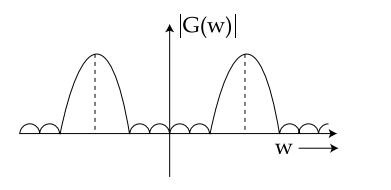
(b) Double-sided Exponential (ii) 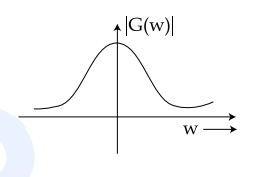
(c) Cosine Pulse (iii) 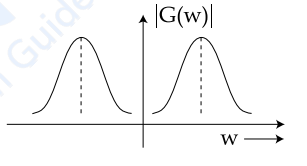
(d) Damped Sine (iv) 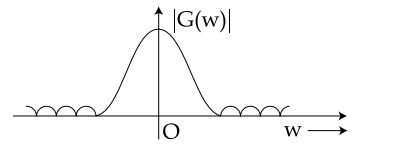
a-(iv), b-(ii), c-(i), d-(iii)
Two questions sort all four spectra: does it have ripples, and is it centred at the origin or split in two?
Ripples mean a rectangular time window. A sharp-edged pulse transforms to a sinc, whose side lobes are the ripples:
\(\text{rect}(t/\tau)\ \longleftrightarrow\ \tau\,\text{sinc}\!\left(\dfrac{\omega\tau}{2}\right)\)
A smooth, gradually decaying time function transforms to a smooth, ripple-free spectrum. So (i) and (iv) belong to the rectangular family, and (ii) and (iii) to the exponential family.
Two lobes mean multiplication by a sinusoid. Multiplying any signal by \(\cos\omega_0t\) shifts its spectrum to \(\pm\omega_0\):
\(x(t)\cos\omega_0t\ \longleftrightarrow\ \tfrac{1}{2}\left[X(\omega-\omega_0)+X(\omega+\omega_0)\right]\)
So a single central lobe means no carrier; a split pair means the signal oscillates.
Now assign all four.
| Signal | Ripples? | Centred or split? | Spectrum |
|---|---|---|---|
| (a) Rectangular pulse | yes — sharp edges | centred | (iv) |
| (b) Double-sided exponential | no — smooth \(e^{-a|t|}\) | centred | (ii) |
| (c) Cosine pulse | yes — a rect times a cosine | split | (i) |
| (d) Damped sine | no — smooth envelope | split | (iii) |
which is option 4.
The two ripple-free spectra confirmed. The double-sided exponential gives a Lorentzian centred at zero,
\(e^{-a|t|}\ \longleftrightarrow\ \dfrac{2a}{a^{2}+\omega^{2}}\)
and the damped sine is that same Lorentzian shape shifted to \(\pm\omega_0\):
\(e^{-at}\sin\omega_0t\,u(t)\ \longleftrightarrow\ \dfrac{\omega_0}{(a+j\omega)^{2}+\omega_0^{2}}\)
The underlying principle. Smoothness in one domain buys compactness in the other. A discontinuity in time — the vertical edge of a rectangle — forces the spectrum to decay only as 1/ω, which is what the ripples are; a signal with no discontinuity decays far faster. This is exactly why window functions such as Hamming and Hanning are used in spectral analysis: rounding the edges of the observation window suppresses the side lobes.
Hence, the correct matching is a-(iv), b-(ii), c-(i), d-(iii).
Similar Questions
Fourier transform or Fourier integral of a function f(t) is given by
The Fourier transform of the following time domain function is :
Match the following lists :
List – I List – II a. 1 i. \(\pi\delta(\omega)+\dfrac{1}{j\omega}\) b. u(t) ii. 1 c. δ(t) iii. \(\dfrac{-2}{\omega^{2}}\) d. | t | iv. \(2\pi\delta(\omega)\)
Important Questions from Fourier Transform
- The FT of $x(t) = e^{4t} u(-t)$ is:
Fourier transform of the unit impulse δ(t) is
The function f(t) is a periodic function of period 2π. In the range (-π, π), it equals e-t. If f(t) = \(\sum\nolimits_{ - \infty }^\infty {{c_n}{e^{{\mathop{\rm int}} }}}\) denotes its Fourier series expansion, the sum \({\sum\nolimits_{ - \infty }^\infty {\left| {{c_n}} \right|} ^2}\) is
The function f(t) has a Fourier transform F(ω). The Fourier transform of F(t) is
Differentiating a signal in the time domain corresponds to _________ its FT in the frequency domain by _________.



