
Match the following lists :List – I List – II a. 1 i. \(\pi\delta(\omega)+\dfrac{1}{j\omega}\) b. u(t) ii. 1 c. δ(t) iii. \(\dfrac{-2}{\omega^{2}}\) d. | t | iv. \(2\pi\delta(\omega)\)
a-iv, b-i, c-ii, d-iii
Start with the impulse, the anchor of the whole table.
\(\mathcal{F}\{\delta(t)\}=\int_{-\infty}^{\infty}\delta(t)e^{-j\omega t}\,dt=1\)
by the sifting property. So c → ii: an impulse in time is flat in frequency, containing every frequency equally.
Now use duality for the constant. Since δ(t) transforms to 1, the dual statement is that 1 transforms to an impulse in frequency, scaled by 2π:
\(\mathcal{F}\{1\}=2\pi\delta(\omega)\)
So a → iv. Physically a DC signal has all of its energy at ω = 0 and nowhere else. Notice the pleasing symmetry: entries a and c are duals of each other, and this pair alone eliminates options 2, 3 and 4.
The unit step. Splitting u(t) into a DC part and an odd part, \(u(t)=\tfrac{1}{2}+\tfrac{1}{2}\mathrm{sgn}(t)\), and using \(\mathcal{F}\{\mathrm{sgn}(t)\}=2/(j\omega)\),
\(\mathcal{F}\{u(t)\}=\pi\delta(\omega)+\dfrac{1}{j\omega}\)
So b → i. The impulse term is the average value of the step (½, scaled by 2π) and the 1/jω term carries the discontinuity at t = 0. Forgetting the πδ(ω) term is the standard error here.
The remaining entry, |t|. By elimination d → iii, and it can be confirmed: \(|t|=t\,\mathrm{sgn}(t)\), and multiplication by t in the time domain corresponds to \(j\dfrac{d}{d\omega}\) in frequency, so
\(\mathcal{F}\{|t|\}=j\dfrac{d}{d\omega}\left(\dfrac{2}{j\omega}\right)=-\dfrac{2}{\omega^{2}}\)
(strictly in the generalised-function sense, ignoring an impulse term at the origin).
Assemble. a-iv, b-i, c-ii, d-iii — option 1.
The pattern behind the table. The narrower a signal is in time, the wider its transform: an impulse spreads over all ω, a constant collapses to a single ω. That inverse relationship is the essence of the uncertainty principle for signals.
Hence, the correct matching is a-iv, b-i, c-ii, d-iii.
Similar Questions
Fourier transform or Fourier integral of a function f(t) is given by
The Fourier transform of the following time domain function is :
Match the following :
List - I List - II (spectrum |G(w)| in the original figure) (a) Rectangular Pulse (i) 
(b) Double-sided Exponential (ii) 
(c) Cosine Pulse (iii) 
(d) Damped Sine (iv) 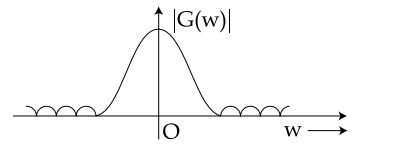
Codes :
Important Questions from Fourier Transform
- The FT of $x(t) = e^{4t} u(-t)$ is:
Fourier transform of the unit impulse δ(t) is
The function f(t) is a periodic function of period 2π. In the range (-π, π), it equals e-t. If f(t) = \(\sum\nolimits_{ - \infty }^\infty {{c_n}{e^{{\mathop{\rm int}} }}}\) denotes its Fourier series expansion, the sum \({\sum\nolimits_{ - \infty }^\infty {\left| {{c_n}} \right|} ^2}\) is
The function f(t) has a Fourier transform F(ω). The Fourier transform of F(t) is
Differentiating a signal in the time domain corresponds to _________ its FT in the frequency domain by _________.



