The standard deviation of Y is double of standard deviation of x. The correlation coefficient between X and Y is 0.5. The acute angle between lines of regression is
arctan \(\left( {\frac{3}{5}} \right)\)
Understanding the Angle Between Regression Lines
Regression lines are statistical tools used to model the relationship between two variables, say X and Y. The regression line of Y on X predicts the value of Y based on a given value of X, while the regression line of X on Y predicts the value of X based on Y. These two lines typically intersect at the point representing the mean of X and the mean of Y \((\bar{X}, \bar{Y})\). The angle between these lines provides insight into the correlation between the variables.
Problem Analysis
We are given the following information about two variables, X and Y:
- The standard deviation of Y is double the standard deviation of X: \(\sigma_Y = 2\sigma_X\).
- The correlation coefficient between X and Y is \(r = 0.5\).
Our goal is to find the acute angle between the line of regression of Y on X and the line of regression of X on Y.
Key Concepts for Regression Angle Calculation
To find the angle between the two regression lines, we need their slopes.
- The equation of the regression line of Y on X is typically written as \(Y - \bar{Y} = b_{YX}(X - \bar{X})\). The slope of this line is \(m_1 = b_{YX}\).
- The equation of the regression line of X on Y is typically written as \(X - \bar{X} = b_{XY}(Y - \bar{Y})\). To find the slope of this line when Y is plotted against X (as is standard in the XY plane), we rearrange the equation to express Y in terms of X: \(Y - \bar{Y} = \frac{1}{b_{XY}}(X - \bar{X})\). The slope of this line is \(m_2 = \frac{1}{b_{XY}}\).
The regression coefficients \(b_{YX}\) and \(b_{XY}\) are given by the formulas:
- \(b_{YX} = r \frac{\sigma_Y}{\sigma_X}\)
- \(b_{XY} = r \frac{\sigma_X}{\sigma_Y}\)
The acute angle \(\theta\) between two lines with slopes \(m_1\) and \(m_2\) is given by the formula:
\[ \tan \theta = \left| \frac{m_2 - m_1}{1 + m_1 m_2} \right| \]Step-by-Step Solution
Step 1: Calculate the regression coefficients \(b_{YX}\) and \(b_{XY}\).
We are given \(r = 0.5\) and \(\sigma_Y = 2\sigma_X\).
Calculate \(b_{YX}\):
\[ b_{YX} = r \frac{\sigma_Y}{\sigma_X} = 0.5 \times \frac{2\sigma_X}{\sigma_X} = 0.5 \times 2 = 1 \]Calculate \(b_{XY}\):
\[ b_{XY} = r \frac{\sigma_X}{\sigma_Y} = 0.5 \times \frac{\sigma_X}{2\sigma_X} = 0.5 \times \frac{1}{2} = 0.25 \]Step 2: Determine the slopes of the two regression lines in the XY plane.
The slope of the regression line of Y on X is \(m_1 = b_{YX}\).
\[ m_1 = 1 \]The slope of the regression line of X on Y (when plotted as Y vs X) is \(m_2 = \frac{1}{b_{XY}}\).
\[ m_2 = \frac{1}{0.25} = 4 \]Step 3: Use the formula for the angle between two lines.
The slopes are \(m_1 = 1\) and \(m_2 = 4\). The formula for the acute angle \(\theta\) is:
\[ \tan \theta = \left| \frac{m_2 - m_1}{1 + m_1 m_2} \right| \]Substitute the values of \(m_1\) and \(m_2\):
\[ \tan \theta = \left| \frac{4 - 1}{1 + (1)(4)} \right| \] \[ \tan \theta = \left| \frac{3}{1 + 4} \right| \] \[ \tan \theta = \left| \frac{3}{5} \right| \]Since we are looking for the acute angle, \(\tan \theta\) is positive.
\[ \tan \theta = \frac{3}{5} \]Step 4: Find the angle \(\theta\).
Taking the arctan (or inverse tangent) of both sides gives the angle:
\[ \theta = \arctan\left(\frac{3}{5}\right) \]This is the acute angle between the two lines of regression.
| Concept | Formula | Calculated Value |
|---|---|---|
| Regression coefficient \(b_{YX}\) | \(r \frac{\sigma_Y}{\sigma_X}\) | \(1\) |
| Regression coefficient \(b_{XY}\) | \(r \frac{\sigma_X}{\sigma_Y}\) | \(0.25\) |
| Slope of Y on X (\(m_1\)) | \(b_{YX}\) | \(1\) |
| Slope of X on Y (\(m_2\)) | \(\frac{1}{b_{XY}}\) | \(4\) |
| Tangent of angle \(\theta\) | \(\left| \frac{m_2 - m_1}{1 + m_1 m_2} \right|\) | \(\frac{3}{5}\) |
| Acute Angle \(\theta\) | \(\arctan(\tan \theta)\) | \(\arctan\left(\frac{3}{5}\right)\) |
Revision Table: Regression Angle Formulas
| Term | Description | Formula |
|---|---|---|
| Regression Coefficient Y on X | Slope of Y on X line | \(b_{YX} = r \frac{\sigma_Y}{\sigma_X}\) |
| Regression Coefficient X on Y | Slope of X on Y line (X as dependent) | \(b_{XY} = r \frac{\sigma_X}{\sigma_Y}\) |
| Slope of Y on X line (in XY plane) | Slope \(m_1\) | \(m_1 = b_{YX}\) |
| Slope of X on Y line (in XY plane) | Slope \(m_2\) when rearranged as Y = f(X) | \(m_2 = \frac{1}{b_{XY}}\) |
| Tangent of angle between lines | \(\tan \theta\) | \(\left| \frac{m_2 - m_1}{1 + m_1 m_2} \right|\) |
| Angle between lines | \(\theta\) | \(\arctan\left(\left| \frac{m_2 - m_1}{1 + m_1 m_2} \right|\right)\) |
Additional Information: Properties of Regression Lines and Correlation
The angle between the two regression lines is closely related to the correlation coefficient \(r\).
- If \(r = 0\) (no correlation), then \(b_{YX} = 0\) and \(b_{XY} = 0\). The slope of Y on X is \(m_1 = 0\) (a horizontal line). The slope of X on Y has \(b_{XY} = 0\), meaning \(X - \bar{X} = 0(Y - \bar{Y})\), so \(X = \bar{X}\) (a vertical line). A horizontal line and a vertical line are perpendicular, so the angle between them is \(90^\circ\). The formula gives \(\tan \theta = |\frac{m_2 - m_1}{1 + m_1 m_2}| = |\frac{\infty - 0}{1 + 0}| = \infty\), which means \(\theta = 90^\circ\).
- If \(|r| = 1\) (perfect correlation), then the two regression lines coincide. The angle between them is \(0^\circ\) or \(180^\circ\). The formula gives \(\tan \theta = |\frac{m_2 - m_1}{1 + m_1 m_2}|\). If \(|r|=1\), then \(b_{YX}b_{XY} = r \frac{\sigma_Y}{\sigma_X} \times r \frac{\sigma_X}{\sigma_Y} = r^2 = 1\). Also, \(m_1 = b_{YX}\) and \(m_2 = \frac{1}{b_{XY}}\), so \(m_1 m_2 = b_{YX} \frac{1}{b_{XY}} = \frac{b_{YX}}{b_{XY}}\). If \(b_{YX}b_{XY}=1\), then \(b_{YX} = \frac{1}{b_{XY}}\), which means \(m_1 = m_2\). If the slopes are equal, the lines are parallel or coincident, and the angle is \(0^\circ\). The formula gives \(\tan \theta = |\frac{m_1 - m_1}{1 + m_1^2}| = \frac{0}{1 + m_1^2} = 0\), so \(\theta = 0^\circ\).
- The angle between the lines decreases as the absolute value of the correlation coefficient \(|r|\) increases. A smaller angle indicates stronger correlation.
- In our problem, \(r = 0.5\). This is a moderate positive correlation, so we expect an acute angle between \(0^\circ\) and \(90^\circ\). Our result \(\arctan\left(\frac{3}{5}\right)\) confirms this, as \(3/5\) is between 0 and infinity.
Similar Questions
If a constant 60 is subtracted from each of the values of X and Y, then the regression coefficient is
Given the regression lines X + 2Y - 5 = 0, 2X + 3Y - 8 = 0 and Var(X) = 12, the value of Var(Y) is
The data about the sales and advertisement expenditure of a firm is given below
Sales (in crore of Rs.) Advertisement exp (in crores of Rs.) Means 40 6 Standard Daviation 10 1.5
The correlation coefficient between sales and advertisement expenditure is 0.9. The likely sales for a proposed advertisement expenditure of Rs. 10 croreFor the variables X, Y and Z, r xy = 0.80, r xz = 0.64, and r yz = 0.79, the square of multiple correlation coefficient \(\rm \mathop R\nolimits_{xyz}^2 \) is:
If x and y are uncorrelated variables then this implies:
For a bivariate data set on (x, y), if the means, standard deviations and correlation coefficient are
x̅ = 1.0, y̅ = 2.0, s x= 3.0, s y= 9.0, r = 0.8
Then the regression line of y on x is:
Important Questions from Regression Analysis
There is no value of x that can simultaneously satisfy both the given equations. Therefore, find the ‘least squares error’ solution to the two equations, i.e., find the value of x that minimizes the sum of squares of the errors in the two equations. __________
2x = 3
4x = 1
- Using linear regression (least squares), the best-fit line for the given dataset is $y = 2.2x + 2.3$. Given the residual sum of squares is 25.8, the coefficient of determination ($r^2$), is ______________ . (rounded off to two decimal places)
$x$ 2 3 4 5 $y$ 8 9 7 16 - Given the pairs of values of $(X, Y)$ as $(2, 60)$, $(4, 70)$ and $(6, 90)$, $m$ is the slope of the linear regression plot of $Y$ on $X$. The value of $m$ is _______.
- The data given in the table are fitted to the equation $y = mx$ using the method of least squares. The value of $m$ is ______ (rounded off to one decimal place).
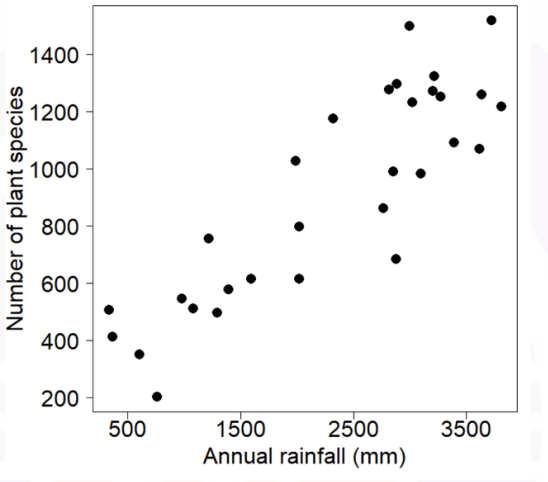
$x$ 1 2 3 4 $y$ 2 6 7 10 The graph below shows a plot of annual rainfall on the X axis and number of plant species on the Y axis. Based on the pattern in the graph, which one of the following statistical methods would be most appropriate to model the relationship between annual rainfall and the number of plant species?