If a constant 60 is subtracted from each of the values of X and Y, then the regression coefficient is
not changed
Understanding the Regression Coefficient and Transformations
The question asks how subtracting a constant value from both the independent variable (X) and the dependent variable (Y) affects the regression coefficient. Let's analyze this based on the properties of regression coefficients.
In a simple linear regression model, the estimated relationship between Y and X is typically represented as:
\(\hat{Y} = a + bX\)
Here, '\(b\)' is the regression coefficient (or slope), which measures the average change in Y associated with a one-unit increase in X. The formula for the regression coefficient \(b\) is:
\(b = \dfrac{\text{Cov}(X, Y)}{\text{Var}(X)}\)
where \(\text{Cov}(X, Y)\) is the covariance between X and Y, and \(\text{Var}(X)\) is the variance of X.
Effect of Subtracting a Constant
Let's consider the effect of subtracting a constant, say \(c = 60\), from both X and Y. Let the new variables be \(X' = X - c\) and \(Y' = Y - c\).
Effect on Variance
The variance of a variable measures the spread of the data around its mean. If we subtract a constant from every value of a variable, the mean also changes by that constant, but the spread around the new mean remains the same. Therefore, subtracting a constant does not change the variance.
\(\text{Var}(X') = \text{Var}(X - c) = \text{Var}(X)\)
Effect on Covariance
The covariance measures the extent to which two variables change together. The formula for covariance is:
\(\text{Cov}(X, Y) = E[(X - E[X])(Y - E[Y])]\)
For the new variables \(X'\) and \(Y'\):
\(\text{Cov}(X', Y') = \text{Cov}(X - c, Y - c)\)
Let \(\mu_X = E[X]\) and \(\mu_Y = E[Y]\). Then \(E[X'] = E[X - c] = E[X] - c = \mu_X - c\) and \(E[Y'] = E[Y - c] = E[Y] - c = \mu_Y - c\).
So, \(\text{Cov}(X', Y') = E[((X - c) - (\mu_X - c))((Y - c) - (\mu_Y - c))]\)
\(\text{Cov}(X', Y') = E[(X - c - \mu_X + c)(Y - c - \mu_Y + c)]\)
\(\text{Cov}(X', Y') = E[(X - \mu_X)(Y - \mu_Y)]\)
This is the same as the original covariance.
\(\text{Cov}(X', Y') = \text{Cov}(X, Y)\)
Effect on Regression Coefficient
Now let's look at the regression coefficient \(b'\) for the transformed variables \(X'\) and \(Y'\):
\(b' = \dfrac{\text{Cov}(X', Y')}{\text{Var}(X')}\)
Substituting the results from the variance and covariance analysis:
\(b' = \dfrac{\text{Cov}(X, Y)}{\text{Var}(X)}\)
This is the same as the original regression coefficient \(b\).
\(b' = b\)
Conclusion
Subtracting a constant value (like 60) from each observation of both the independent variable (X) and the dependent variable (Y) does not change the value of the regression coefficient (slope). This type of transformation is called a shift in origin. Regression coefficients (slopes) are invariant under shifts in origin for both variables.
Therefore, if a constant 60 is subtracted from each of the values of X and Y, the regression coefficient is not changed.
Revision Table: Effect of Transformations on Statistics
| Statistic | Transformation: \(X' = X + c\) | Transformation: \(X' = cX\) | Transformation: \(X' = X + c\) & \(Y' = Y + d\) |
|---|---|---|---|
| Mean (\(E[X]\)) | \(E[X'] = E[X] + c\) | \(E[X'] = c \cdot E[X]\) | \(E[X'] = E[X] + c\), \(E[Y'] = E[Y] + d\) |
| Variance (\(\text{Var}(X)\)) | \(\text{Var}(X') = \text{Var}(X)\) | \(\text{Var}(X') = c^2 \cdot \text{Var}(X)\) | \(\text{Var}(X') = \text{Var}(X)\), \(\text{Var}(Y') = \text{Var}(Y)\) |
| Standard Deviation (\(s_x\)) | \(s_{x'} = s_x\) | \(s_{x'} = |c| \cdot s_x\) | \(s_{x'} = s_x\), \(s_{y'} = s_y\) |
| Covariance (\(\text{Cov}(X, Y)\)) | N/A | N/A | \(\text{Cov}(X', Y') = \text{Cov}(X, Y)\) |
| Correlation Coefficient (\(r\)) | N/A | N/A | \(r_{X'Y'} = r_{XY}\) (if signs of transformation constants are same) |
| Regression Coefficient (b) | N/A | N/A | \(b_{Y'X'} = b_{YX}\) |
| Intercept (a) | N/A | N/A | \(a_{Y'X'} = a_{YX} + d - c \cdot b_{YX}\) |
Additional Information on Regression Coefficients
The regression coefficient is a key measure in regression analysis. It quantifies the linear relationship between the independent and dependent variables. Understanding how transformations affect it is crucial for data analysis.
- Scale Changes: If X is scaled (e.g., \(X' = cX\)) or Y is scaled (e.g., \(Y' = dY\)), the regression coefficient will change. Specifically, if \(X' = cX\) and \(Y' = Y\), \(b_{YX'} = b_{YX}/c\). If \(X' = X\) and \(Y' = dY\), \(b_{Y'X} = d \cdot b_{YX}\). If \(X' = cX\) and \(Y' = dY\), \(b_{Y'X'} = (d/c) \cdot b_{YX}\).
- Origin Shifts: As shown, adding or subtracting a constant (shift in origin) from X and Y does not change the slope \(b\). It only affects the intercept \(a\). The new intercept \(a'\) for \(Y' = a' + b'X'\) when \(X' = X-c\) and \(Y'=Y-d\) is related to the original intercept \(a\) for \(Y = a + bX\) by \(a' = a + d - bc\).
- Units: The regression coefficient \(b\) has units of (units of Y) / (units of X).
- Relationship with Correlation: The sign of the regression coefficient is the same as the sign of the correlation coefficient. Both indicate the direction of the linear relationship.
Similar Questions
Given the regression lines X + 2Y - 5 = 0, 2X + 3Y - 8 = 0 and Var(X) = 12, the value of Var(Y) is
The data about the sales and advertisement expenditure of a firm is given below
Sales (in crore of Rs.) Advertisement exp (in crores of Rs.) Means 40 6 Standard Daviation 10 1.5
The correlation coefficient between sales and advertisement expenditure is 0.9. The likely sales for a proposed advertisement expenditure of Rs. 10 croreThe standard deviation of Y is double of standard deviation of x. The correlation coefficient between X and Y is 0.5.
The acute angle between lines of regression is
For the variables X, Y and Z, r xy = 0.80, r xz = 0.64, and r yz = 0.79, the square of multiple correlation coefficient \(\rm \mathop R\nolimits_{xyz}^2 \) is:
If x and y are uncorrelated variables then this implies:
For a bivariate data set on (x, y), if the means, standard deviations and correlation coefficient are
x̅ = 1.0, y̅ = 2.0, s x= 3.0, s y= 9.0, r = 0.8
Then the regression line of y on x is:
Important Questions from Regression Analysis
There is no value of x that can simultaneously satisfy both the given equations. Therefore, find the ‘least squares error’ solution to the two equations, i.e., find the value of x that minimizes the sum of squares of the errors in the two equations. __________
2x = 3
4x = 1
- Using linear regression (least squares), the best-fit line for the given dataset is $y = 2.2x + 2.3$. Given the residual sum of squares is 25.8, the coefficient of determination ($r^2$), is ______________ . (rounded off to two decimal places)
$x$ 2 3 4 5 $y$ 8 9 7 16 - Given the pairs of values of $(X, Y)$ as $(2, 60)$, $(4, 70)$ and $(6, 90)$, $m$ is the slope of the linear regression plot of $Y$ on $X$. The value of $m$ is _______.
- The data given in the table are fitted to the equation $y = mx$ using the method of least squares. The value of $m$ is ______ (rounded off to one decimal place).
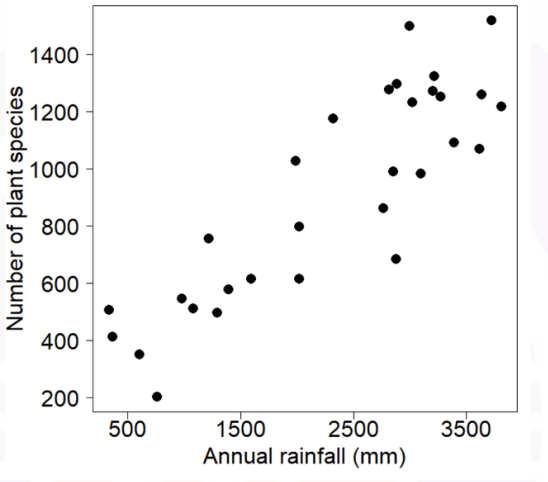
$x$ 1 2 3 4 $y$ 2 6 7 10 The graph below shows a plot of annual rainfall on the X axis and number of plant species on the Y axis. Based on the pattern in the graph, which one of the following statistical methods would be most appropriate to model the relationship between annual rainfall and the number of plant species?