For the variables X, Y and Z, r xy = 0.80, r xz = 0.64, and r yz = 0.79, the square of multiple correlation coefficient \(\rm \mathop R\nolimits_{xyz}^2 \) is:
0.64
Calculating the Square of the Multiple Correlation Coefficient
The multiple correlation coefficient measures the linear relationship between a dependent variable and a set of independent variables. The square of the multiple correlation coefficient, denoted as \(R^2\), represents the proportion of the variance in the dependent variable that is predictable from the independent variables.
For three variables, say X, Y, and Z, the square of the multiple correlation coefficient when predicting one variable (e.g., X) from the other two (Y and Z) is given by the formula:
$$\rm \mathop R\nolimits_{x.yz}^2 = \frac{\mathop r\nolimits_{xy}^2 + \mathop r\nolimits_{xz}^2 - 2 \mathop r\nolimits_{xy} \mathop r\nolimits_{xz} \mathop r\nolimits_{yz}}{1 - \mathop r\nolimits_{yz}^2}$$
Where:
- \(\rm \mathop R\nolimits_{x.yz}^2\) is the square of the multiple correlation coefficient between X and the combination of Y and Z.
- \(\rm \mathop r\nolimits_{xy}\) is the simple correlation coefficient between X and Y.
- \(\rm \mathop r\nolimits_{xz}\) is the simple correlation coefficient between X and Z.
- \(\rm \mathop r\nolimits_{yz}\) is the simple correlation coefficient between Y and Z.
The question provides the following simple correlation coefficients:
- \(\rm \mathop r\nolimits_{xy} = 0.80\)
- \(\rm \mathop r\nolimits_{xz} = 0.64\)
- \(\rm \mathop r\nolimits_{yz} = 0.79\)
We are asked to find \(\rm \mathop R\nolimits_{xyz}^2\), which we interpret as the square of the multiple correlation coefficient when predicting one variable from the other two. Let's assume we are predicting X from Y and Z, as this is a common application of the formula and will allow us to use the given simple correlation values directly in the standard formula \(\rm \mathop R\nolimits_{x.yz}^2\).
Let's calculate the components needed for the formula:
- \(\rm \mathop r\nolimits_{xy}^2 = (0.80)^2 = 0.64\)
- \(\rm \mathop r\nolimits_{xz}^2 = (0.64)^2 = 0.4096\)
- \(\rm \mathop r\nolimits_{yz}^2 = (0.79)^2 = 0.6241\)
- \(\rm 2 \mathop r\nolimits_{xy} \mathop r\nolimits_{xz} \mathop r\nolimits_{yz} = 2 \times 0.80 \times 0.64 \times 0.79\)
- \(\rm 2 \times 0.80 \times 0.64 \times 0.79 = 1.60 \times 0.64 \times 0.79\)
- \(\rm 1.60 \times 0.64 = 1.024\)
- \(\rm 1.024 \times 0.79 = 0.80896\)
Now, substitute these values into the formula for \(\rm \mathop R\nolimits_{x.yz}^2\):
$$\rm \mathop R\nolimits_{x.yz}^2 = \frac{0.64 + 0.4096 - 0.80896}{1 - 0.6241}$$
Calculate the numerator:
$$\rm Numerator = 0.64 + 0.4096 - 0.80896 = 1.0496 - 0.80896 = 0.24064$$
Calculate the denominator:
$$\rm Denominator = 1 - 0.6241 = 0.3759$$
Now, divide the numerator by the denominator to find \(\rm \mathop R\nolimits_{x.yz}^2\):
$$\rm \mathop R\nolimits_{x.yz}^2 = \frac{0.24064}{0.3759} \approx 0.640116$$
Rounding the result to two decimal places, we get 0.64. This value represents the square of the multiple correlation coefficient when predicting X from Y and Z.
Comparing Calculated Value with Options
Let's compare our calculated value with the given options:
| Option | Value |
|---|---|
| 1 | 0.43 |
| 2 | 0.33 |
| 3 | 0.53 |
| 4 | 0.64 |
Our calculated value, approximately 0.64, matches Option 4.
Revision Table: Multiple Correlation Concepts
| Concept | Description |
|---|---|
| Simple Correlation (r) | Measures the linear relationship strength and direction between two variables. Ranges from -1 to +1. |
| Multiple Correlation (R) | Measures the linear relationship strength between a dependent variable and a set of independent variables. Ranges from 0 to +1. |
| Squared Multiple Correlation (\(R^2\)) | The proportion of variance in the dependent variable explained by the independent variables. Ranges from 0 to 1. |
Additional Information: Understanding \(R^2\)
The value of \(R^2\) provides a measure of the goodness of fit of a multiple regression model. For example, if we were predicting X based on Y and Z, an \(R^2\) of 0.64 means that 64% of the variance in X can be explained by the combined linear relationship with Y and Z. A higher \(R^2\) indicates a better fit of the model to the data, suggesting that the independent variables (Y and Z) are good predictors of the dependent variable (X).
It is important to note that while a high \(R^2\) suggests a strong predictive relationship, it does not imply causation. Also, adding more independent variables to a multiple regression model will always increase \(R^2\) (or keep it the same), but this does not necessarily mean the new model is better, especially if the added variables are not truly related to the dependent variable. Adjusted \(R^2\) is sometimes used to account for the number of predictors in the model.
Similar Questions
If a constant 60 is subtracted from each of the values of X and Y, then the regression coefficient is
Given the regression lines X + 2Y - 5 = 0, 2X + 3Y - 8 = 0 and Var(X) = 12, the value of Var(Y) is
The data about the sales and advertisement expenditure of a firm is given below
Sales (in crore of Rs.) Advertisement exp (in crores of Rs.) Means 40 6 Standard Daviation 10 1.5
The correlation coefficient between sales and advertisement expenditure is 0.9. The likely sales for a proposed advertisement expenditure of Rs. 10 croreThe standard deviation of Y is double of standard deviation of x. The correlation coefficient between X and Y is 0.5.
The acute angle between lines of regression is
If x and y are uncorrelated variables then this implies:
For a bivariate data set on (x, y), if the means, standard deviations and correlation coefficient are
x̅ = 1.0, y̅ = 2.0, s x= 3.0, s y= 9.0, r = 0.8
Then the regression line of y on x is:
Important Questions from Regression Analysis
There is no value of x that can simultaneously satisfy both the given equations. Therefore, find the ‘least squares error’ solution to the two equations, i.e., find the value of x that minimizes the sum of squares of the errors in the two equations. __________
2x = 3
4x = 1
- Using linear regression (least squares), the best-fit line for the given dataset is $y = 2.2x + 2.3$. Given the residual sum of squares is 25.8, the coefficient of determination ($r^2$), is ______________ . (rounded off to two decimal places)
$x$ 2 3 4 5 $y$ 8 9 7 16 - Given the pairs of values of $(X, Y)$ as $(2, 60)$, $(4, 70)$ and $(6, 90)$, $m$ is the slope of the linear regression plot of $Y$ on $X$. The value of $m$ is _______.
- The data given in the table are fitted to the equation $y = mx$ using the method of least squares. The value of $m$ is ______ (rounded off to one decimal place).
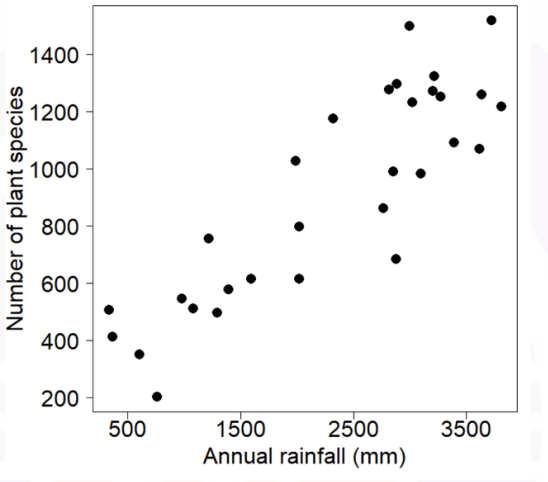
$x$ 1 2 3 4 $y$ 2 6 7 10 The graph below shows a plot of annual rainfall on the X axis and number of plant species on the Y axis. Based on the pattern in the graph, which one of the following statistical methods would be most appropriate to model the relationship between annual rainfall and the number of plant species?