
There is no value of x that can simultaneously satisfy both the given equations. Therefore, find the ‘least squares error’ solution to the two equations, i.e., find the value of x that minimizes the sum of squares of the errors in the two equations. __________ 2x = 3 4x = 1
Concepts:
Least Square Method:
It is an approximation method to minimize the error.
In this method, the distance between the estimated value and the actual value is minimized.
According to the least square method, \({\rm{R\;}} = \mathop \sum \limits_1^{\rm{n}} {\left( {\overline {{{\rm{x}}_{\rm{i}}}} - {\rm{x}}} \right)^2}\) where \(\overline {{{\rm{x}}_{\rm{i}}}}\) are the estimated (or guessed value) and x is the actual values.
By minimizing this distance R the least-squares error can be found out.
Calculations:
Given the functions are:\(2{\rm{x\;}} = {\rm{\;}}3 \Rightarrow 2{\rm{x}} - 3 = 0{\rm{\;and\;}}4{\rm{x}} = 1{\rm{\;}} \Rightarrow 4{\rm{x}} - 1 = 0{\rm{\;}}\)
∴ \({\rm{R}} = {\rm{\;}}{\left( {2{\rm{x}} - 3} \right)^2} + {\left( {4{\rm{x}} - 1} \right)^2}.{\rm{\;}}\)
Hence, to minimize the value of \({\rm{R}},{\rm{\;\;}}\frac{{{\rm{dR}}}}{{{\rm{dx}}}} = 0\)
∴ \({\rm{\;}}\frac{{{\rm{dR}}}}{{{\rm{dx}}}} = 2 \times 2\left( {2{\rm{x}} - 3} \right) + 4 \times 2\left( {4{\rm{x}} - 1} \right) = 0{\rm{\;}}\)
∴ \({\rm{x}} = \frac{1}{2}{\rm{\;}}\& {\rm{\;}}{{\rm{R}}_{{\rm{min}}}} = {\left( {2 \times \frac{1}{2} - 3} \right)^2} + {\left( {4 \times \frac{1}{2} - 1} \right)^2} = 5{\rm{\;\;\;}}\)
∴ The value of x that minimizes the sum of squares of the errors in the two equations is 1/2.
Important Questions from Regression Analysis
- Using linear regression (least squares), the best-fit line for the given dataset is $y = 2.2x + 2.3$. Given the residual sum of squares is 25.8, the coefficient of determination ($r^2$), is ______________ . (rounded off to two decimal places)
$x$ 2 3 4 5 $y$ 8 9 7 16 - Given the pairs of values of $(X, Y)$ as $(2, 60)$, $(4, 70)$ and $(6, 90)$, $m$ is the slope of the linear regression plot of $Y$ on $X$. The value of $m$ is _______.
- The data given in the table are fitted to the equation $y = mx$ using the method of least squares. The value of $m$ is ______ (rounded off to one decimal place).
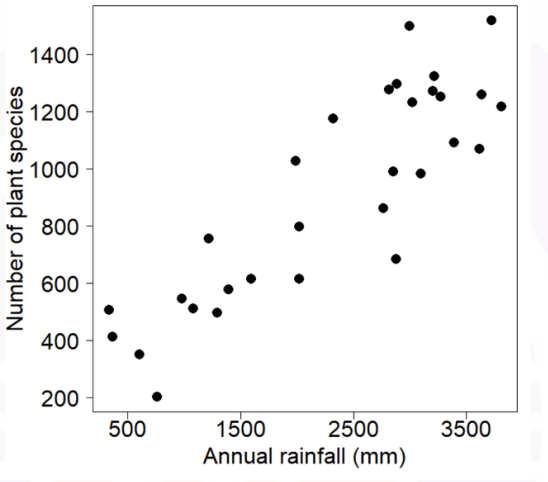
$x$ 1 2 3 4 $y$ 2 6 7 10 The graph below shows a plot of annual rainfall on the X axis and number of plant species on the Y axis. Based on the pattern in the graph, which one of the following statistical methods would be most appropriate to model the relationship between annual rainfall and the number of plant species?
- Arrange the following steps of formulating research proposal in a logical sequential order :
(i) Defining research problem.
(ii) Formulation of hypothesis.
(iii) Review of literature.
(iv) Collection of data.
(v) Research Design.
Choose the correct answer from the options given below :


