(i) Defining research problem.
(ii) Formulation of hypothesis.
(iii) Review of literature.
(iv) Collection of data.
(v) Research Design.
Choose the correct answer from the options given below :
Research Proposal: Defining the Problem
The very first step in creating a research proposal is to clearly define the research problem. This involves identifying a specific issue, question, or area that needs investigation. Without a well-defined problem, the entire research direction can become unclear.
Literature Review: Understanding Existing Knowledge
Once the research problem is defined, the next logical step is to conduct a thorough review of the literature. This involves examining existing studies, theories, and publications related to the research problem. It helps in understanding what is already known, identifying gaps in knowledge, and refining the research question.
Hypothesis Formulation: Guiding the Research
After understanding the existing knowledge through the literature review, the researcher can proceed to the formulation of a hypothesis. A hypothesis is a specific, testable prediction about the relationship between variables or the expected outcome of the research. It provides a clear focus for the study.
Research Design: Planning the Investigation
With a defined problem, literature background, and a formulated hypothesis, the researcher needs to develop a research design. This is the blueprint for the study, outlining the methods and procedures that will be used to collect and analyze data. It ensures the research is conducted systematically and effectively to address the hypothesis or research question.
Data Collection: Gathering Evidence
The final step in this sequence is the collection of data. Based on the research design, relevant data is gathered using the chosen methods (e.g., surveys, experiments, interviews). This data will then be analyzed to test the hypothesis or answer the research question.
Summary of Steps
Therefore, the logical sequential order for formulating a research proposal is:
- i. Defining research problem
- iii. Review of literature
- ii. Formulation of hypothesis
- v. Research Design
- iv. Collection of data
This sequence ensures a structured and systematic approach to research proposal development, moving from broad identification to specific planning and execution.
Important Questions from Regression Analysis
There is no value of x that can simultaneously satisfy both the given equations. Therefore, find the ‘least squares error’ solution to the two equations, i.e., find the value of x that minimizes the sum of squares of the errors in the two equations. __________
2x = 3
4x = 1
- Using linear regression (least squares), the best-fit line for the given dataset is $y = 2.2x + 2.3$. Given the residual sum of squares is 25.8, the coefficient of determination ($r^2$), is ______________ . (rounded off to two decimal places)
$x$ 2 3 4 5 $y$ 8 9 7 16 - Given the pairs of values of $(X, Y)$ as $(2, 60)$, $(4, 70)$ and $(6, 90)$, $m$ is the slope of the linear regression plot of $Y$ on $X$. The value of $m$ is _______.
- The data given in the table are fitted to the equation $y = mx$ using the method of least squares. The value of $m$ is ______ (rounded off to one decimal place).
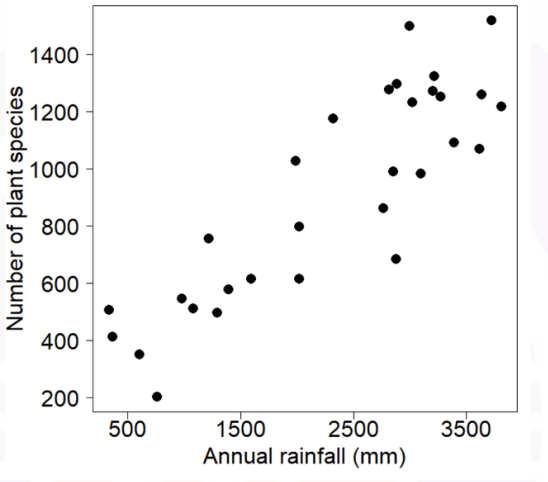
$x$ 1 2 3 4 $y$ 2 6 7 10 The graph below shows a plot of annual rainfall on the X axis and number of plant species on the Y axis. Based on the pattern in the graph, which one of the following statistical methods would be most appropriate to model the relationship between annual rainfall and the number of plant species?