Given the regression lines X + 2Y - 5 = 0, 2X + 3Y - 8 = 0 and Var(X) = 12, the value of Var(Y) is
4
Understanding Regression Lines and Variance
The problem provides two linear equations representing regression lines and the variance of one variable, Var(X). We need to find the variance of the other variable, Var(Y). Regression lines describe the relationship between two variables, X and Y. There are typically two regression lines: the regression of Y on X and the regression of X on Y.
The equation of the regression of Y on X is generally written as \(Y = a + b_{yx}X\), where \(b_{yx}\) is the regression coefficient of Y on X. This coefficient represents the change in Y for a unit change in X.
The equation of the regression of X on Y is generally written as \(X = c + b_{xy}Y\), where \(b_{xy}\) is the regression coefficient of X on Y. This coefficient represents the change in X for a unit change in Y.
These regression coefficients are related to the correlation coefficient (\(r\)) between X and Y and their standard deviations (\(\sigma_x\) and \(\sigma_y\)) by the formulas:
- \(b_{yx} = r \frac{\sigma_y}{\sigma_x}\)
- \(b_{xy} = r \frac{\sigma_x}{\sigma_y}\)
An important property is that the product of the regression coefficients \(b_{yx} \cdot b_{xy}\) is equal to the square of the correlation coefficient \(r^2\). Since the correlation coefficient \(r\) must satisfy \(-1 \le r \le 1\), its square \(r^2\) must satisfy \(0 \le r^2 \le 1\). Thus, the product of the slopes \(b_{yx} \cdot b_{xy} \le 1\).
Identifying Regression Lines and Slopes
We are given two equations:
- X + 2Y - 5 = 0
- 2X + 3Y - 8 = 0
Let's find the slope of Y with respect to X and the slope of X with respect to Y for each equation.
Analysis of Equation 1: X + 2Y - 5 = 0
- To get Y on X form (\(Y = mX + c\)):
\(2Y = -X + 5\)
\(Y = -\frac{1}{2}X + \frac{5}{2}\)
The slope of Y on X is \(m_1 = -\frac{1}{2}\). - To get X on Y form (\(X = m'Y + c'\)):
\(X = -2Y + 5\)
The slope of X on Y is \(m'_1 = -2\).
Analysis of Equation 2: 2X + 3Y - 8 = 0
- To get Y on X form (\(Y = mX + c\)):
\(3Y = -2X + 8\)
\(Y = -\frac{2}{3}X + \frac{8}{3}\)
The slope of Y on X is \(m_2 = -\frac{2}{3}\). - To get X on Y form (\(X = m'Y + c'\)):
\(2X = -3Y + 8\)
\(X = -\frac{3}{2}Y + 4\)
The slope of X on Y is \(m'_2 = -\frac{3}{2}\).
Now, we need to determine which equation represents the regression of Y on X and which represents the regression of X on Y using the condition \(b_{yx} \cdot b_{xy} \le 1\). The slopes \(m_1, m_2\) are candidates for \(b_{yx}\), and the slopes \(m'_1, m'_2\) are candidates for \(b_{xy}\).
Let's consider two possibilities:
- Possibility A: Equation 1 is Y on X, Equation 2 is X on Y.
\(b_{yx} = m_1 = -1/2\)
\(b_{xy} = m'_2 = -3/2\)
Product: \(b_{yx} \cdot b_{xy} = (-\frac{1}{2}) \cdot (-\frac{3}{2}) = \frac{3}{4}\). Since \(3/4 \le 1\), this is a valid assignment. - Possibility B: Equation 1 is X on Y, Equation 2 is Y on X.
\(b_{xy} = m'_1 = -2\)
\(b_{yx} = m_2 = -2/3\)
Product: \(b_{yx} \cdot b_{xy} = (-\frac{2}{3}) \cdot (-2) = \frac{4}{3}\). Since \(4/3 > 1\), this is not a valid assignment.
Therefore, Equation 1 (X + 2Y - 5 = 0) must be the regression of Y on X, giving \(b_{yx} = -1/2\). Equation 2 (2X + 3Y - 8 = 0) must be the regression of X on Y, giving \(b_{xy} = -3/2\).
Note that since both regression coefficients \(b_{yx}\) and \(b_{xy}\) are negative, the correlation coefficient \(r\) must also be negative. \(r = -\sqrt{b_{yx} \cdot b_{xy}}\).
Calculating Var(Y)
We have \(b_{yx} = -1/2\) and \(b_{xy} = -3/2\).
We can calculate \(r^2\):
\(r^2 = b_{yx} \cdot b_{xy} = (-\frac{1}{2}) \cdot (-\frac{3}{2}) = \frac{3}{4}\)
The correlation coefficient is \(r = -\sqrt{\frac{3}{4}} = -\frac{\sqrt{3}}{2}\) (negative because slopes are negative).
We are given Var(X) = 12. The standard deviation of X is \(\sigma_x = \sqrt{\text{Var(X)}} = \sqrt{12} = \sqrt{4 \times 3} = 2\sqrt{3}\).
We use the formula relating \(b_{yx}\), \(r\), \(\sigma_y\), and \(\sigma_x\):
\(b_{yx} = r \frac{\sigma_y}{\sigma_x}\)
Substitute the known values:
\(-\frac{1}{2} = (-\frac{\sqrt{3}}{2}) \frac{\sigma_y}{2\sqrt{3}}\)
Now, solve for \(\sigma_y\):
\(-\frac{1}{2} = -\frac{\sqrt{3}}{2} \cdot \frac{\sigma_y}{2\sqrt{3}}\)
\(-\frac{1}{2} = -\frac{\sqrt{3} \cdot \sigma_y}{4\sqrt{3}}\)
\(-\frac{1}{2} = -\frac{\sigma_y}{4}\)
Multiply both sides by -4:
\((-4) \cdot (-\frac{1}{2}) = (-4) \cdot (-\frac{\sigma_y}{4})\)
\(2 = \sigma_y\)
The standard deviation of Y is \(\sigma_y = 2\).
Finally, the variance of Y is Var(Y) = \(\sigma_y^2\).
Var(Y) = \(2^2 = 4\).
Alternatively, we could use the formula for \(b_{xy}\):
\(b_{xy} = r \frac{\sigma_x}{\sigma_y}\)
\(-\frac{3}{2} = (-\frac{\sqrt{3}}{2}) \frac{2\sqrt{3}}{\sigma_y}\)
\(-\frac{3}{2} = -\frac{\sqrt{3} \cdot 2\sqrt{3}}{2\sigma_y}\)
\(-\frac{3}{2} = -\frac{2 \cdot 3}{2\sigma_y}\)
\(-\frac{3}{2} = -\frac{6}{2\sigma_y}\)
\(-\frac{3}{2} = -\frac{3}{\sigma_y}\)
Multiply both sides by \(-2\sigma_y\):
\((-2\sigma_y) \cdot (-\frac{3}{2}) = (-2\sigma_y) \cdot (-\frac{3}{\sigma_y})\)
\(3\sigma_y = 6\)
\(\sigma_y = \frac{6}{3} = 2\)
Var(Y) = \(\sigma_y^2 = 2^2 = 4\).
Both methods yield the same result for Var(Y).
| Step | Description | Calculation |
|---|---|---|
| 1 | Identify slopes from Eq 1 (X + 2Y - 5 = 0) | \(m_1(Y \text{ on } X) = -1/2\), \(m'_1(X \text{ on } Y) = -2\) |
| 2 | Identify slopes from Eq 2 (2X + 3Y - 8 = 0) | \(m_2(Y \text{ on } X) = -2/3\), \(m'_2(X \text{ on } Y) = -3/2\) |
| 3 | Use \(b_{yx} \cdot b_{xy} \le 1\) to identify lines | Eq 1 as Y on X (\(b_{yx}=-1/2\)) & Eq 2 as X on Y (\(b_{xy}=-3/2\)) gives product \(3/4 \le 1\). This is correct. |
| 4 | Calculate \(r^2\) | \(r^2 = b_{yx} \cdot b_{xy} = (-1/2) \cdot (-3/2) = 3/4\) |
| 5 | Find \(\sigma_x\) from Var(X) | Var(X) = 12, \(\sigma_x = \sqrt{12} = 2\sqrt{3}\) |
| 6 | Use \(b_{yx} = r \frac{\sigma_y}{\sigma_x}\) or \(b_{xy} = r \frac{\sigma_x}{\sigma_y}\) to find \(\sigma_y\) | Using \(b_{yx}\): \(-1/2 = (-\sqrt{3}/2) \frac{\sigma_y}{2\sqrt{3}} \implies \sigma_y = 2\) |
| 7 | Calculate Var(Y) | Var(Y) = \(\sigma_y^2 = 2^2 = 4\) |
The value of Var(Y) is 4.
Revision Table: Key Concepts for Regression and Variance
| Concept | Description | Formula/Property |
|---|---|---|
| Regression Lines | Lines describing the linear relationship between two variables (X and Y). | Y on X: \(Y = a + b_{yx}X\) X on Y: \(X = c + b_{xy}Y\) |
| Regression Coefficients | Slopes of the regression lines. \(b_{yx}\) (Y on X) and \(b_{xy}\) (X on Y). | \(b_{yx} = \frac{\text{Cov}(X, Y)}{\text{Var}(X)}\) \(b_{xy} = \frac{\text{Cov}(X, Y)}{\text{Var}(Y)}\) |
| Correlation Coefficient (\(r\)) | Measures the strength and direction of the linear relationship. | \(r = \frac{\text{Cov}(X, Y)}{\sigma_x \sigma_y}\) \(-1 \le r \le 1\) |
| Relation of Coefficients to \(r\), \(\sigma_x\), \(\sigma_y\) | Formulas connecting slopes, correlation, and standard deviations. | \(b_{yx} = r \frac{\sigma_y}{\sigma_x}\) \(b_{xy} = r \frac{\sigma_x}{\sigma_y}\) |
| Product of Regression Coefficients | Always equal to the square of the correlation coefficient. | \(b_{yx} \cdot b_{xy} = r^2\) |
| Condition for Slopes | Derived from \(0 \le r^2 \le 1\). | \(0 \le b_{yx} \cdot b_{xy} \le 1\) |
| Variance (Var) | Measure of the spread or dispersion of a set of data points around their mean. Square of standard deviation. | Var(X) = \(\sigma_x^2\) Var(Y) = \(\sigma_y^2\) |
| Standard Deviation (\(\sigma\)) | Square root of variance. Represents the typical distance from the mean. | \(\sigma_x = \sqrt{\text{Var}(X)}\) \(\sigma_y = \sqrt{\text{Var}(Y)}\) |
Additional Information on Regression Analysis
Regression analysis is a powerful statistical method used to estimate the relationships among variables. It helps in understanding how the typical value of the dependent variable changes when any one of the independent variables is varied, while the other independent variables are held fixed.
- Linear Regression: The type of regression discussed here is linear regression, where the relationship is modeled using a straight line.
- Identifying Lines: When given two lines that might be regression lines, the condition \(b_{yx} \cdot b_{xy} \le 1\) is crucial for identification. If the product of the slopes calculated assuming Line 1 is Y on X and Line 2 is X on Y is greater than 1, then the assumption is wrong, and Line 1 must be X on Y while Line 2 is Y on X (or vice versa, check both cases).
- Point of Intersection: The two regression lines, if they intersect, do so at the point representing the mean of X (\(\bar{X}\)) and the mean of Y (\(\bar{Y}\)). This is because the regression line of Y on X passes through \((\bar{X}, \bar{Y})\), and the regression line of X on Y also passes through \((\bar{X}, \bar{Y})\). We could solve the system of equations to find the means:
- X + 2Y = 5
- 2X + 3Y = 8
- Multiply first equation by 2: 2X + 4Y = 10
- Subtract second equation: (2X + 4Y) - (2X + 3Y) = 10 - 8 \(\implies\) Y = 2
- Substitute Y = 2 into X + 2Y = 5: X + 2(2) = 5 \(\implies\) X + 4 = 5 \(\implies\) X = 1
- So, \(\bar{X} = 1\) and \(\bar{Y} = 2\).
- Interpretation of Coefficients: The signs of \(b_{yx}\), \(b_{xy}\), and \(r\) must be the same. If one is positive, they all are; if one is negative, they all are. In this problem, both slopes are negative, confirming that \(r\) should be negative.
- Variance: Variance quantifies the spread of a distribution. A higher variance means data points are more spread out from the mean. It is always non-negative.
Similar Questions
If a constant 60 is subtracted from each of the values of X and Y, then the regression coefficient is
The data about the sales and advertisement expenditure of a firm is given below
Sales (in crore of Rs.) Advertisement exp (in crores of Rs.) Means 40 6 Standard Daviation 10 1.5
The correlation coefficient between sales and advertisement expenditure is 0.9. The likely sales for a proposed advertisement expenditure of Rs. 10 croreThe standard deviation of Y is double of standard deviation of x. The correlation coefficient between X and Y is 0.5.
The acute angle between lines of regression is
For the variables X, Y and Z, r xy = 0.80, r xz = 0.64, and r yz = 0.79, the square of multiple correlation coefficient \(\rm \mathop R\nolimits_{xyz}^2 \) is:
If x and y are uncorrelated variables then this implies:
For a bivariate data set on (x, y), if the means, standard deviations and correlation coefficient are
x̅ = 1.0, y̅ = 2.0, s x= 3.0, s y= 9.0, r = 0.8
Then the regression line of y on x is:
Important Questions from Regression Analysis
There is no value of x that can simultaneously satisfy both the given equations. Therefore, find the ‘least squares error’ solution to the two equations, i.e., find the value of x that minimizes the sum of squares of the errors in the two equations. __________
2x = 3
4x = 1
- Using linear regression (least squares), the best-fit line for the given dataset is $y = 2.2x + 2.3$. Given the residual sum of squares is 25.8, the coefficient of determination ($r^2$), is ______________ . (rounded off to two decimal places)
$x$ 2 3 4 5 $y$ 8 9 7 16 - Given the pairs of values of $(X, Y)$ as $(2, 60)$, $(4, 70)$ and $(6, 90)$, $m$ is the slope of the linear regression plot of $Y$ on $X$. The value of $m$ is _______.
- The data given in the table are fitted to the equation $y = mx$ using the method of least squares. The value of $m$ is ______ (rounded off to one decimal place).
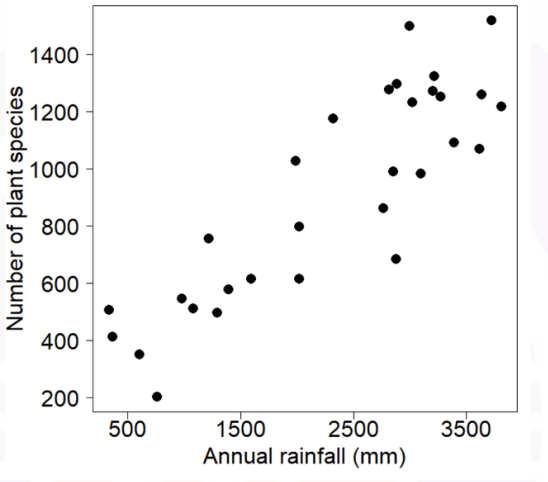
$x$ 1 2 3 4 $y$ 2 6 7 10 The graph below shows a plot of annual rainfall on the X axis and number of plant species on the Y axis. Based on the pattern in the graph, which one of the following statistical methods would be most appropriate to model the relationship between annual rainfall and the number of plant species?