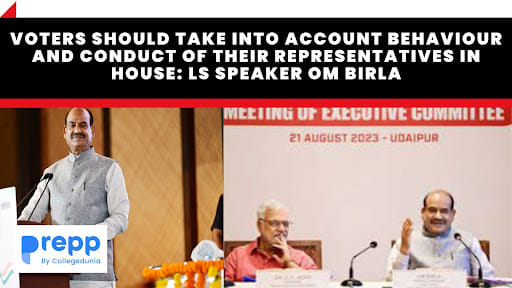
Voters Should Take Into Account Behaviour And Conduct Of Their Representatives In House: LS speaker Om Birla
Relevance: GS2- Transparency & accountability and institutional and other measures; GS4 - Accountability and ethical governance; strengthening of ethical and moral values in governance;
(Source: The Hindu, 08/22/23)
Click here for Daily Current Affairs
Why in the news?
- Recently, Lok Sabha Speaker Om Birla inaugurated the ninth Commonwealth Parliamentary Association (CPA) India Region Conference at Udaipur.
- The theme of the two-day Conference is "Strengthening Democracy and good governance in the digital age."
- The speaker said that it is the responsibility of public representatives to uphold the faith of the people in the Legislature and noted that it is the duty of public representatives to ensure that the legislature works for the socioeconomic welfare of the people.
Table of Contents
Strengthening Democracy and good governance in the digital age
- Positive approach: The public's faith in parliamentary democracy is strengthened when well-thought-out decisions are taken for the progress of the nation by adopting a positive approach.
- Disruption and Dignity of the House: Disruption within legislatures hinders the functioning of parliamentary democracy and slows down national development. The planned disruptions lower the dignity of the House and call for curbing such tendencies.
- The speaker highlighted the fact that voters, while exercising their democratic rights, must take into account the behavior and conduct of their representatives in the House and make their assessments.
- Impartiality and neutrality: Presiding Officers are emphasized to conduct themselves impartially and neutrally, ensuring the dignity of the Chair and impartial functioning of the House.
- Constructive debates: Constructive and meaningful debates on citizen-centric governance must be at the heart of legislative functioning.
- Uniformity in State Legislatures: The "One Nation, One Legislative Platform" is suggested for uniformity among State Legislatures.
- Democratic Traditions and Conventions: Strong democratic traditions and conventions have been established in democratic institutions, and it's the responsibility of legislators to preserve and enrich these traditions to meet changing needs
How technology can help the functioning of the legislature?
- Boost efficiency: Technological innovations such as robotics, AI, machine learning, and blockchain can boost efficiency and transparency in legislative operations.
- Promote Accountability: The extensive adoption of information technology will enhance accountability and transparency in governance, enabling legislatures to function more efficiently for the overall betterment of society.
- Public Engagement and Feedback: Modern technology is seen as a means to create an effective system for the public to provide suggestions and feedback to representatives or democratic institutions regarding rules and discrepancies in laws.
Commonwealth Parliamentary Association
- The Commonwealth Parliamentary Association (CPA) is one of the oldest established organizations in the Commonwealth. It was founded in 1911.
- It is a membership association that brings together Members, irrespective of gender, race, religion or culture, who are united by a community of interest, respect for the rule of law and individual rights and freedoms, and by the pursuit of the positive ideals of parliamentary democracy.
- The Association is made up of over 180 Legislatures (or Branches) divided up between nine geographic regions of the Commonwealth.
- It offers a vast opportunity for Parliamentarians and parliamentary staff to collaborate on issues of mutual interest and to share good practices.
(*Click this link to read prelims specific weekly current affairs articles)
FAQs
Question: What is meant by Commonwealth?
Answer:
The Commonwealth is a voluntary association of 56 independent and equal countries in Africa, Asia, the Americas, Europe and the Pacific.
Question: What is meant by accountability?
Answer:
Accountability, unlike transparency, which emphasises openness, can be seen as a sort of acknowledgment.It can be simply stated as having to explain one's actions or judgments.An individual or organisation must account for its actions, accept responsibility and publish the outcomes in a transparent way.
Question: What is e-Governance?
Answer:
e-Governance is defined as the use of information and communication technology (ICT) at all levels of government to provide citizens with services, interact with businesses, and communicate and exchange information between different government departments in a timely, efficient, and transparent manner.
UPSC Mains Practice Question:
|
MCQ
Question: Consider the following statements: (UPSC-2018)
- The Speaker of the Legislative Assembly Shall vacate his/her office if he/she ceases to be a member of the Assembly.
- Whenever the Legislative Assembly is dissolved, the Speaker shall vacate his/her immediately.
Which of the statements given above is/are correct?
(a) 1 only
(b) 2 only
(c) Both 1 and 2
(d) Neither 1 nor 2
Answer: (a) See the Explanation
- A member of the Legislative Assembly who holds the office of Speaker or Deputy Speaker:
- must vacate his office if he ceases to be a member of the Assembly; Hence, statement 1 is correct
- may resign his office at any time by writing under his hand addressed, if he is the Speaker, to the Deputy Speaker, and if he is the Deputy Speaker, to the Speaker; and
- maybe removed from his office by a resolution of the Legislative Assembly passed.
- When the Legislative Assembly is dissolved, the Speaker is required to remain in office until the first sitting of the Assembly following the dissolution.Hence, statement 2 is incorrect
Therefore, option (a) is the correct answer.
Download the PREPP App and attempt FREE IAS Exam Mock Tests and get complete study material!

Full Test - 04: UPSC CSE Prelims CSAT (Paper-II)
Full Test - 03: UPSC CSE Prelims CSAT (Paper-II)
UPSC CSE Prelims 2026 GS Paper 1 Question Paper (24-May-2026)
UPSC CSE Prelims 2026 CSAT Paper 2 Question Paper (24-May-2026)

17 February 2025 | The Hindu Must Read Articles | Current Affairs

16 February 2026 | The Hindu Must Read Articles | Current Affairs

13 February 2026 | The Hindu Must Read Articles | Current Affairs









Comments