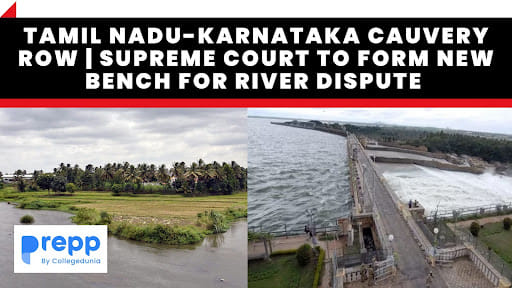
Tamil Nadu-Karnataka Cauvery Row | Supreme Court To Form New Bench For River Dispute
(Source: The Hindu, 08/21/2023)
Click here for Daily Current Affairs
Why in the news?
- Recently, the Chief Justice of India agreed to constitute a new bench to hear the State of Tamil Nadu’s plea on the Cauvery River water dispute.
- Tamil Nadu urged the Supreme Court to issue directions to Karnataka to release the stipulated amount of water for September as per the Cauvery Tribunal Award as amended by the Supreme Court.
Table of Contents
Why has Tamil Nadu approached the Supreme Court?
- On August 10th, Karnataka was directed to release 15,000 cusecs of water from its reservoirs at Billigundulu on August 11 for 15 days.
- However, this was arbitrarily reduced to 10,000 cusecs by the Cauvery Water Management Authority in its 22nd meeting held on August 11 due to Karnataka’s insistence.
- This amounted to around 0.86 TMC a day or a total of 12.9 TMC in 15 days.
- Tamil Nadu has claimed that Karnataka has not complied with the directive to release this lowered quantity of water from the KRS and Kabini reservoirs.
- According to Karnataka, there has been a poor inflow to its reservoirs due to the lower rainfall in the Cauvery catchment region including Kerala.
- Tamil Nadu urged the Court to constitute a bench to direct the release of Cauvery water for August as per the Cauvery Water Management Authority order as The water was necessary to meet the pressing demands of the standing crops.
- Tamil Nadu’s Requests:
- Direct Karnataka to release 24,000 cusecs of water from its Billigundulu reservoirs for the remainder of August.
- Ensure the release of stipulated water for September 2023 (36.76 TMC).
- Karnataka should compensate for the shortfall of 28.849 TMC water during the current irrigation year.
- Direct the Cauvery Water Management Authority to ensure that the directions issued to Karnataka re implemented.
Court’s response
The Chief Justice of India stated that a bench would be constituted immediately to hear the State’s plea.
What is the Cauvery water dispute?
- The Cauvery water dispute is a long-standing dispute over the sharing of river water from the Cauvery River among the states of Karnataka, Tamil Nadu, Kerala, and the Union Territory of Pondicherry.
- The major point of contention among the parties is the distribution of river water among them for various purposes such as irrigation, drinking water, and industrial purposes.
History
- The origin of the dispute can be traced back to British rule in the form of a dispute between the Presidency of Madras and the erstwhile Princely state of Mysore.
- An agreement was reached for the sharing of water between the two states in 1924.
- However, the agreement was valid only for 50 years and expired in 1974.
- Following the expiry of the 1924 agreement, Karnataka began to divert water into its four reservoirs.
- This resulted in a dispute among the states on the use of riparian water.
Tribunal
- The Cauvery Water Disputes Tribunal (CWDT) was established in 1990 as per Section 4 of the Inter-State Water Disputes Act, 1956.
- The CWDT issued its final award in February 2007.
- It specified the amount of water to be received by each state during different periods of the year.
- Award: Assuming that the total availability of water in the Cauvery basin is 740 TMC in a normal year - Tamil Nadu (419 TMC), Karnataka (270 TMC), Kerala (30 TMC), Pondicherry (7 TMC).
- 10 TMC was reserved for environmental purposes and 4 TMC for inevitable release into the sea.
- However, the CWDT has not given a detailed formula of distribution when there is shortage of water due to insufficient rains.
- The award states that the allocated shares should be proportionally reduced during water shortages.
Subsequent verdict of the SC
- The order of the tribunal was notified only in 2013 following the directions of the Supreme Court.
- Tamil Nadu approached the Supreme Court through a Special leave petition under Article 136 because Karnataka was not adhering to the provisions of the award.
- In 2018, the SC declared the River Cauvery a national asset and upheld the water-sharing arrangements which had been finalized by the CWDT.
- It ruled that Karnataka would get 284.75 TMC, Tamil Nadu 404.25 TMC, Kerala 30 TMC and Puducherry 7 TMC.
- The Union Government was directed to notify the Cauvery Management Scheme
- The Cauvery Water Management Authority (CWMA) and the Cauvery Water Regulation Committee (CWRC) was established to implement the decision of the Court and the tribunal.
River Cauvery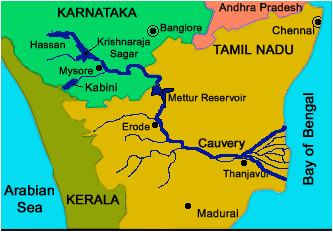
|
To know more about river water disputes in Idia, click the link.
FAQs
Question: What is a river’s catchment region?
Answer:
It refers to the area of land over which rain falls and from which the river drains its water. The catchment area of larger rivers is known as a basin and the catchment area of smaller rivers is known as a watershed.
Question: What is a Special Leave Petition?
Answer:
According to Article 136 of the Constitution, the Supreme Court may, in its discretion, grant special leave to appeal from any judgment, decree, determination, sentence or order in any cause or matter passed or made by any court or tribunal in the territory of India. It has been termed a constiutional right similar to Article 32 by the Supreme Court.
Question: What is a tribunal?
Answer:
A Tribunal is a quasi-judicial institution established to deal with issues like the resolution of administrative or tax-related disputes. The term ‘Tribunal’ is derived from the word ‘Tribunes’, meaning ‘Magistrates of the Classical Roman Republic. A tribune is responsible for adjudicating disputes, determining rights, making and reviewing administrative decisions, etc.
MCQs
Question: Consider the following pairs Wildlife Naturally found in
- Blue-finned Mahseer - Cauvery River
- Irrawaddy Dolphin - Chambal River
- Rusty-spotted Cat - Eastern Ghats
Which of the pairs given correctly matched? (UPSC CSE 2019)
(a) 1 and 2 only
(b) 2 and 3 only
(c) 1 and 3 only
(d) 1, 2 and 3
Answer: (c) See the Explanation
- The Cauvery River is home to two kinds of Mahseer - the blue-finned and orange-finned Mahseer. Hence statement 1 is correct.
- The Irrawady Dolphin is an endangered species found in three rivers of Southeast Asia ie Mekong, Mahekam, and Ayeyarwady. It cannot be found in the Chambal river. Hence statement 2 is incorrect.
- The Rusty Spotted Cat is found in the Gir National Park, Tadoba-Andhari Tiger Reserve and the Eastern Ghats. Hence statement 3 is correct.
Therefore, option (c) is the correct answer.
Question: Consider the following pairs:
Famous place River
- Pandharpur Chandrabhaga
2.Tiruchirappalli Cauvery
3.Hampi Malaprabha
Which of the pairs given above are correctly matched? (UPSC CSE 2019)
1 and 2 only
2 and 3 only
1 and 3 only
1, 2 and 3
Answer: (a) See the Explanation
- Pandharpur is a city located on the banks of the Chandrapur river in Maharashtra. Hence pair 1 is correct.
- Tiruchirappalli is a city on the banks of the Kaveri river in Tamil Nadu. Hence pair 2 is correct.
- Hampi is a city on the banks of the Tungabhadra river in Karanataka. Hence pair 3 is incorrect.
- The major city on the river Malaprabha is Pattadakal in Karnataka.
Therefore, option (a) is the correct answer.
Question: In which of the following regions of India are shale gas resources found?
- Cambay Basin
- Cauvery Basin
- Krishna-Godavari Basin
Select the correct answer using the code given below. (UPSC CSE 2016)
(a) 1 and 2 only
(b) 3 only
(c) 2 and 3 only
(d) 1, 2 and 3
Answer: (d) See the Explanation
- According to the Ministry of Petroleum and Natural Gas (MoPNG) there are six potential shale gas bearing basins in the country.
- These include the Cambay, Assam-Arakan, Gondwana, Krishna-Godavari, Kaveri, and the Indo-Gangetic plain.
- Shales are fine-grained sedimentary rocks that can be rich resources of petroleum and natural gas.
Therefore, option (d) is the correct answer.
Download the PREPP App and attempt FREE IAS Exam Mock Tests and get complete study material!

Full Test - 04: UPSC CSE Prelims CSAT (Paper-II)
Full Test - 03: UPSC CSE Prelims CSAT (Paper-II)
UPSC CSE Prelims 2026 GS Paper 1 Question Paper (24-May-2026)
UPSC CSE Prelims 2026 CSAT Paper 2 Question Paper (24-May-2026)

17 February 2025 | The Hindu Must Read Articles | Current Affairs

16 February 2026 | The Hindu Must Read Articles | Current Affairs

13 February 2026 | The Hindu Must Read Articles | Current Affairs









Comments