Drilling In The North Sea — History And Environmental Concerns
Relevance: GS3 - Conservation, environmental pollution and degradation, environmental impact assessment, Disaster and disaster management GS1 - Distribution of key natural resources across the world, Geographical features and their location-changes in critical geographical features (including water-bodies and ice-caps) and in flora and fauna and the effects of such changes.
(Source: The Hindu, 08/18/2023)
Click here for Daily Current Affairs
Why in the news?
- Recently, the government of the UK announced that it would grant more than 100 new licenses for oil and gas exploration in the North Sea in order to make the country more energy independent.
- However, environmental advocacy groups have criticized the move as it aggravates the threat of climate change and threatens workers, waters, and wildlife.
Table of Contents
A short history of drilling in the U.K. North Sea
- The Geneva Convention on the Continental Shelf, 1958 was the first international legislation to establish the rights of countries over the continental shelves adjacent to their respective coasts.
- It opened the way forward for exploration activities in the North Sea.
- The North Sea Transition Authority (NTSA) is responsible for regulating oil, gas, and carbon storage industries.
- British Petroleum was awarded the first license for exploration in the region in 1964 following which the company discovered natural gas off the east Anglican coast in 1965.
- By the 1980s, over a hundred installations looking for oil and gas had been established in the North Sea.
- The Foinaven and Schiehallion fields were discovered in the 1990s, as a result of which exploration and exploitation were initiated in the West of Shetland region.
- Production of oil and gas from the North Sea has reduced from its peak of 1,37,099 thousand tonnes total of crude oil and natural gas in 1999 to 38,037 thousand tonnes by 2022.
U.K.’s new oil drilling projects
- The Government of the U.K. is likely to approve the development of Rosebank, which is considered the U.K.’s largest undeveloped oil and gas field, and other sites in the North Sea.
- The government plans to slow the decline in the production of oil and gas in order to secure domestic supplies.
- Even if the U.K. reaches net zero in 2050, nearly 25% of the country’s energy needs will come from oil and gas.
- It also announced support for new carbon capture and storage initiatives.
Why is offshore drilling problematic?
- According to the Natural Resources Defence Council, a U.S.-based environmental advocacy group, offshore drilling poses serious risks to employees working on offshore oil rigs, and the natural environment and wildlife in the region.
- Labor: It is a high-risk job that also affects the availability of labor in other industries in the region.
- Climate change: Drilling for oil in seas and oceans results in a rise in sea level and warming of seawater.
- This increases the potential threats posed by climate change.
- Biodiversity: The marine biodiversity of the North Sea is directly affected by offshore drilling in the region.
- Additionally, the coral reefs, shellfish, and marine ecosystems face indirect threats due to the increased acidity of the waters as a result of carbon pollution.
- Emissions: According to the U.K.-based NGO, Carbon Tracker, the average emissions of major oil companies have to be reduced by 40% by 2040 compared to 2019 levels.
- This means that new offshore oil rig projects pose a risk to the success of the commitments under the Paris Agreement.
- Health: Moreover, offshore oil exploration is expensive and extremely polluting.
- There are serious health issues associated with offshore drilling such as asthma, and other respiratory problems.
Pros of offshore drilling
- Increased Oil Production: It directly increases the quantity of oil produced for fuel and energy.
- Employment: It directly leads to employment generation and thus stimulates the economy.
- Self-reliance: Offshore drilling helps attain self-sufficiency in terms of fuel and protection from external influences.
- Oil Prices: It lowers the price of oil as a result of local production and lower transportation costs.
Is the U.K. honoring its climate commitments?
- According to a Progress Report prepared by the Climate Change Committee that advises the Government of the U.K., the U.K. is not adequately prepared for climate change.
- The National Adaptation Programme is a statutory programme to be followed by the government to prepare for climate change, as required under the Climate Change Act.
- Activities for adaptation to climate change have not been at the scale required to accommodate the potential threat of climate change.
- The U.K.’s climate action is inconsistent with the Paris Agreement despite an overall rating of “almost sufficient”.
- The U.K.’s Nationally Determined Contributions (NDCs) and long-term targets are not an equitable share of global efforts to address climate change.
- The U.K. has committed to achieving ‘net zero carbon emissions by 2050.
North Sea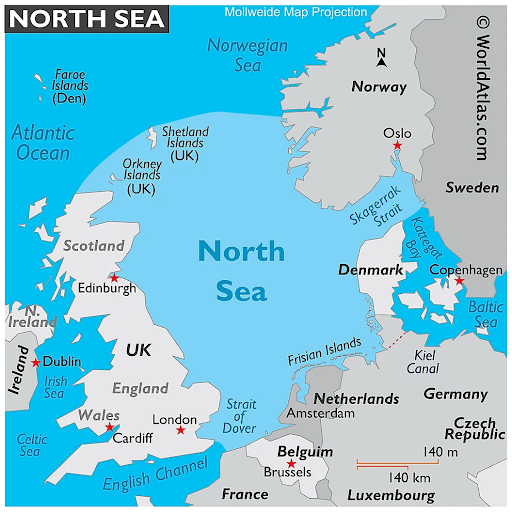
|
Oil exploration ban in Ecuador
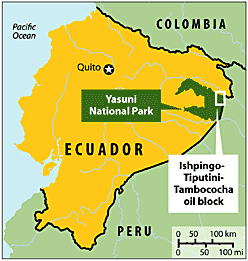
Yasuni National Park
|
(*Click this link to read prelims specific weekly current affairs articles)
FAQs
Question: What is offshore drilling?
Answer:
Offshore drilling refers to the process of extracting petroleum and natural gas from the seabed through a fixed or mobile platform located off the coast in the open ocean and deepwater regions.
Question: What is the continental shelf?
Answer:
The continental shelf is the portion of the continent that is submerged underwater. It is the shallowest and widest part of the ocean floor that extends from the coast to the edge of the continent, where it drops sharply into the continental slope.
It is rich in biodiversity and resources, such as fish, oil, and gas.
UPSC Mains Practice Question:
|
MCQs
Question: Consider the following pairs:
- North Sea - The Rhine
- Andaman Sea - Mekong
- Irish Sea - Thames
Which of the above pairs are correctly matched?
(a) 1 only
(b) 2 only
(c) 3 only
(d) None of the above
Answer: (a) See the Explanation
- The Rhine and the Thambes both flow into the North Sea. Hence pair 1 is correct and pair 3 is incorrect.
- The River Mekong flows into the South China Sea, not the Andaman Sea. Hence pair 2 is incorrect.
Therefore, option (a) is the correct answer.
Question: In the context of mitigating the impending global warming due to anthropogenic emissions of carbon dioxide, which of the following can be the potential sites for carbon sequestration?
- Abandoned and uneconomic coal seams
- Depleted oil and gas reservoirs
- Subterranean deep saline formations
Select the correct answer using the code given below. (UPSC CSE 2017)
(a) 1 and 2 only
(b) 3 only
(c) 1 and 3 only
(d) 1, 2 and 3
Answer: (d) See the Explanation
- Carbon sequestration is the process by which carbon sinks remove carbon dioxide (CO2) from the Earth's atmosphere.
- Carbon sinks can be of two types:
- Natural sinks like oceans, forests, soil, etc.
- Artificial sinks like depleted oil reserves, abandoned mines, etc. Hence statements 1 and 2 are correct.
- Deep Saline Formations have the highest capacity for carbon sequestration. Hence statement 3 is correct.
Therefore, option (d) is the correct answer.
Download the PREPP App and attempt FREE IAS Exam Mock Tests and get complete study material!

Full Test - 04: UPSC CSE Prelims CSAT (Paper-II)
Full Test - 03: UPSC CSE Prelims CSAT (Paper-II)
UPSC CSE Prelims 2026 CSAT Paper 2 Question Paper (24-May-2026)
UPSC CSE Prelims 2026 GS Paper 1 Question Paper (24-May-2026)

17 February 2025 | The Hindu Must Read Articles | Current Affairs

16 February 2026 | The Hindu Must Read Articles | Current Affairs

13 February 2026 | The Hindu Must Read Articles | Current Affairs









Comments