No Governor’s assent; Manipur Assembly session a non-starter
Relevance: GS2: Indian constitution, Role of Governor; Issues and challenges pertaining to the federal structure; Parliament and State legislatures
(Source: The Hindu, 08/22/23)
Click here for Daily Current Affairs
Why in the news?
- A special session of the 60-member Manipur state Assembly to address the recent ethnic violence was not held.
- More than a month before the ethnic riots between the tribal Kuki and the non-tribal Meitei groups, the State Assembly's most recent session was adjourned sine die..
- It is more proof of the "breakdown" of the constitutional machinery in the violence hit state.
Table of Contents
Why does the governor refuse to summon a session?
- The recommendation of the Council of Ministers to call the Manipur Legislative Assembly was not followed, which shows how serious the situation engulfing the state is.
- Even though the Cabinet recommended, the Governor did not issue the notification convening the House. The delay in releasing the announcement by Raj Bhavan is apparently owing to the State's political and law and order circumstances.
- Legislators of Kuki ethnicity have voiced their inability to attend the Assembly session owing to the existing situation, as violence persists in sections of the state.
- It seems improbable that the Governor is uninformed of the constitutional position that He/she is obligated by the recommendation of the government when convening the Assembly. The Constitution Bench made this statement in Nabam Rebia (2016).
- Whether the Governor is driven by his/her own judgement or the Union government's appraisal of the circumstances, it is difficult to justify the failure to conduct the Assembly session as requested by the Council of Ministers.
Provisions Related to Governor’s Role in Calling an Assembly Session
- Article 174: It states that the Governor may summon the House or each House of the State Legislature to assemble at any time and location he deems appropriate.
- The Governor is also charged with ensuring that the House is called at least once every six months, according to the article.
- Article 163: Although summoning the House is the Governor's prerogative, Article 163 requires the Governor to act on the "aid and advice" of the Cabinet.
- So, when the Governor summons the House under Article 174, it is not at his or her own initiative, but on the advice and recommendation of the Cabinet.
To know more about click here
(*Click this link to read prelims specific weekly current affairs articles)
FAQs
Question: What is Article 174?
Answer:
The Governor has the authority to convene, dissolve, and prorogue the state legislative assembly under Article 174 of the Constitution.
Question: What is a state emergency?
Answer:
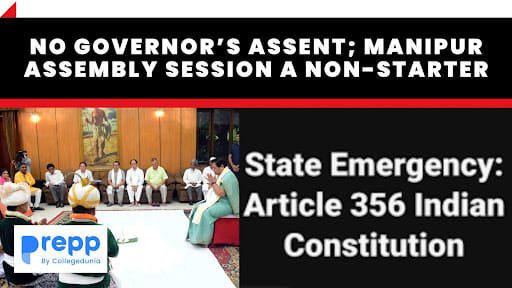
Article 356 states that the President may proclaim a state of emergency upon receipt of briefs from the Governor of a specific state or upon the President's observation of the state's deteriorating processes. When the Governor feels a disaster has happened or is impending, he or she proclaims a State of Emergency to complement local resources in averting or reducing damages, loss, difficulty, or suffering.
UPSC Mains Practice Question:
|
MCQs
Question: With reference to the Legislative Assembly of a State in India, consider the following statements: (UPSC 2019)
- The Governor makes a customary address to members of the house at the commencement of the first session of the year.
- When a State Legislature does not have a rule on the particular matter, it follows the Lok Sabha rule on that matter.
Which of the following statements given above is/are correct?
(a)1 only
(b) 2 only
(c) Both 1 and 2
(d) Neither 1 nor 2
Answer: (c) See the Explanation
- Article 176 (1): The Governor has the legislative authority to address the state legislature at the start of the first session following each general election and the first session of each year. So statement 1 is correct.
- Article 208 (1): A House of the Legislature of a State may enact rules governing its procedure and conduct of business, subject to the requirements of this Constitution.
- Article 208 (2): Until rules are made under clause (1), the rules of procedure and standing orders in effect immediately before the commencement of this Constitution with respect to the Legislature for the corresponding Province shall have effect in relation to the Legislature of the State, subject to such modifications and adaptations as the Speaker of the Legislative Assembly, or the Chairman of the Legislative Council, as the case may be.
- Article 208 (3): In a state with a Legislative Council, the Governor may make rules governing the procedure for communications between the two Houses after consulting with the Speaker of the Legislative Assembly and the Chairman of the Legislative Council. So statement 2 is correct.
Therefore option (c) is the correct answer.
Question: Consider the following statements: (UPSC 2018)
- No criminal proceedings shall be instituted against the Governor of a State any court during his term of office.
- The emoluments and allowances of the Governor of a State shall not be diminished during his term of office.
Which of the statements given above is/ are correct?
(a) 1 only
(b) 2 only
(c) Both 1 and 2
(d) Neither 1 nor 2
Answer: (c) See the Explanation
- Article 361 states that: No criminal actions shall be launched or pursued in any court against the President or the Governor of a State during his term of office. So statement 1 is correct.
- No process shall be issued by any court for the arrest or incarceration of the President or the Governor of a State during his term of office.
- Article 158 states that: The Governor shall not be a member of either House of Parliament or a House of the Legislature of any State specified in the First Schedule, and if a member of either House of Parliament or a House of the Legislature of any such State is appointed Governor, he shall be deemed to have vacated his seat in that House on the date he takes office as Governor.
- The Governor shall not hold any other office of profit.
- The Governor shall be entitled to the use of his official residences without payment of rent, as well as such emoluments, allowances, and privileges as may be determined by Parliament by law and, until such provision is made, such emoluments, allowances, and privileges as are specified in the Second Schedule. So statement 2 is correct.
Therefore option (c) is the correct answer.
Download the PREPP App and attempt FREE IAS Exam Mock Tests and get complete study material!

Full Test - 04: UPSC CSE Prelims CSAT (Paper-II)
Full Test - 03: UPSC CSE Prelims CSAT (Paper-II)
UPSC CSE Prelims 2026 CSAT Paper 2 Question Paper (24-May-2026)
UPSC CSE Prelims 2026 GS Paper 1 Question Paper (24-May-2026)

17 February 2025 | The Hindu Must Read Articles | Current Affairs

16 February 2026 | The Hindu Must Read Articles | Current Affairs

13 February 2026 | The Hindu Must Read Articles | Current Affairs









Comments