Unviable Arunachal Hydro Projects Have Been Dumped On Central PSUs, Say Experts
Relevance: GS3 - Infrastructure: Energy, Conservation, environmental pollution and degradation, environmental impact assessment. Disaster and disaster management Effects of liberalization on the economy, changes in industrial policy and their effects on industrial growth. GS2 - Government policies and interventions for development in various sectors and issues arising out of their design and implementation.
(Source: The Hindu, 08/13/2023)
Click here for Daily Current Affairs
Why in the news?
- According to experts, the 12 hydropower projects in Arunachal Pradesh that were handed over to three Central public sector undertakings (CPSUs) on August 12 are economically unviable.
- They have also raised concerns about the environmental dangers posed by these dams.
Table of Contents
Why has the government taken over hydel projects in Arunachal Pradesh?
- Hydroelectric projects with a total installed capacity of 11,523 MW have been given up by private sector companies as they are economically unviable.
- At least ₹1,42,000 crore will be required for these projects to be executed by the CPSUs
- As a result, private sector companies have not developed them despite investing plenty of resources over the years.
- This forced them to sell the projects to the public sector at a loss.
- Public sector enterprises have no accountability which means they can implement unviable projects
- The Satluj Jal Vidyut Nigam and the North Eastern Electric Power Corporation Limited (NEEPCO) have been awarded five projects each, with a total installed capacity of 5,097 MW and 2,626 MW, respectively.
- The National Hydroelectric Power Corporation (NHPC) will handle the other two projects with a total installed capacity of 3,800 MW.
- The government decided to transfer the projects to the private sector as they remained non-starters despite having been allotted to the private sector nearly 15 years ago.
- In September 2019, the State government said in the Assembly that ₹1,495.6 crore was collected as upfront money from firms for power generation projects in the state.
Meeting net-zero goal
- The Arunachal Pradesh Power Commissioner signed the agreement with the three CPSUs on behalf of the state in Itanagar.
- The CPSUs would begin work on at least seven of the 12 projects by March 2024.
- The government’s push for hydropower initiatives was justified by its ability to contribute to the objective of achieving net-zero carbon emissions by 2070.
- It will contribute towards achieving India’s nationally determined contribution target i.e. to achieve non-fossil fuel energy capacity of 500 GW by 2030.
- Hydropower is a green source of energy, whose use will also increase the groundwater level and promote the growth of flora & fauna.
What are the other advantages of hydro-power projects?
- Hydel energy projects are also good avenues for generating employment opportunities.
- It will boost the local economy and foster skill development and technical expertise in the region.
- It will result in an estimated investment inflow of about ₹1,26,500 Crores to the state of Arunachal Pradesh.
- This is expected to increase the per capita income of the state to more than that of Maharashtra and Gujarat.
- Indian states that have harnessed their hydropower potential have become prosperous similar to the developed nations like the USA, Canada, Norway, etc., which have harnessed 80%-90% of their hydropower potential.
Concerns associated with these projects
- It will result in a massive change in the state’s economic and socio-cultural life, along with the river ecosystem.
- Deforestation for setting up the projects lead to an increase in the debris and sediments carried by rivers, thereby changing the behavior of the rivers.
- The Eastern Himalayan are more susceptible to landslides, which may be aggravated by the unscientific construction of dams in the region.
- The climate change-induced chain in rainfall patterns in the region over the last decade has increased the probability of floods and droughts.
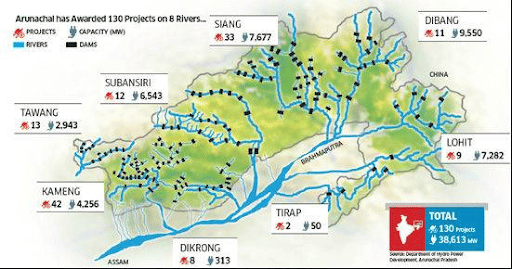
Hydroelectric projects in Arunachal Pradesh
|
(*Click this link to read prelims specific weekly current affairs articles)
FAQs
Question: What is hydroelectric energy?
Answer:
Hydroelectric energy refers to a form of renewable energy that is generated by using the kinetic energy of falling water to produce electricity. Water stored in a reservoir of a dam is passed through a turbine to generate power.
Question: What is net zero?
Answer:
Net zero refers to the cutting of greenhouse gas emissions to near zero with any remaining emissions re-absorbed from the atmosphere, by oceans and forests for instance. It is also known as carbon neutrality.
UPSC Mains Practice Question:
|
MCQs
Question: Consider the following statements about Net Zero:
- It is a condition in which a country would bring down its emissions to zero, taking pre-industrial levels as a base range.
- India has not yet committed to a net zero timeline.
Which of the statements given above is/are correct?
(a) 1 only
(b) 2 only
(c) Both 1 and 2
(d) Neither 1 nor 2
Answer: (d) See the Explanation
- Net Zero Emissions are also referred to as carbon neutrality. It does not mean that a country would bring down its emissions to zero. Rather, the country’s emissions are compensated by the absorption and removal of greenhouse gases from the atmosphere. Hence statement 1 is incorrect.
- India has promised to achieve net zero by 2070. Hence statement 2 is incorrect.
Therefore, option (d) is the correct answer.
Download the PREPP App and attempt FREE IAS Exam Mock Tests and get complete study material!

Full Test - 04: UPSC CSE Prelims CSAT (Paper-II)
Full Test - 03: UPSC CSE Prelims CSAT (Paper-II)
UPSC CSE Prelims 2026 GS Paper 1 Question Paper (24-May-2026)
UPSC CSE Prelims 2026 CSAT Paper 2 Question Paper (24-May-2026)

17 February 2025 | The Hindu Must Read Articles | Current Affairs

16 February 2026 | The Hindu Must Read Articles | Current Affairs

13 February 2026 | The Hindu Must Read Articles | Current Affairs









Comments