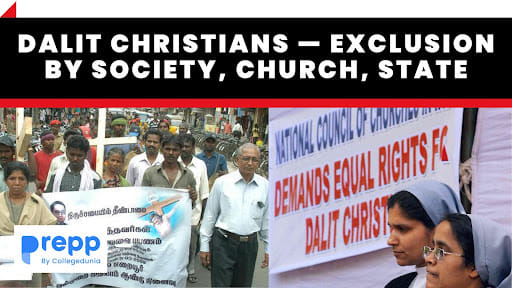
Dalit Christians — Exclusion By Society, Church, State
Relevance: GS1 - Salient features of Indian Society, Diversity of India.Social empowerment GS2- Indian Constitution, Social Justice, Welfare schemes for vulnerable sections of the population by the Centre and States and the performance of these schemes; mechanisms, laws, institutions and Bodies constituted for the protection and betterment of these vulnerable sections
(Source: The Hindu, 08/14/2023)
Click here for Daily Current Affairs
Why in the news?
- This article discusses the Dalit Christians in India, their identity, and their demand for SC status.
- Currently, only those belonging to Hindu, Sikh, or Buddhist communities are categorized as SCs as per the Constitution (Scheduled Castes) Order, 1950.
- The inclusion of Dalit Christians among the Scheduled Castes has been opposed by both their co-religionists i.e. non-convert Christians and other SC communities.
Table of Contents
What is the problem faced by the Dalit Christians?
- Although the Dalits had converted to Christianity to escape casteism, discrimination, and other social evils, they have not been able the equality they desired.
- According to Dr. B.R. Ambedkar, “To the Untouchables, Hinduism is a veritable chamber of horror.”
- As a result, their upward social mobility has been compromised by the contradictions and ambiguities associated with their identity.
- According to Ashish Nandy, the Indian Constitution suggests that caste-based discrimination exists only in Hinduism, Sikhism, and Buddhism.
- Therefore, benefits are extended to the Dalit members of these communities.
- Dalit Christians are excluded from enjoying these benefits due to the assumption that Christianity is a ‘foreign import’.
- This could however lead to questions about their democratic citizenship.
Intersectional burdens
- The Theory of Intersectionality can be used to examine the problem faced by the community as it allows for an understanding of caste within religion.
- This allows for a better understanding of Dalit Christians as a religious minority group.
- It contrasts the single-axis framework adopted by the Indian state and its laws that provide legal protection to isolated categories and discriminates against groups where categories overlap, such as Dalit Christians.
- Various oppressing systems such as race, gender, sexuality, and ability intersect with each other, resulting in distinctive individual social experiences.
- It is therefore difficult to understand these oppressive systems in isolation.
- Kimberlé Crenshaw, the pioneer of Intersectionality stated in “Mapping the Margins: Intersectionality, Identity Politics, and Violence against Women of Color” that women of color are discriminated against as both women and people of color, due to their intersectional identity.
- Similarly, Dalit Christians experience structural intersectional discrimination by being excluded by society, the church, and the state.
Intersectionality and identity
- Identity refers to an individual’s claim to membership in specific social identities and categories in society.
- It is how an individual sees themselves in relation to different social groups and categories that exist in society such as gender, caste, religion, and ethnicity.
- Similar to black women, the term “Dalit Christian” cannot be interpreted merely as two words but as a distinctive hybrid category of multiple social identities.
- According to the Indian state, a Hindu Dalit ceases to be a Dalit upon converting to Christianity as Christianity does not recognize casteism.
- This means that they lose their Dalit identity in the eyes of the law and are pushed into intersectional invisibility.
- According to Amartya Sen, this can be explained by the ‘collectivities’ of identities to which a person can belong providing a particular identity that becomes variously relevant in different contexts.
- These priorities over these identities must be relative to a particular issue and thus the person can choose a dominant identity from among the collectivity to avail of benefits.
A ‘single-axis’ framework
- Consider the Soosai Etc vs Union of India And Others (1985) case.
- Soosai, a Dalit Catholic shoemaker, petitioned the Supreme Court of India for an extension in setting up a kiosk on a platform in Madras which was provided by the State government so that he was on par with Hindu shoemakers.
- The case was dismissed by the Supreme Court which stated that it is necessary to establish whether the various handicaps and disabilities that a person suffered from due to their caste membership in their original social order i.e. Hinduism was similarly and severely oppressive in the new social order i.e. post-conversion.
- The Court used the single-axis framework in delivering the judgment and ignored Soosai’s Dalitness completely.
Commissions on the Dalit Christian issue
- The Union Government appointed a Commission headed by former CJI K.G. Balakrishnan to study the possibility of granting SC status to Dalit Christians.
- It will examine the change in the traditions, customs, and social experiences faced by an SC person after converting to another religion and its implications on their inclusion as SCs.
- The Justice Ranganath Misra Commission (2007) recommended ‘permitting Dalits who converted to Christianity to avail of reservation benefits under the SC quota’.
- In 2008, Deshpande and Bapna, who were appointed by the National Commission for Minorities, found that there is no compelling evidence to justify denying Dalit Christians of SC status.
Government perspective
- Union Government: An affidavit filed by the Union Government before the Supreme Court in 2019, it refused to accept these reports as evidence of continued social disabilities due to caste identity and stated that there was a lack of empirical evidence to support these claims.
- It also stated that Dalit Buddhists cannot be compared to Islam or Christian Dalits because their conversions were voluntary while the latter were due to other factors.
- The religions that were included as SCs were branches or off-shoots of Hinduism while Christian Dalits could not claim “backward” status since untouchability is a feature of Hindu religion and its branches alone.
- In 2023, a resolution of the Tamil Nadu Legislative Assembly was passed to amend the 1950 Presidential (SC) order regarding this matter.
Conclusion
- The ‘single-axis’ communal framework of the law has resulted in Dalit Christians being excluded from the SC list despite the evidence in favor of such a decision due to the state’s unwillingness.
- The amendment of the 1950 Presidential (SC) order to include Dalit Christians in the SC list is a potential way forward that passes on the benefits of SC status to the Dalit Christian community.
(*Click this link to read prelims specific weekly current affairs articles)
FAQs
Question: Who are Dalits?
Answer:
The term Dalit was first used by Jyotirao Phule to represent the oppressed classes or untouchable castes of Hinduism. It is a Marathi term that means broken or scattered. According to the Indian Constitution, Dalits are those that fall under the category of Scheduled castes.
Question: What is the National Commission for Minorities?
Answer:
The National Commission for Minorities (NCM) is an autonomous body established by the Indian government in 1992 under the National Commission for Minorities Act, 1992. It is responsible for advising the central and state governments on matters related to the welfare and development of minority communities in India. IT consists of a Chairperson, Vice-Chairperson, and five members.
UPSC Mains Practice Question:
|
MCQs
Question: In India, if a religious sect/community is given the status of a national minority, what special advantages is it entitled to?
- It can establish and administer exclusive educational institutions.
- The President of India automatically nominates a representative of the community to Lok Sabha.
- It can derive benefits from the Prime Minister’s 15-Point Programme.
Which of the statements given above is/ are correct? (UPSC CSE 2011)
(a) 1 only
(b) 2 and 3 only
(c) 1 and 3 only
(d) 1, 2 and 3
Answer: (c) See the Explanation
- According to Article 30, religious minorities are entitled to establish and administer exclusive educational institutions. Hence statement 1 is correct.
- There are no provisions for communal representation in the Lok Sabha which means the President does not make such a nomination. Hence statement 2 is incorrect.
- They can derive benefits from the Prime Minister’s 15-Point Programme which aims to ensure that the benefits of all schemes reach the underprivileged. Hence statement 3 is correct.
Therefore, option (c) is the correct answer.
Question: Which one of the following categories of Fundamental Rights/incorporates protection against untouchability as a form of discrimination? (UPSC CSE 2020)
(a) Right against Exploitation
(b) Right to Freedom
(c) Right to Constitutional Remedies
(d) Right to Equality
Answer: (d) See the Explanation
- Article 17 of the Constitution of India states that “Untouchability” is abolished and its practice in any form is forbidden.
- It also states that the enforcement of any disabilities that arise out of “Untouchability” shall be treated as a punishable offense in accordance with law.
Therefore, option (d) is the correct answer.
Download the PREPP App and attempt FREE IAS Exam Mock Tests and get complete study material!

Full Test - 04: UPSC CSE Prelims CSAT (Paper-II)
Full Test - 03: UPSC CSE Prelims CSAT (Paper-II)
UPSC CSE Prelims 2026 GS Paper 1 Question Paper (24-May-2026)
UPSC CSE Prelims 2026 CSAT Paper 2 Question Paper (24-May-2026)

17 February 2025 | The Hindu Must Read Articles | Current Affairs

16 February 2026 | The Hindu Must Read Articles | Current Affairs

13 February 2026 | The Hindu Must Read Articles | Current Affairs









Comments