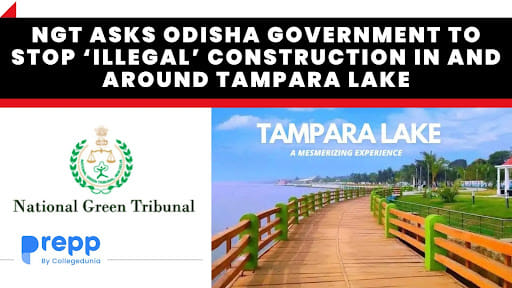
NGT Asks Odisha Government To Stop ‘Illegal’ Construction In And Around Tampara Lake
Relevance: GS3 - Conservation, environmental pollution and degradation, environmental impact assessment GS1 - Distribution of key natural resources across the world, GS2 - Statutory, regulatory and various quasi-judicial bodies.
(Source: The Hindu, 08/12/2023)
Click here for Daily Current Affairs
Why in the news?
- Recently, the Eastern Zone bench of the National Green Tribunal directed the Odisha government not to go ahead with ‘illegal’ construction in and around Tampara Lake.
- Tampara Lake is a freshwater lake and a designated Ramasar site.
Table of Contents
What was the petition before the NGT?
- The NGT was hearing a petition filed by the Wildlife Society of Orissa, an environmental pressure group.
- The WSO alleged that the large-scale construction work that was taking place near the lake was illegal and lacked the requisite permissions to take up construction around the lake and in its zone of influence.
- Wetland rules have not been implemented in the region and the grievance committee and State wetland authority have met only once in the last six years.
- The Berhampur Development Authority (BeDA) had finalized additional infrastructure projects at a cost of ₹8 crore.
- In order to make Tampara an eco-tourism hub, the government is planning to introduce water sports like surfing, kayaking, and scuba diving and build tourist-friendly facilities such as restaurants, hotels, resorts, and cottages, etc.
- The construction has taken place within water area and 50 meters of Tampara Lake.
- Since all Ramsar sites are protected under Wetland Conservation Rules 2017, the erection of a concrete structure along the lake by the state government is a violation of the Rules.
Major concerns
- Reclamation of the Tampara land to build these tourist facilities will threaten the rich biodiversity of the lake.
- The huge tourist inflow and resultant anthropogenic pressure will irreversibly affect the lake’s delicate ecosystem and lead to habitat loss for indigenous aquatic species.
- There is a lack of research on the potential impacts of mega-infrastructure construction and tourism-related waste generation on the carrying capacity and ecology of the protected region.
Verdict
- NGT judicial member Amit Sthalekar and expert member Arun Kumar Verma directed the state to constitute a committee to consider the matter.
- The committee will comprise a senior scientist of the MoEF&CC, a senior scientist of the Central Pollution Control Board, the District Collector of Ganjam, or his nominee, and the Secretary of State Wetland Authority, Odisha, or his nominee.
- The next date of hearing has been fixed for September 13 and the committee has been asked to submit its report within four weeks.
Lake Tampara
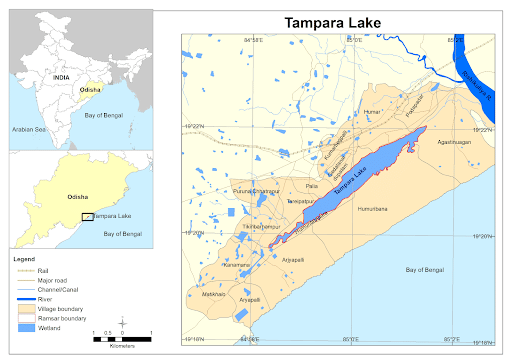
- It is a freshwater lake in Ganjam district of Odisha.
- Formation: The use of explosives in a battle between the English and French forces in Ganjam in 1766 led to the formation of a large depression.
- This later became Tampara Lake.
- It was initially called Tamp by the British and renamed by the locals as Tampara.
- It is located on the right bank of the Rushikulya River, whose floodwaters fill the lake.
- The lake plays a major role in flood control in the region during the monsoon.
- Size: 30 hectares.
- Conservation Status: It was added to the list of Ramsar Wetlands in 2021.
- It was included in the Wetland Atlas of the Union Ministry of Environment, Forest and Climate Change in 2010.
- Wildlife: Tampara supports around 60 species of birds, 46 species of fishes, 48 species of phytoplanktons, and more than seven species of terrestrial plants and macrophytes.
- Vulnerable species in the lake include the common carp (Cyprinus carpio), common pochard (Aythya ferina), and river tern (Sterna aurantia).
- It is a part of the Olive Ridley turtle’s nesting sites i.e. the Rushikulya basin.
- Livelihoods
- Fishing is an important source of livelihood for the locals with the lake providing an estimated average fish yield of 12 tonnes per year.
- It also acts as a source of water for agriculture and domestic use.
- It is a well-known tourism and recreation site.
NGT
|
(*Click this link to read prelims specific weekly current affairs articles)
FAQs
Question: What are the wetland conservation Rules, 2017?
Answer:
The Wetlands (Conservation and Management) Rules, 2017 act as the regulatory framework for the conservation and management of wetlands in India. It changed the management of wetlands away from a central body and toward state-level organizations. It forbids encroachment, the establishment, and growth of industries, waste disposal, and the discharge of untreated wastes and effluents into wetlands.
Question: What is the Wetland Atlas?
Answer:
It acts as a database of the number and extent of wetlands in India. It was prepared by the Space Applications Center of ISRO in 2010 and sponsored by the Ministry of Environments, Forest, and Climate Change.
UPSC Mains Practice Question:
|
MCQs
Question: Consider the following statements:
- Under Ramsar Convention, it is mandatory on the part of the Government of India to protect and conserve all the wetlands in the territory of India.
- The Wetlands (Conservation and Management) Rules, 2010 were framed by the Government of India based on the recommendations of the Ramsar Convention.
- The Wetlands (Conservation and Management) Rules, 2010 also encompass the drainage area or catchment regions of the wetlands as determined by the authority.
Which of the statements given above is/are correct? (UPSC CSE 2019)
(a) 1 and 2 only
(b) 2 and 3 only
(c) 3 only
(d) 1, 2 and 3
Answer: (c)
Question: How is the National Green Tribunal (NGT) different from the Central Pollution Control Board (CPCB)?
- The NGT has been established by an Act whereas the CPCB has been created by executive order of the Government.
- The NGT provides environmental justice and helps reduce the burden of litigation in the higher courts whereas the CPCB promotes cleanliness of streams and wells, and aims to improve the quality of air in the country.
Which of the statements given above is/are correct? (UPSC CSE 2018)
(a) 1 only
(b) 2 only
(c) Both 1 and 2
(d) Neither 1 nor 2
Answer: (b) See the Explanation
- The NGT has been established under the NGT Act, 2010 and the CPCB has been established under the Water (Prevention and Control of Pollution Act) 1974. Therefore both are statutory bodies. Hence statement 1 is incorrect.
- The aim of the NGT is to ensure environmental justice and reduce the burden of litigation in higher courts.
- The CPCB acts under the Water (Prevention and Control of Pollution Act) 1974 and Air (Prevention and Control of Pollution Act) 1981 to promote the cleanliness of streams and wells and improve the quality of air in the country. Hence statement 2 is correct.
Therefore, option (b) is the correct answer.
Download the PREPP App and attempt FREE IAS Exam Mock Tests and get complete study material!

Full Test - 04: UPSC CSE Prelims CSAT (Paper-II)
Full Test - 03: UPSC CSE Prelims CSAT (Paper-II)
UPSC CSE Prelims 2026 GS Paper 1 Question Paper (24-May-2026)
UPSC CSE Prelims 2026 CSAT Paper 2 Question Paper (24-May-2026)

17 February 2025 | The Hindu Must Read Articles | Current Affairs

16 February 2026 | The Hindu Must Read Articles | Current Affairs

13 February 2026 | The Hindu Must Read Articles | Current Affairs









Comments