Self Help Groups (SHGs) - Indian Polity Notes
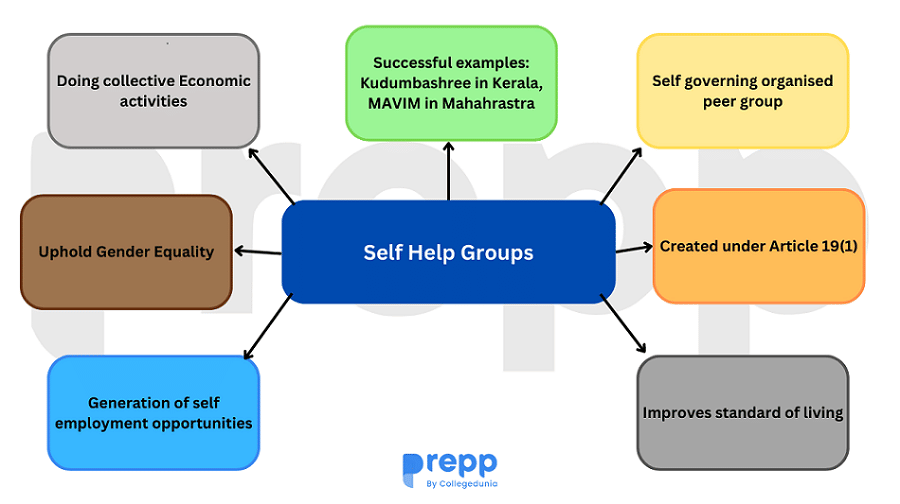
Self-Help Group (SHG) is group of people who face similar problems and join together to find solutions to better living conditions. Self Help Groups are popularly made for the purpose of doing collective economic activities and earning collective profit out of these activities with the help of Microfinance. SHGs are typically made up of individuals who lack access to official financial institutions. Self-Help Groups can exist with or without registration. Kudumbashree in Kerala is one of the most successful SHGs in India. This article explains the Self-Help Group (SHGs) which is important for UPSC IAS Examination.
| To Read update on this topic: |
|
Table of Contents |
Self Help Groups - Concept
- Self-Help Groups (SHGs) can be defined as a self-governing, peer-controlled informal network of people with comparable socioeconomic backgrounds who want to work together to achieve a common goal.
- To foster self-employment and poverty alleviation, SHGs use the concept of "Self Help."
- These groups form together to create a group in order to solve their shared problem and raise their living standards.
- Any local resident who needs education or skill development may assist in the formation of the Self-Help Group.
- They are known as Facilitators or Animators. They are well-known in the neighbourhood. A female facilitator may contribute significantly to women's empowerment in rural India.
- In India, SHGs are not governed by a specific law. They are created on the basis of Article 19(1) of the Indian Constitution, which states that citizens have the right to organise any organisation or group with mutual consent.
- Strength of SHGs: An ideal SHG should have 10-20 members.
- SHGs should not contain more than one member from the same family; this allows for the inclusion of multiple families.
- Members: It would be either all males or all women since mixed groupings are not effective.
- It has also been shown that women SHGs are more successful than males since their members are better at saving and borrowing.
SHGs - Needs
- The necessity to handle problems at the grassroots level with different cultural, traditional, and historical backgrounds.
- As a result, the government finds it impossible to handle economic problems on its own.
- Thus, bringing together people who are dealing with similar issues might be a game changer in the Indian economy.
- Inclusion in Finance According to the NSSO statistics, 51.4% of farmer households lack access to formal finance.
- This has had numerous bad consequences, including poverty and farmer suicide.
- Many people in India are unable to secure loans owing to a lack of collateral. SHGs can assist in resolving this issue.
Functions performed by Self Help Groups
|
Functions |
Description |
|---|---|
|
Employment Generation |
|
|
Providing Loans |
|
|
Providing banking and pension services |
|
|
Settle issues |
|
SHG Bank Linkage – Why is it Important?
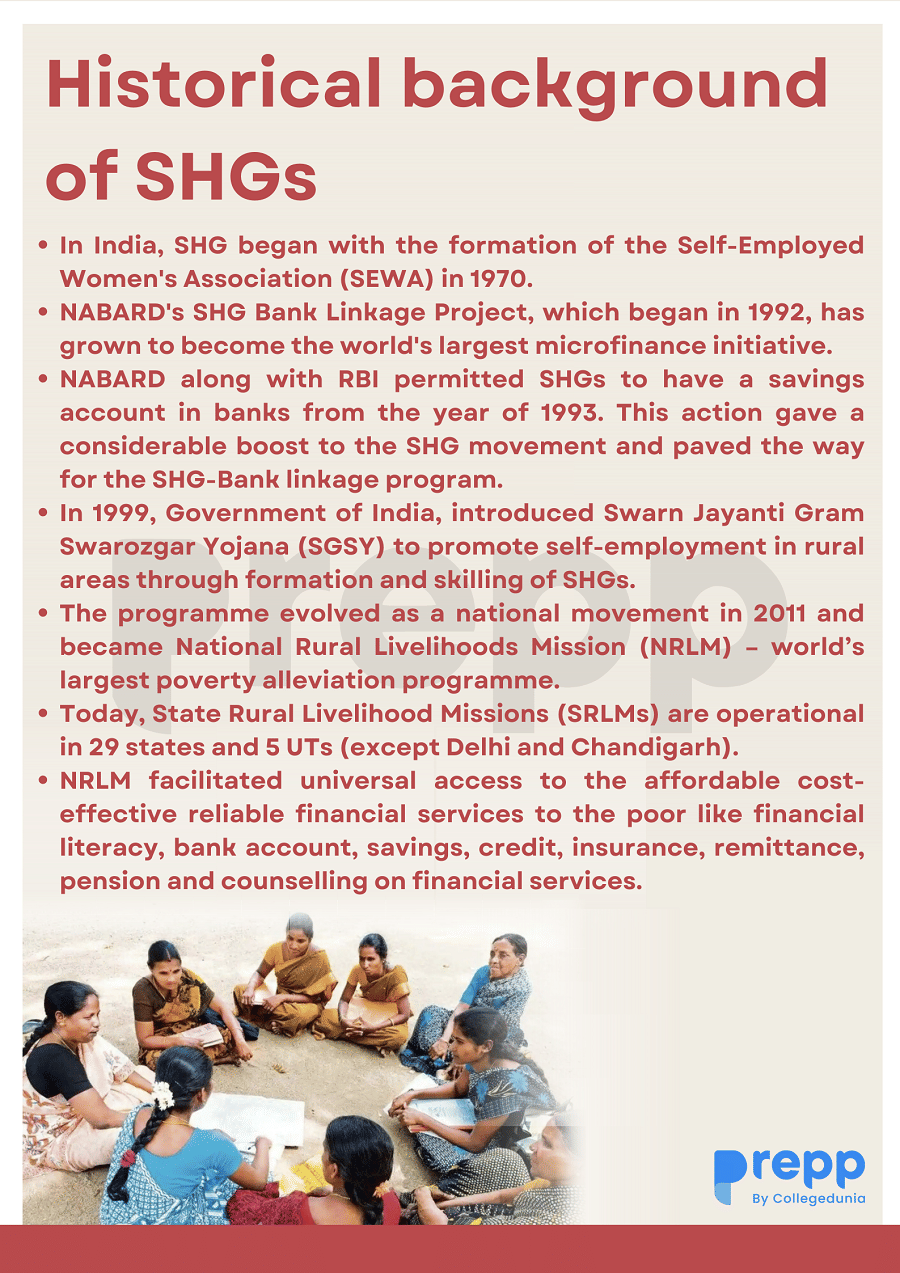
- The Self-Help Group-Bank Linkage Programme (SBLP), which started as a pilot programme in 1992 has developed with rapid strides over the years.
- The SHG-Bank Linkage Programme was started on the recommendation of the S K Kalia Committee.
- Under the SBLP, the following three different models have emerged:
- Model I: SHGs promoted, guided and financed by banks.
- Model II: SHGs promoted by NGOs/ Government agencies and financed by banks.
- Model III: SHGs promoted by NGOs and financed by banks using NGOs/formal agencies as financial intermediaries.
- Model II has emerged as the most popular model under the SBLP programme. Commercial banks, co-operative banks and the regional rural banks have been actively participating in the SBLP.
Significance of Self Help Groups
- Social integrity: SHGs promote communal efforts to eliminate behaviours such as dowry and drunkenness.
- Gender Equality: SHGs empower women and instil leadership skills in them.
- Easier access to government schemes: Government schemes are primarily intended for marginalised groups in society.
- These persons are extremely tough to include and identify. When they are gathered together, it is simpler for the government to rapidly and effectively identify people in need of support.
- Improves standard of living: The SHGs' collective team effort for financial inclusion enables the vulnerable sections of society to improve their standard of living, family planning, and health care.
- Financial Inclusion: Priority Sector for Financial Inclusion Lending standards and the promise of returns encourage banks to lend to SHGs.
- Alternative source of employment: It reduces reliance on agriculture by assisting in the establishment of micro-enterprises such as tailoring, groceries, and tool repair businesses.
- It reduces reliance on agriculture by assisting with the establishment of micro-enterprises such as tailoring, food stores, and tool repair businesses.
- Participation in Democracy: SHGs can take an active role in areas of local government. This would include weaker and marginalised segments of society in local government.
- SHGS During Covid 19: They helped in meeting shortfalls in masks, sanitizers and protective equipment, running community kitchens, fighting misinformation and even providing banking and financial solutions to far-flung communities.
SHGs and Women Empowerment
- In rural regions, the self-help group (SHG) movement is one of the most potent incubators of female resilience and entrepreneurship.
- It is an effective means of changing the social construct of gender in communities.
- Women in rural communities are now able to generate their own income.
- While there are many young semi-literate women with home-grown abilities, a lack of cash and backward societal standards hinder them from fully committing to any decision-making position and establishing their own independent enterprise.
- Women operate in a variety of fields as Business Correspondents (BC), Bank Sakhis, Kisan Sakhis, and Pashu Sakhis.
Some case studies related to SHGs
|
Case study |
Description |
|---|---|
|
Kudumbashree in Kerala |
|
|
Mahila Arthik Vikas Mahamandal (MAVIM) in Maharashtra |
|
|
Grihalaxmi in Jharkhand |
|
Limitations of SHGs
- The survival of many SHGs is dependent on the promotional agencies. SHGs are liable to collapse if these agencies withdraw their funding.
- The majority of SHGs do not take advantage of new technology advancements and talents. This is due to a lack of understanding of new technology and a lack of abilities to use them effectively. Furthermore, efficient procedures to support skill development in rural areas are lacking.
- Within the SHGs, there is no professionalism. This does not encourage the growth and enhancement of SHGs. This precludes the members' pay from rising and their living conditions from improving. This also leads to accounting errors and financial mismanagement.
- The majority of SHGs are unregistered. They are governed on the basis of mutual trust among the members. The SHG members' savings may not be safe, causing distrust among the members.
- There are about 6 lakh villages and 1.2 lakh bank branches. Furthermore, because the cost of servicing remains high, many public sector banks and microfinance organizations are unwilling to provide financial services to the poor.
- The SHGs' long-term viability and the quality of their operations have been hotly debated.
Government measures to make SHGs more effective
The government plays a crucial role as a facilitator for the SHGs. There are various government schemes dedicated to the promotion of the SHGs. Some of them are as follows:
- Swarn Jayanti Gram Swarojgaar Yojana (SGSY): It seeks to form SHGs and develop the skills of its members to promote self-employment in rural areas.
- This programme evolved to be a national movement in 2011 to become the National Rural Livelihood Mission.
- National Rural Livelihood Mission (NRLM) is the largest poverty alleviation program in the world. This scheme covers 100 million families through 8.5million SHGs.
- 84 million SHGs received collateral-free credit of which 88% are rural women.
- There is an outstanding loan of over Rs.615 billion. The NPAs of the credit is 6.5%.
- This is much lesser than the total NPAs of the Indian Banks – 10.2%.
- In the Union Budget this year, the government allowed an overdraft up to Rs.5000 to every verified woman SHG member who has Jan Dhan Bank account.
- Also, one woman in every SHG will be allowed a MUDRA loan up to Rs.1 Lakh.
Union Budget 2023-24 - Vision for AmritKaal – an empowered and inclusive economy.
- By mobilising rural women into 81 lakh Self Help Groups (SHGs), the Deendayal Antyodaya Yojana National Rural Livelihood Mission has accomplished extraordinary success.
- The government will help these organisations advance to the next level of economic freedom by forming big producer businesses or collectives, each with several thousand members and professionally administered.
- They will be assisted in obtaining basic materials as well as improving the design, quality, branding, and promotion of their goods."
Way Forward
- SHGs are viewed as rural development engines.
- However, effective SHGs are uncommon since living conditions in rural regions remain deplorable.
- The government must take a proactive role in promoting SHGs at the grass-roots level.
- Constant monitoring of SHGs is required at all times.
- A distinct government organisation to oversee the progress of SHGs in achieving their goals and objectives.
- As a result, banks and the National Bank for Agriculture and Rural Development, in collaboration with local governing bodies, must guarantee that financial inclusion is given at the grassroots level, taking into account the different requirements of rural India.
Conclusion
In this period of liberalisation, privatisation, and globalisation, women are more concerned with their liberty, rights and freedom, security, social standing, and so on, but they are still denied these things; hence, they should be granted their due rights and freedoms with dignity. The government should create a favourable environment for the emergence and development of the SHG movement. It should act as a facilitator as well as a promoter. Government officials should approach the poor and marginalised as viable and responsible consumers, as well as prospective entrepreneurs. SHGs play a critical role in the economic and social growth of women from rural areas.
|
|
|
|---|---|
| Indian Polity UPSC Notes | Indian Judiciary |
| Transparency & Accountability | Lokpal & Lokayuktas Act |
| Role of Civil Services in a Democracy | Pressure Groups |
FAQs
Question: What is a Self-Help Group (SHG)?
Answer: A Self-Help Group (SHG) is a voluntary association of 10-20 individuals, primarily from economically weaker sections, who come together to contribute savings and provide loans to members, aiming to promote financial independence and empowerment.
Question: How do SHGs contribute to financial inclusion?
Answer: SHGs contribute to financial inclusion by providing small loans to members without the need for formal banking channels. These loans are funded by pooled savings, making credit more accessible to marginalized communities.
Question: What role does the government play in supporting SHGs?
Answer: The government supports SHGs through schemes like the National Rural Livelihood Mission (NRLM) and MUDRA, providing financial aid, training, and capacity-building programs to promote the sustainability of SHGs.
Question: What are the primary benefits of joining an SHG?
Answer: The primary benefits include access to credit, skill development, financial literacy, and enhanced empowerment, particularly for women, through collective decision-making and economic independence.
Question: How do SHGs empower women in rural India?
Answer: SHGs empower women by offering them financial independence, training, and decision-making power within the group, leading to enhanced roles in community and household matters.
MCQs
1. What is the typical size of a Self-Help Group (SHG)?
A. 2-5 members
B. 10-20 members
C. 50-100 members
D. 100-150 members
Answer: (B) See the Explanation
A typical SHG consists of 10-20 members, usually from similar socio-economic backgrounds, who come together to contribute savings and support each other financially.
2. Which of the following government schemes is aimed at supporting SHGs in India?
A. Mahatma Gandhi National Rural Employment Guarantee Act (MGNREGA)
B. National Rural Livelihood Mission (NRLM)
C. Ayushman Bharat
D. Pradhan Mantri Awas Yojana
Answer: (B) See the Explanation
The National Rural Livelihood Mission (NRLM) is a government scheme aimed at supporting SHGs by providing financial assistance, training, and capacity-building for rural livelihoods.
3. What is the primary purpose of an SHG’s pooled savings?
A. Investing in the stock market
B. Providing loans to group members
C. Building large infrastructures
D. Purchasing government bonds
Answer: (B) See the Explanation
The primary purpose of pooled savings in an SHG is to provide small loans to group members, helping them meet financial needs or start small businesses.
4. Which agency provides microfinance support to SHGs in India?
A. Securities and Exchange Board of India (SEBI)
B. Micro Units Development & Refinance Agency (MUDRA)
C. Reserve Bank of India (RBI)
D. Food Corporation of India (FCI)
Answer: (B) See the Explanation
MUDRA (Micro Units Development & Refinance Agency) provides microfinance support to SHGs, helping them access credit for business activities.
5. What type of empowerment do SHGs primarily focus on?
A. Political empowerment
B. Social empowerment
C. Financial empowerment
D. Environmental empowerment
Answer: (C) See the Explanation
SHGs primarily focus on financial empowerment by offering credit facilities, promoting savings, and providing economic independence to their members.
GS Mains Questions and Model Answers
1. Analyze the role of Self-Help Groups in promoting financial inclusion and rural development in India.
Answer: Self-Help Groups (SHGs) play a crucial role in promoting financial inclusion and rural development in India by providing easy access to credit for marginalized communities. By pooling savings from members, SHGs offer low-interest loans to individuals who lack access to formal banking channels, thereby fostering financial inclusion. SHGs also contribute to rural development by encouraging entrepreneurship and income generation through small businesses, agriculture, and cottage industries. Furthermore, SHGs empower women by involving them in decision-making processes and providing financial literacy training, which enhances their role in household and community matters.
2. Discuss the significance of government schemes like NRLM in supporting SHGs and their role in poverty alleviation.
Answer: Government schemes like the National Rural Livelihood Mission (NRLM) have been instrumental in supporting the formation and growth of SHGs across India. These schemes provide financial assistance, capacity-building programs, and training to SHGs, helping them become sustainable economic entities. NRLM focuses on improving rural livelihoods, poverty alleviation, and promoting women’s empowerment. By linking SHGs with banks and other financial institutions, the government ensures that marginalized communities have access to credit, which helps them improve their incomes and reduce poverty. The success of SHGs in rural India is a testament to the effectiveness of these schemes.
3. How do Self-Help Groups contribute to women’s empowerment in rural India? Discuss with examples.
Answer: Self-Help Groups (SHGs) have been a powerful tool for women's empowerment in rural India. By providing women with access to credit, SHGs allow them to start small businesses, contribute to household income, and gain financial independence. Women involved in SHGs often receive training in entrepreneurship, financial literacy, and leadership, which boosts their confidence and decision-making power. For example, women SHGs in Kerala have successfully run businesses such as poultry farming, tailoring, and handicrafts. These activities not only improve economic conditions but also enhance the social standing of women within their communities, promoting gender equality.
Previous Year Questions on Self-Help Groups (SHGs)
1. UPSC CSE Prelims 2019
Question: Which of the following is a key objective of the National Rural Livelihood Mission (NRLM)?
A. Urban infrastructure development
B. Poverty alleviation through promoting SHGs
C. Ensuring universal healthcare
D. Establishing large-scale industries
Answer: B
Explanation: The primary objective of NRLM is poverty alleviation through the promotion of Self-Help Groups (SHGs), which provide access to credit and encourage sustainable livelihoods in rural areas.
2. UPSC CSE Mains 2018 (GS Paper 2)
Question: Self-Help Groups (SHGs) have been effective in promoting financial inclusion and women’s empowerment. Discuss the role of SHGs in India’s rural development strategy.
Answer: Self-Help Groups (SHGs) play a significant role in India’s rural development strategy by promoting financial inclusion and empowering women. By providing members with access to savings and credit, SHGs help economically weaker sections, particularly women, to improve their financial standing. SHGs also offer a platform for women to gain confidence, learn financial literacy, and become self-reliant. Government schemes like NRLM and MUDRA have further strengthened SHGs by offering financial support and training. Through SHGs, rural women have gained opportunities to start businesses, improve household incomes, and contribute to community development, thereby driving rural progress.
Download the PREPP App and attempt FREE IAS Exam Mock Tests and get complete study material!

Live Test : UPSC CSE Prelims CSAT (Paper-II) (Oct 20 - 23)
Full Test - 04: UPSC CSE Prelims CSAT (Paper-II)
Full Test - 03: UPSC CSE Prelims CSAT (Paper-II)
UPSC CSE Prelims 2026 GS Paper 1 Question Paper (24-May-2026)
UPSC CSE Prelims 2026 CSAT Paper 2 Question Paper (24-May-2026)

17 February 2025 | The Hindu Must Read Articles | Current Affairs

16 February 2026 | The Hindu Must Read Articles | Current Affairs

13 February 2026 | The Hindu Must Read Articles | Current Affairs









Comments