Good Governance - Indian Polity Notes
Good governance is the administration of public affairs in a just, fair, and reasonable manner. In federal nations such as India, there is a greater likelihood of varied administrative systems, which may lead to complexities and challenges that contribute to the formation of the idea of Good Governance. The Government of India has introduced the Good Governance Index to analyse the state of governance and the impact of different initiatives undertaken by state governments and UTs.
According to the World Bank, Good governance is essential for creating and preserving a climate that promotes equitable growth for economic policies.
This article explains the Good governance, its Need and Principles of Good Governance are useful for UPSC IAS 2023 exam preparation.
|
Table of Contents |
Good Governance - Concept
- In India, the concept of Good Governance was established in response to several administrative and judicial concerns.
- It is a relatively new word that emerged in the 1990s; nevertheless, the notion of good governance is not new to Indian culture.
- Kautilya's Arthashastra emphasised the universal appeal and applicability of basic concepts of good government, accountability, and fairness.
- What is Governance?: It is the process of decision-making and decision-implementation, an analysis of governance focuses on the formal and informal actors involved in decision-making and decision-implementation, as well as the formal and informal structures that have been put in place to arrive at and implement the decision.
- Good governance ensures that corruption is avoided, minorities' perspectives are considered, and the voices of society's most disadvantaged are heard in decision-making.
- It is also relevant to society's current and future requirements.
|
|
|
|---|---|
| Cooperatives in India | Societies and Trusts |
| Transparency and Accountability | E-Governance |
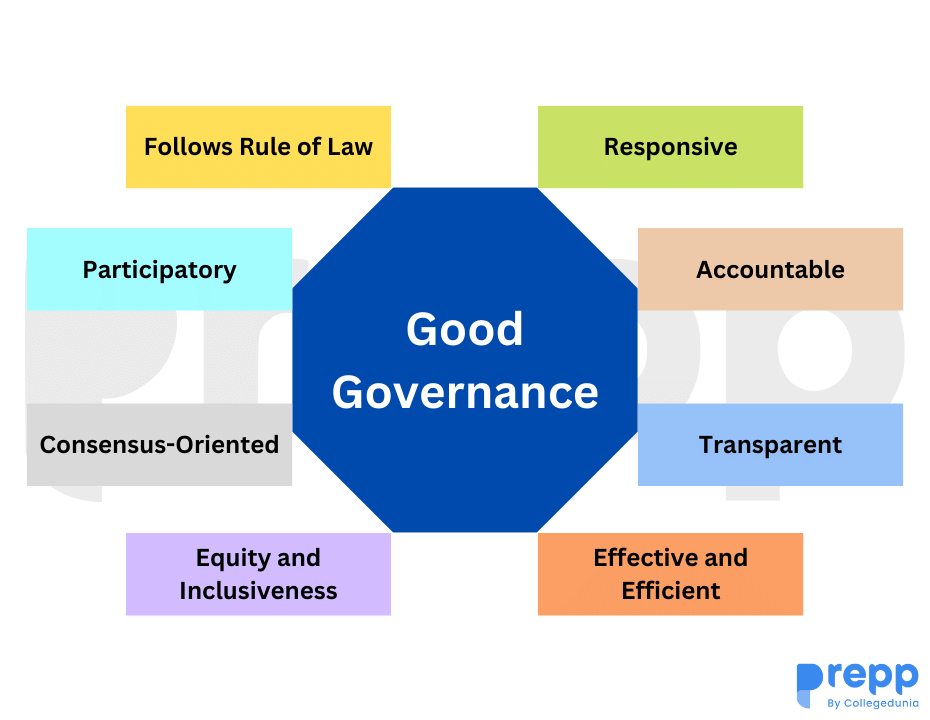
Eight Principles of Good Governance
The United Nations (UN) has identified eight key features of effective governance. Here's a quick rundown of what they're all about:
- Responsive: Institutions and processes must serve all stakeholders within a reasonable time frame.
- Accountable: Good governance seeks to improve people's lives, and this cannot happen until the Governmental institutions, commercial sectors, and civil society organizations are held accountable to public and institutional stakeholders.
- Transparent: The public should have access to information about the functioning of the government.
- Effective and Efficient: The community's resources should be utilized wisely to maximize the production and demands of their community.
- Equity and Inclusiveness: A just society is ensured by good government.
- Consensus-oriented: Decision-making assures that, even if everyone does not accomplish everything they desire, a common minimum can be obtained by everyone that is not harmful to anyone.
- Participatory: Men and women, as well as disadvantaged parts of society, backward classes, minorities, and others, should be free to express themselves through authorized local organizations or representatives.
- Rule of Law: The legal framework, particularly human rights laws, should be enforced impartially. The strong will dominate over the weak if there is no rule of law.
Need of Good Governance
Economic Development
- A state's economic progress will be unstable if it lacks strong administration.
- All aspects of economic development encounter challenges, including production, distribution, investment, and even consumption.
- Such barriers will be removed if excellent governance is achieved, and a fair distribution of state resources will be achievable.
Social Development
- In a civilization, people of various religions, castes, and social strata coexist. Now, if income is not distributed fairly among all of these people, societal unrest will rise.
- Again, equitable wealth distribution is insufficient. We need to make accommodations for minorities to be able to walk without fear.
- Similarly, several reform measures must be established in order to close the gender gap in society.
Political Development
- It has a significant association with political growth.
- Its success is primarily dependent on the political leadership's honesty and adherence to the political establishment's rules and regulations.
- The design of policies for the welfare of the people, as well as constructive cooperation between political institutions and political parties, play a significant role in developing good competition and good governance among themselves.
Challenges
Criminalization of politics
- According to the Association of Democratic Reforms, 43 percent of Lok Sabha 2019 members are facing criminal accusations. It is a 26 percent increase over 2014.
- The criminalization of the political process, as well as the alliance of politicians, civil officials, and economic interests, are having a negative impact on public policy formation and governance.
- As a result, Section 8 of the Representation of the People Act 1951 must be amended to disqualify anyone who is facing criminal accusations for grave and heinous offenses or corruption.
Corruption
- Corruption is a key challenge to strengthening governance quality.
- While people's greed is clearly a cause of corruption, it is the institutional incentives and a lack of a strong enforcement system to penalize the corrupt that have led to India's increasing graph curve.
- According to Transparency International's Corruption Perception Index - 2019, India's ranking has dropped from 78 to 80.
Gender inequality
- It is inequitable that women are underrepresented in government institutions and other linked industries.
- As a result, ensuring women's empowerment is critical to ensuring good government.
Delayed Justice
A citizen has the right to speedy justice, yet due to a variety of conditions, the average person does not receive timely justice.
Administrative System Centralization
Lower-level governments can only function efficiently if they are given the authority. This is especially important for Panchayati Raj Institutions (PRIs), which now face insufficient devolution of funds and officials to carry out the constitutionally mandated functions.
Initiative Of Good Governance In India
Right to information
By making the government more open to public examination, the right to information promotes openness, transparency, and accountability in administration.
E-Governance
- The National e-Governance Plan aims to make all government services available to the general public through common service delivery channels, while also ensuring the efficiency, transparency, and dependability of such services at reasonable rates.
- Pro-Active Governance and Timely Implementation (PRAGATI), Digital India Program, MCA21 (to increase the timeliness and certainty in the delivery of Ministry of Company Affairs services), Passport Seva Kendra (PSK), online Income Tax Return, and other e-Governance programs have been introduced.
- The emphasis should be on ' Minimum Government, Maximum Governance.'
Ease of doing business
- The government has taken steps to improve business conditions, including legislation aimed at improving the country's business environment and policy ecosystems (such as the Bankruptcy Code, the Goods and Services Tax or GST, and the anti-money-laundering law).
- The government has launched the project ‘Make in India.'
Police reforms
- Modernizing police forces and putting the 2015 Model Police Act into action.
- Reform of the First Information Report (FIR) filing procedure, including the introduction of electronic FIR filing for minor offenses.
- Launch a common national emergency number to address residents' emergency security demands.
Aspirational Districts Programme
- The Aspirational Districts Programme (ADP) was launched in January 2018 with the goal of transforming the lives of people in the county's underdeveloped areas in a timely way.
- The initiative aims to change 115 of the most backward districts through targeted interventions in health and nutrition, education, agricultural and water management, financial inclusion, and skill development.
Decentralization
- The Centralised Planning Commission was abolished and replaced by the National Institution for Transforming India (NITI Aayog).
- For the fiscal years 2015 to 2020, the 14th Finance Commission enhanced tax devolution of the divisible pool to states from 32% to 42%.
Good Governance Index
- Good Governance Index is a comprehensive and implementable paradigm that allows for ranking of States and Districts by assessing the State of Governance across States and UTs.
- Objective: The goal of GGI is to develop a mechanism that can be used consistently across all States to evaluate the effectiveness of different initiatives undertaken by the Central and State Governments, including UTs.
- The Index builds a competitive spirit for progress while providing a comparative image of the States based on the GGI Framework.
- It is supported by 58 indicators across ten sectors. Example; Agriculture and Allied Sectors, Commerce & Industries, Human Resource Development, Public Health etc.
Conclusion
Every citizen of the country is concerned about the optimum functioning of the government. Citizens are willing to pay a premium for effective government services, but what is necessary is a transparent, responsible, and understandable governing structure that is free from bias and prejudice. To rebuild effective governance in the country, we must reformulate our national policy to prioritize the Gandhian principle of “Antyodaya.”India should also work on increasing governance probity, which will make governance more ethical. The government should continue to concentrate on the Sabka Saath, Sabka Vikas values, which will lead to inclusive and sustainable growth.
|
|
|
|---|---|
| Indian Polity UPSC Notes | The Preamble |
| Fundamental Rights | Indian Parliamentary System |
FAQs
Q1: What is meant by good governance?
Answer: Good governance refers to the effective, transparent, accountable, and inclusive management of public affairs, ensuring fairness, justice, and equal participation in policy-making.
Q2: What are the key elements of good governance?
Answer: The key elements include transparency, accountability, rule of law, participation, responsiveness, equity, efficiency, and effectiveness.
Q3: How does good governance contribute to development?
Answer: Good governance promotes sustainable development by ensuring public resources are utilized efficiently and equitably, fostering citizen trust and long-term socio-economic progress.
Q4: What is the role of civil society in good governance?
Answer: Civil society organizations act as watchdogs, advocating for transparency, public accountability, and citizen participation in decision-making processes.
Q5: What initiatives have the Indian government taken to promote good governance?
Answer: The Indian government has launched initiatives like the RTI Act, e-Governance projects, and the Citizen’s Charter to enhance transparency, accountability, and responsiveness.
MCQs
- Which of the following is a principle of good governance?
A) Bureaucratic secrecy
B) Transparency
C) Autocracy
D) Inefficiency
Answer: (B) See the Explanation
Transparency is a fundamental aspect of good governance, allowing citizens access to information about government activities and ensuring accountability.
- Which act in India aims to ensure transparency in public governance?
A) Right to Information Act, 2005
B) Indian Penal Code, 1860
C) Companies Act, 2013
D) Arms Act, 1959
Answer: (A) See the Explanation
The RTI Act empowers citizens to request information from public authorities, fostering accountability and transparency in governance.
- Which international organization promotes the principles of good governance?
A) WTO
B) IMF
C) World Bank
D) NATO
Answer: (C) See the Explanation
The World Bank emphasizes good governance as crucial for sustainable development and provides support for governance reforms in various countries.
- What does the term e-Governance signify?
A) Government using electronic warfare
B) Using technology to enhance governance
C) Promoting dictatorship through technology
D) Paper-based administration
Answer: (B) See the Explanation
e-Governance involves the use of information and communication technologies (ICT) to improve public service delivery, enhance transparency, and promote participation.
- Which initiative aims at citizen-centric service delivery in India?
A) NITI Aayog
B) Swachh Bharat Mission
C) Citizen’s Charter
D) MPLAD Scheme
Answer: (C) See the Explanation
Citizen’s Charter aims to make public services more responsive and accountable by clearly defining service standards and ensuring their effective delivery.
GS Mains Questions and Model Answers
Q1. Analyze the importance of good governance in achieving sustainable development.
Answer: Good governance plays a crucial role in achieving sustainable development by ensuring transparent, accountable, and inclusive decision-making processes. It promotes equity by addressing social, economic, and environmental issues efficiently. Governance frameworks help prevent the misuse of public resources, ensuring that development initiatives benefit all sections of society. In the Indian context, good governance initiatives like the RTI Act and e-Governance projects have empowered citizens and increased public accountability. Ensuring good governance at all levels fosters trust, promotes economic growth, and ensures long-term socio-economic stability by enabling the efficient delivery of public services.
Q2. Discuss the challenges faced by India in achieving good governance.
Answer: India faces several challenges in achieving good governance, including bureaucratic inefficiency, corruption, lack of transparency, and limited citizen participation. The digital divide further hampers the success of e-Governance initiatives. Additionally, centralized decision-making and delays in public service delivery impact governance effectiveness. Political interference and inadequate implementation of reforms are significant obstacles. Although the government has introduced various measures to promote accountability, challenges remain in aligning governance with the principles of equity, efficiency, and responsiveness. Strengthening institutional capacity and public participation are necessary to overcome these hurdles.
Q3. Evaluate the role of civil society in promoting good governance in India.
Answer: Civil society organizations (CSOs) have become essential partners in promoting good governance by advocating for transparency, accountability, and public participation. They act as watchdogs, monitoring government activities and ensuring that the voices of marginalized communities are heard. In India, CSOs have been instrumental in pushing for reforms such as the Right to Information Act and facilitating citizen engagement through social audits. They play a critical role in fostering accountability by holding authorities responsible for their actions. However, civil society also faces challenges like funding constraints and political restrictions, which limit its effectiveness. Strengthening collaboration between the government and civil society is essential for ensuring participatory governance.
Previous Year Questions on Good Governance
1. UPSC CSE 2019
Question. “Good governance is the key to achieving the objectives of economic growth and social justice.” Discuss.
Answer: Good governance is essential for achieving economic growth and social justice by ensuring that public policies are efficiently implemented and benefit all sections of society. Transparent governance reduces corruption and enhances trust between the state and citizens, promoting economic growth. Accountability mechanisms ensure that public funds are used judiciously, preventing leakages and promoting inclusive development.
In India, initiatives like the RTI Act and Citizen’s Charter have contributed to greater transparency and service delivery. Social justice can only be achieved when governance frameworks address inequalities, foster participation, and ensure that the benefits of development reach marginalized communities. Thus, good governance aligns economic growth with the principles of fairness and social equity.
2. UPSC CSE 2020
Question. “e-Governance is an enabler of good governance.” Critically examine.
Answer: e-Governance plays a pivotal role in promoting good governance by improving the efficiency, transparency, and responsiveness of public administration. It enables faster delivery of services, reduces bureaucratic delays, and enhances citizen participation through digital platforms. Initiatives like the Digital India campaign and Aadhaar-based services exemplify the potential of e-Governance in India.
However, e-Governance also faces challenges such as the digital divide, limited internet access in rural areas, and concerns about data privacy. While it has enhanced service delivery, its benefits are not uniformly distributed. To fully realize the potential of e-Governance, there is a need to address these challenges and ensure that digital tools are accessible to all sections of society.
Download the PREPP App and attempt FREE IAS Exam Mock Tests and get complete study material!

Live Test : UPSC CSE Prelims CSAT (Paper-II) (Oct 20 - 23)
Full Test - 04: UPSC CSE Prelims CSAT (Paper-II)
Full Test - 03: UPSC CSE Prelims CSAT (Paper-II)
UPSC CSE Prelims 2026 GS Paper 1 Question Paper (24-May-2026)
UPSC CSE Prelims 2026 CSAT Paper 2 Question Paper (24-May-2026)

17 February 2025 | The Hindu Must Read Articles | Current Affairs

16 February 2026 | The Hindu Must Read Articles | Current Affairs

13 February 2026 | The Hindu Must Read Articles | Current Affairs









Comments