E-Governance - Indian Polity notes
E-Governance, means "electronic governance," is the use of information and communication technologies (ICTs) at all levels of government, the public sector, and beyond to improve governance. In India, e-Governance has slowly grown from the computerization of government departments to programmes that encompass the finer features of governance, such as citizen centricity, service orientation, and transparency. Examples: Digital India, the National Portal of India, Common Entrance Test etc.
This article explains about the E-Governance, Types, Government initiatives that are useful for UPSC IAS exam preparation.
|
Table of Contents |

E-Governance
- Electronic governance, often known as e-Governance, is the use of information and communication technology (ICT) to provide government services, exchange statics, conduct communication procedures, and integrate numerous independent systems and services.
- E-governance is the most effective use of information and communication technologies to transform and improve the coherence, productivity, efficacy, transparency, and liability of informational and transnational exchanges within government, between government agencies at various levels, citizens, and businesses.
- According to UNESCO, E-governance is the use of information and communication systems by the public sector to improve information and service delivery, encourage resident engagement in decision-making, and make government more accountable, transparent, and productive.
- e-Governance is fundamentally a shift toward SMART governance, which stands for simple, moral, accountable, responsive, and transparent governance.
|
|
|
|---|---|
| Social Audit | Citizen's charter |
| Good Governance | Transparency and Accountability |
Terms of e-Governance
|
Terms |
Description |
|---|---|
|
e-Administration |
|
|
e-Services |
|
|
e-Democracy |
|
Evolution Of E-Governance In India
The inception of e-Governance proceeded through four stages in India:
- Computerization: The bulk of government offices are fully equipped with computers in the initial stage, thanks to the availability of personal computers. Word processing was the first application of computers, followed by data processing.
- Networking: In this stage, some units of a few government organizations are connected through a hub leading to sharing of information and flow of data between different government entities.
- Online presence: In the third stage, With increased internet connectivity, there was a need to maintain a digital presence. As a result, government departments and other groups have to maintain their websites. In general, these web-pages/web-sites featured information about the individual government entities' organizational structure, contact information, reports and publications, objectives, and vision statements
- Online interactivity: The opening up of communication channels between government agencies and individuals, civil society organizations, and other organizations was a logical consequence of online presence. The main goal of this stage was to reduce the amount of personal interaction with government bodies by making Forms, Instructions, Acts, and Rules available for download.
Models Of E-Governance
- In e-governance, there are four types of Models;
- G2G (Government to Government)
- G2C (Government to Citizens)
- G2B (Government to Business)
- G2E (Government to Employees)
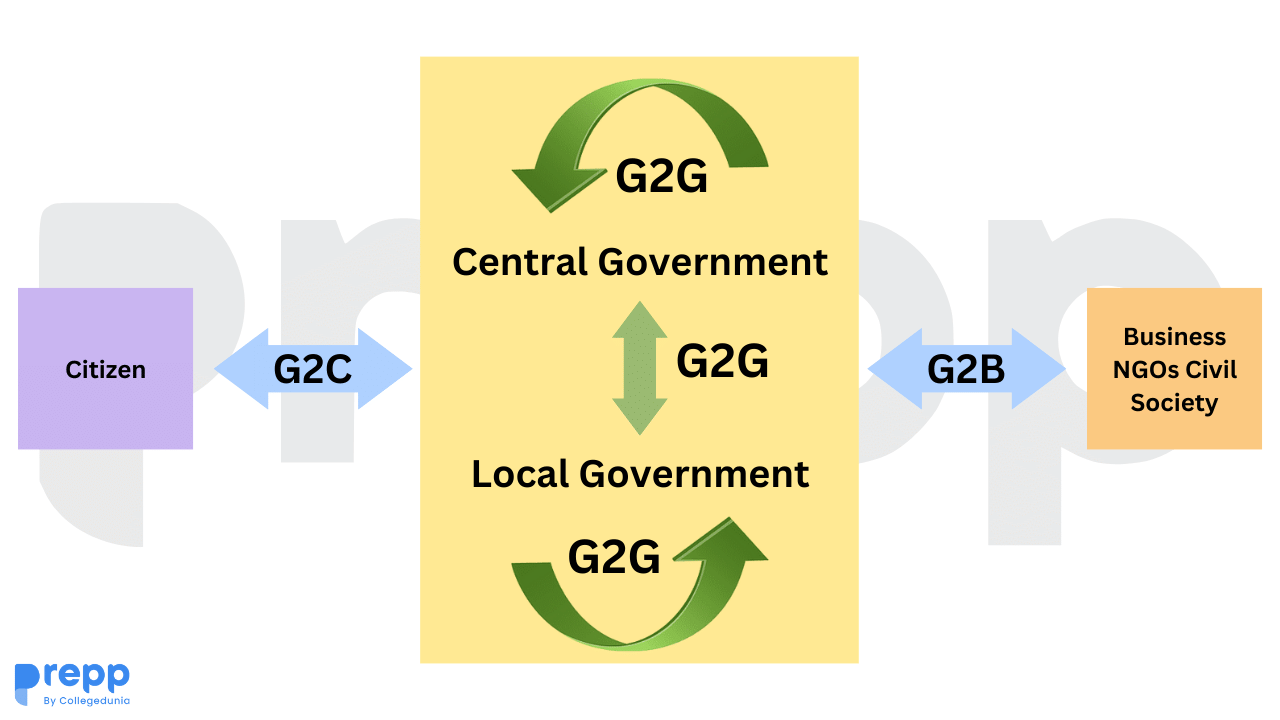
G2G (Government to Government)
- In this case, ICT is being used not just to restructure government procedures but also to boost the flow of information and services inside and between government bodies.
- This type of contact occurs only inside the realm of government, and it might be horizontal, i.e. between different government agencies and functional areas within an organization, or vertical, i.e. between national, provincial, and local government agencies and levels within an organization. The major goal is to boost efficiency, productivity, and output.
- Examples: Khajane Project in Karnataka, SmartGov (Andhra Pradesh), etc.
G2C (Government to Citizens)
- In this case, the government and citizens collaborate to establish an interface that allows citizens to profit from the effective delivery of a wide range of public services.
- On the one hand, this increases the availability and accessibility of public services while also improving the quality of such services.
- It allows citizens to choose when and how they interact with the government, as well as when and where they interact with the government.
- The main goal is to make the government more user-friendly.
- Examples: Computerisation of Land Records, e-Courts, India Portal, Bhoomi Project: Online delivery of Land Records (Karnataka), eSeva (Andhra Pradesh), Project FRIENDS in Kerala, etc.
G2B (Government to Business)
- Here, e-Government solutions are utilized to help the business community – producers of goods and services – interface with the government in a more seamless manner.
- When interacting with the government, the goal is to remove red tape, save time, lower operational expenses, and create a more transparent corporate environment.
- Transactional G2B activities, such as licenses, permits, procurement, and revenue collection, are possible. In areas like trade, tourism, and investment, they can also be promotional and facilitative.
- These measures assist in creating a welcoming climate for businesses, allowing them to operate more efficiently.
- Examples: GeM, e-Procurement Project in Andhra Pradesh and Gujarat, MCA 21 by the Ministry of Corporate Affairs, etc
G2E (Government to Employees)
- The government, by far the largest employer, must contact its employees on a daily basis, just like any other organization.
- This is a two-way conversation between the employer and the employee.
- On the one hand, using ICT tools makes these interactions faster and more efficient, while on the other hand, it increases employee satisfaction.
- Examples: HRMS portals, Appraisal portals etc.
Benefits Of E-Governance
- Inclusive government: E-Governance helps in building trust between governments and citizens, an essential factor in good governance by using internet-based strategies to involve citizens in the policy process, illustrating government transparency and accountability.
- Easy implementation: With e-governance, paperwork has been reduced and made simple. It facilitates sharing of information and ideas between all government agencies and departments to build one mega database.
- Speedy process: Technology makes communication easier and speedier. Internet, phones, cell phones have reduced the time taken in normal communication. Through e-governance, the decision-making process of government will also fasten.
- Reduces costs of running a government: Most of the government expenditure is appropriated towards the cost of stationery. Paper-based communication requires lots of stationery, printers, computers, etc. which calls for continuous heavy expenditure.
- High operational efficiency: The quality of the government's interactions with citizens is used to assess its effectiveness. In a typical government system, processing paperwork is a complex task that takes a lot of resources, and time spent on paper-work adds little value to residents.
- Transparency: The use of information and communication technology (ICT) improves the transparency of the governance process. The government's entire information would be available on the internet. The citizens have access to the information at any time. However, this will only be achievable if the government's whole data set is uploaded on the internet and made accessible to the general public.
- Accountability: Once the governing process is made transparent the government is automatically made accountable. Accountability is the answerability of the government to the people. It is the answerability for the deeds of the government. An accountable government is a responsible government.
Challenges For E-Governance In India
- Low Digital Literacy: Most of the people in India are not aware of the usage of Information Technology and digital literacy is almost non-existent among more than 90% of India's population. This should be given importance for the successful penetration of e-governance services.
- Lack of integrated services: Most of the e-governance services which are offered by the state or central government are not integrated. There is a lack of communication between different departments of government. Hence, the information that resides within one department has no or very little meaning to some other department of the government.
- Awareness of e-governance services: Citizens are not aware of the government facilities. There is a need for generating widespread awareness among the public at large
- Geography: Communication networks must be established in all areas, as the villages and remote areas are not connected by communication networks.
- Privacy and Security: A lack of clear security measures and regulations can hamper the development of projects that contain sensitive information such as personal information, financial records, health records etc.
Initiatives Taken For E-Governance In India
|
Initiatives |
Significance |
|---|---|
|
e-Courts |
|
|
e-District |
|
|
SWIFT initiative |
|
|
MCA21 |
|
|
e-Office |
|
|
e-Pramaan |
|
|
e-Kranti |
|
Recommendations Of ARC
The Second Administrative Reforms Commission (SARC) in its report on e-governance titled “Promoting e-Governance: The SMART Way Forward” has recommended that “A clear road map with a set of milestones is necessary to achieve the objective of transforming the citizen-government interaction at all levels to the e-Governance mode by 2020.
The Commission’s recommendations can be summed up here:
- Governmental forms, processes and structures should be redesigned to make them adaptable to e-Governance, backed by procedural, institutional and legal changes.
- Each government organization should prepare a time bound plan for providing transactional information through their websites.
- Evaluation of success or failure of e-Governance projects may be done by independent agencies on the basis of parameters fixed
- Public-Private partnership should be promoted in several components of e-Governance projects.
- Gram Panchayats should be involved in monitoring the operation of the Common Service Centres in the first four years of their operation.
- Union and State Governments should take proactive measures for establishing Knowledge Management Systems as a pivotal step for administrative reforms in general and e-Governance in particular.
- Develop a national e-Governance ‘enterprise architecture’ framework as has been done in some countries.
- Developing Technological Solutions: Develop a national e-Governance ‘enterprise architecture’ framework as has been done in some countries.
NITI AAYOG Action Plan On E-Governance
To improve e-governance over the three years (2017-2020), Niti Aayog gave the following action plan recommendations:
Digital Infrastructure: We should create reliable Information Technology (IT) infrastructure up to the Gram Panchayat level such that it facilitates round-the-clock access to government services.
- Digital Literacy: At the citizen level, along with connectivity, enhancing digital literacy will be important in encouraging take-up
- Interoperability : We should encourage different ministries and departments to adopt inter-operable e-government platforms to ensure their availability and ease of access for citizens.
- Grievance Redressal: Scale-up grievance redressal portals at the state level and utilize data to improve the resolution of grievances. e-office
Ensure the adoption of e-office by different ministries and departments. E-office can improve the operational efficiency of various departments and ministries by reducing paper transactions, cutting processing delays and increasing transparency.
Conclusion
E-Governance is the use of information and communication technologies (ICTs) to improve governance at all levels of government, the public sector, and beyond. According to theoretical research, E-Governance is the process of changing the relationship of government with its constituents, citizens, corporations, and its own organs, via the use of information and communication technology technologies. The ultimate objective of e-governance is to be able to provide citizens with an expanded array of public services in a systematic and cost-effective manner.
|
|
|
|---|---|
| Indian Polity UPSC Notes | The Preamble |
| Fundamental Rights | Indian Parliamentary System |
FAQs
Question: What is e-Governance?
Answer: E-Governance is the use of digital technology and the internet to deliver government services and enhance the interaction between the government and its citizens. It aims to improve transparency, efficiency, and accountability within governmental processes.
Question: How does e-Governance improve transparency in government?
Answer: E-Governance facilitates transparency by providing open access to information, enabling citizens to view government activities online, track services, and access official documents and records, which reduces opportunities for corruption.
Question: What are some examples of e-Governance initiatives in India?
Answer: Examples of e-Governance initiatives in India include the Digital India program, Aadhaar-enabled services, and the MyGov platform, which engages citizens in governance and decision-making through online feedback and consultations.
Question: What are the key components of e-Governance?
Answer: The key components of e-Governance include infrastructure, digital literacy, regulatory frameworks, online services, and platforms for citizen engagement, which together form a comprehensive digital ecosystem for governance.
Question: How does e-Governance contribute to social inclusion?
Answer: E-Governance promotes social inclusion by providing accessible services to remote and marginalized communities, bridging digital divides, and ensuring that all citizens have equal access to government resources and information.
MCQs
1. Which of the following is a primary goal of e-Governance?
A) Increase taxes
B) Improve transparency and efficiency
C) Enhance government size
D) Reduce citizen participation
Answer: (B) See the Explanation
Explanation: E-Governance aims to improve transparency, efficiency, and accountability in government operations by leveraging digital technology for better service delivery and interaction with citizens.
2. Which platform enables citizens to participate in governance by providing feedback to the Indian government?
A) Aadhaar
B) MyGov
C) Digital India
D) UMANG
Answer: (B) See the Explanation
Explanation: MyGov is a platform that encourages citizen participation in governance by enabling them to give feedback, participate in discussions, and contribute ideas to policy-making.
3. E-Governance primarily relies on which type of technology for delivering services?
A) Analog technology
B) Blockchain
C) Digital technology
D) Virtual reality
Answer: (C) See the Explanation
Explanation: E-Governance relies on digital technology, including internet platforms and mobile applications, to deliver services efficiently to the public.
4. Which of the following is NOT a benefit of e-Governance?
A) Reduces corruption
B) Increases access to information
C) Decreases transparency
D) Streamlines service delivery
Answer: (C) See the Explanation
Explanation: E-Governance aims to increase transparency, not decrease it. Transparency is one of the key objectives of e-Governance, along with efficiency and inclusivity.
5. Which initiative is an example of digital inclusion under e-Governance in India?
A) Digital India
B) Green Revolution
C) National Food Security Act
D) Pradhan Mantri Fasal Bima Yojana
Answer: (A) See the Explanation
Explanation: The Digital India initiative is focused on promoting digital inclusion by providing access to digital services across India, thereby supporting e-Governance objectives.
GS Mains Questions and Model Answers
Q1: Discuss the significance of e-Governance in modern governance. How does it enhance public service delivery?
Answer: E-Governance plays a transformative role in modern governance by leveraging technology to improve efficiency, transparency, and citizen engagement. It enhances public service delivery by streamlining processes, reducing response times, and making services accessible online, eliminating the need for physical presence. Through platforms like Digital India, citizens can access services seamlessly, which reduces bureaucratic delays and potential corruption. E-Governance thus bridges the gap between the government and citizens, fostering trust and accountability in public administration.
Q2: How does e-Governance contribute to achieving social inclusion in India?
Answer: E-Governance contributes significantly to social inclusion by enabling equal access to government services for all, regardless of location or socio-economic status. Digital platforms, accessible even in rural areas, empower citizens by providing essential services and information. Initiatives like Common Service Centers (CSCs) ensure that digital access reaches the remotest regions, thus reducing disparities. By making services more inclusive, e-Governance helps marginalized communities become active participants in governance, which is a step toward achieving equity and inclusiveness in India.
Q3: Analyze the challenges faced by e-Governance in India and suggest potential solutions.
Answer: E-Governance in India faces multiple challenges, including digital illiteracy, inadequate infrastructure, and cybersecurity concerns. Rural areas often lack reliable internet connectivity, limiting access. Additionally, data security and privacy concerns must be addressed to build public trust. To overcome these challenges, the government can invest in digital literacy programs, strengthen infrastructure in underserved regions, and enforce stringent cybersecurity measures. Implementing robust data protection laws can further protect citizen information, ensuring a safer e-Governance environment and encouraging widespread adoption.
Previous Year Questions on E-Governance
1. UPSC CSE Prelims 2019:
Question: What is the primary objective of the Digital India program?
A) To create new physical infrastructure
B) To promote the use of digital technology for service delivery
C) To increase imports of digital equipment
D) To establish private tech companies
Answer: (B)
Explanation: The Digital India program primarily aims to promote the use of digital technology for efficient delivery of government services, achieving transparency and accessibility for citizens.
2. UPSC CSE Mains 2021 (GS Paper 2):
Question: "Evaluate the role of e-Governance in improving transparency and accountability in Indian administration."
Answer: E-Governance has substantially improved transparency and accountability in Indian administration by making information accessible to the public. By digitizing records, e-Governance reduces the discretion of officials and allows citizens to track services. Platforms like RTI Online enhance accountability, enabling citizens to request and receive information on government operations. Furthermore, online grievance redressal systems foster transparency, as actions taken by officials become trackable and verifiable. Thus, e-Governance has become a powerful tool in reducing corruption and fostering an open, accountable government in India.
Download the PREPP App and attempt FREE IAS Exam Mock Tests and get complete study material!
UPSC IAS : GS - Medieval History - Subject Knowledge Test

Live Test : UPSC CSE Prelims CSAT (Paper-II) (Sep 08 - 11)
Full Test - 03: UPSC CSE Prelims CSAT (Paper-II)
Full Test - 02: UPSC CSE Prelims CSAT (Paper-II)
UPSC CSE Prelims 2026 GS Paper 1 Question Paper (24-May-2026)
UPSC CSE Prelims 2026 CSAT Paper 2 Question Paper (24-May-2026)

17 February 2025 | The Hindu Must Read Articles | Current Affairs

16 February 2026 | The Hindu Must Read Articles | Current Affairs

13 February 2026 | The Hindu Must Read Articles | Current Affairs









Comments