Role of Civil Services in Democracy - Indian Polity Notes
India is a democratic country, which means that the people have power. The authority is exerted by its authorized representatives, who are given the authority to govern them for a set amount of time. The important role of civil services in a democracy are administration, policy formulation, and policy implementation for the betterment of society and the nation. The topic “Role of Civil Services in Democracy” is an important part of the UPSC/IAS Exam Polity and Governance syllabus which is discussed in this article in detail.
|
Table of Contents |
Historical Background
- Ancient Times: The concept of a well-organized public administration system has existed in India since ancient times.
- The Mauryan government used civil servants under the guise of adhyakshas and other titles.
- The civil servants were recruited on the basis of merit and excellence, according to Chanakya's Arthashastra, and they had a strict investigative system.
- Mughal Era: During the Mughal era, state officers were in charge of the land revenue system.
- British Era: The East India Company had a civil service in contemporary times to handle their commercial activities. The civil services were founded by the British administration in India primarily to reinforce their grip over their Indian territories.
- Lord Wellesley, who served as Governor-General of India from 1798 to 1805, established the College of Fort William in 1800, where every Company employee was required to attend a three-year course.
- To teach employees about the civil service, the East India Company College was founded in Hertfordshire, near London.
- Post-Independence Era: The civil service was reorganized in post-independence India.
- Civil service officers were primarily concerned with maintaining law and order and collecting revenue during the British Raj.
- When the government took on the role of a welfare state after independence, civil services played a key role in implementing national and state welfare and development objectives.
|
|
|
|---|---|
| Relationship Between Civil Service And Democracy | Reforming Bureaucracy to Strengthen Democracy |
| Issues Afflicting Indian Civil Services | Role Played By Civil Services |
Role of Civil Servants in Democracy
A variety of factors have led to civil service's growing relevance in a modern democracy
- Scientific and technical advancements have resulted in radical changes in transportation and communication systems. Big government and large-scale administration became conceivable with the introduction of the telephone, telegraph, trains, and airways.
- They're essentially administrators with a lot of experience as a result of this they can suggest measures to the government for the welfare of the people.
- Civil servants play an important role in upholding democratic values by aiding their political leaders (Ministers) in policy-making and policy implementation.
- The citizen has risen to the foreground of administrative and development debates. The Civil Services, as one of the most powerful instruments of governance, serves as a link between the state and society.
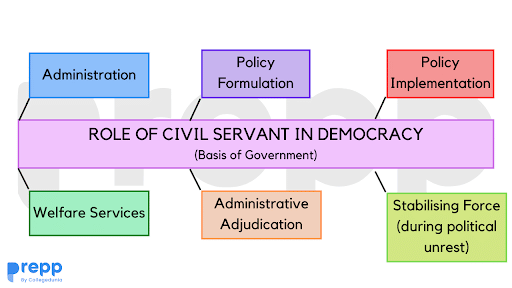
- In a democracy, the civil service plays a critical role in the administration, policy creation, and implementation, as well as running the country ahead on the path to progress and development.
Constitutional Provision
- The President or Governor, directly or through officers subordinate to him, has executive power over the Union and the States, according to Articles 53 and 154. Part XIV of the Constitution {Services under the Union and States (Article 308-323)} governs these officers, who make up the permanent civil service.
- Government of India (Business Transactions) Rules: These Rules govern how officials are expected to assist the President or Governor in carrying out his or her executive tasks.
- Dismissal, dismissal, or reduction in rank of persons engaged in civil capacities under the Union or a State is covered by Article 311.
- Article 312: All India Services.
Functions of the Civil Servants in Democracy
- Policy Formulation: The civil servants are also in charge of formulating policies. In this sense, civil service officers give ministers advice as well as information and ideas.
- Civil Service as a Stabilizing Force: In times of political unrest, the civil service provides stability and permanence. While administrations and ministers come and go, the civil service remains a constant, providing stability and continuity to the administrative structure.
- Instruments of Social Change and Economic Development: Effective policy execution will result in beneficial improvements in ordinary people's lives. A government can only declare a scheme successful when the promised goods and services reach the intended recipients.
- Welfare Services: The services provide a variety of welfare programs, including social security, the welfare of the weaker and more vulnerable members of society, old-age pensions, poverty reduction, and so on.
- Developmental Functions: The services conduct a number of developmental functions, such as encouraging new agricultural techniques, industry, trade, financial functions, and bridging the digital gap, among others.
- Administrative Adjudication: The civil service also provides quasi-judicial services by resolving conflicts between the government and citizens through tribunals and other mechanisms.
Issues in Civil Services
- Professionalism is lacking, and capacity development is inadequate hence it hampers democracy.
- An ineffective incentive scheme that does not reward meritorious and honest government employees.
- Rules and procedures that are rigid and outdated, prevent civil officials from exercising individual judgment and performing efficiently.
- Whistle-blowers are not adequately protected due to a lack of accountability and transparency procedures.
- Irrational transfers and tenure insecurity are the results of political involvement.
- There has been a loss of ethics and principles, resulting in widespread corruption and nepotism.
- The public servants themselves are opposed to reform.
Significance of Civil Servants in Democracy
- Having a reliable recruitment process through a neutral agency protects you from such misuse.
- Today's public policy is a demanding task that necessitates in-depth knowledge and competence in the field of public affairs. A permanent civil service provides consistency and builds competence as well as institutional memory, all of which are important for effective policymaking.
- A permanent and neutral civil service is more likely to evaluate any policy's long-term societal benefits, whereas the political executive may be more concerned with short-term political benefit.
- A permanent civil service helps to assure stability in government administration and serves as a unifying factor, especially in large, culturally varied countries.
- A permanent civil service with a principled basis for operation is likely to emerge over time. This will help in democracy.
Conclusion
- In India, the civil service plays a critical role in enforcing norms and policies. It plays a crucial part in Indian administration. The civil service's role has evolved throughout time.
- Rapid economic expansion has resulted in an increase in the amount of work available.
- Civil Servants need to change their mindset from controllers to facilitators, and from providers to enablers. They must equip themselves with the necessary talents and abilities in order to meet these new challenges.
FAQs
Q1: What is the role of civil services in a democracy?
Answer: Civil services in a democracy play a vital role in policy implementation, administration, and ensuring the smooth functioning of the government. They are responsible for executing the laws and policies made by the elected representatives, maintaining continuity, and providing stability to governance.
Q2: How are civil services different from political executives?
Answer: Unlike political executives, who are elected by the people for a fixed term, civil servants are permanent executives. They offer expertise, continuity, and neutrality in the implementation of policies, irrespective of the ruling political party.
Q3: What are the three main branches of civil services in India?
Answer: The three main branches of civil services in India are the All India Services (like IAS, IPS), the Central Services (such as IRS, IFS), and the State Services. These services ensure the administration of both central and state governments.
Q4: Why is neutrality important for civil services?
Answer: Neutrality in civil services is crucial because it allows civil servants to function without bias or political influence, ensuring that policies are implemented fairly and efficiently, regardless of changes in political leadership.
Q5: How do civil services contribute to the development of the nation?
Answer: Civil services contribute to the nation's development by ensuring the execution of developmental programs, maintaining law and order, managing public resources, and offering policy advice based on expertise and experience. They play a pivotal role in economic planning, social welfare, and infrastructure development.
MCQs
- What is the primary role of civil services in a democratic setup?
a) Formulating laws
b) Implementing laws and policies
c) Engaging in political campaigns
d) Representing citizens in Parliament
Answer: (B) See the Explanation
The primary role of civil services is to implement the laws and policies framed by the legislature and the government, ensuring efficient administration.
- Which of the following is an All India Service?
a) Indian Revenue Service (IRS)
b) Indian Foreign Service (IFS)
c) Indian Administrative Service (IAS)
d) Indian Audit and Accounts Service (IAAS)
Answer: (C) See the Explanation
The IAS is an All India Service, meaning it serves both the central and state governments, unlike the IRS or IFS, which are central services.
- Civil servants are required to be neutral because:
a) They are elected by the public
b) They must serve multiple governments
c) They are part of the legislative body
d) They are political representatives
Answer: (B) See the Explanation
Civil servants must remain neutral because they work under various political leaderships and must implement policies without political bias.
- Which of the following roles is NOT typically performed by civil services in India?
a) Policy advice
b) Law enforcement
c) Judicial decision-making
d) Public administration
Answer: (C) See the Explanation
Civil services handle policy advice, law enforcement, and administration but do not engage in judicial decision-making, which is the domain of the judiciary.
- Which organization is primarily responsible for recruiting civil servants in India?
a) Supreme Court of India
b) Election Commission of India
c) Union Public Service Commission (UPSC)
d) Planning Commission
Answer: (C) See the Explanation
The UPSC is responsible for recruiting civil servants in India through competitive exams like the Civil Services Examination (CSE).
GS Mains Questions and Model Answers
Q1. Discuss the significance of civil services in maintaining democratic governance in India.
Answer: Civil services are essential to maintaining democratic governance in India by ensuring the effective implementation of laws and policies passed by the legislature. They serve as the backbone of the administrative machinery, providing continuity and stability despite changes in political leadership. Civil servants, through their expertise, play a crucial role in policy formulation and advice, ensuring that decisions are based on thorough analysis and long-term national interest. Their neutrality allows them to implement policies fairly, without political bias, which is essential for maintaining public trust in governance. Furthermore, civil services handle key areas such as public administration, law enforcement, and economic development, directly contributing to national progress. By facilitating the delivery of government services to citizens, particularly in rural and remote areas, civil services ensure that the principles of equity, justice, and accountability are upheld in a democratic society.
Q2. Analyze the challenges faced by civil services in India and suggest measures to improve their efficiency.
Answer: The civil services in India face several challenges, including political interference, bureaucratic delays, and a lack of modernization in terms of technology and processes. Corruption and inefficiency at various levels also hinder effective governance. One of the major issues is the lack of accountability and performance evaluation, which leads to a culture of complacency among some civil servants. To improve the efficiency of civil services, several measures can be adopted:
- Administrative reforms to reduce red tape and simplify decision-making processes.
- The adoption of e-governance tools to improve transparency and efficiency in service delivery.
- Training and capacity building programs to equip civil servants with modern administrative and technological skills.
- Introducing performance-based incentives and evaluations to ensure accountability and meritocracy within the system.
- Encouraging civil service neutrality and minimizing political interference will also ensure that the focus remains on public welfare and efficient governance.
Q3. Evaluate the role of civil services in the policy-making process in India.
Answer: Civil services play a crucial role in the policy-making process in India by providing expert advice and administrative inputs to the political executive. Civil servants, particularly in the Indian Administrative Service (IAS), work closely with ministers to draft policies, offering insights based on their knowledge of the ground realities and sectoral expertise. Their role is essential in ensuring that policies are feasible and aligned with constitutional principles and national interests. Moreover, civil servants often engage in consultations with various stakeholders, including the private sector and civil society, to gather inputs and ensure comprehensive policy-making. However, their role is limited by political pressures and sometimes by the bureaucratic rigidity that can slow down the process. Strengthening the autonomy of civil services and ensuring a culture of innovation and openness in policy-making are crucial for enhancing their contribution to this process.
Previous Year Questions on Role of Civil Services in Democracy
1. UPSC CSE Mains 2017
Question. Discuss the role of civil services in ensuring good governance in India.
Answer: Civil services are central to ensuring good governance in India by facilitating efficient public administration, promoting transparency, and ensuring the delivery of government services to all sections of society. Civil servants, particularly from the Indian Administrative Service (IAS), the Indian Police Service (IPS), and other specialized services, are responsible for implementing the policies framed by the elected representatives. They ensure the rule of law, maintain internal security, and execute developmental programs. In addition, civil servants act as a bridge between the government and the people, ensuring that citizens' grievances are addressed and public resources are managed efficiently. However, issues like political interference, corruption, and lack of accountability can undermine their role. To strengthen good governance, civil services must be empowered with autonomy and held accountable through transparent performance metrics. Their role in maintaining neutrality and impartiality is also critical to fostering trust in the administrative system.
2. UPSC CSE Mains 2018
Question. Examine the challenges faced by civil servants in maintaining neutrality in India’s democratic setup.
Answer: Civil servants in India are constitutionally expected to remain neutral and impartial, serving under various governments irrespective of their political ideologies. However, they face numerous challenges in maintaining this neutrality. One of the main issues is political pressure, where civil servants are often forced to align with the ruling party’s interests, compromising their objectivity. The transfer and posting system is another challenge, with civil servants sometimes being transferred as a result of political decisions rather than based on merit or public need. Moreover, corruption and bureaucratic inefficiency can lead to a culture where neutrality is compromised for personal or political gain. To address these challenges, reforms are needed, such as ensuring greater autonomy for civil servants, implementing fixed tenures, and strengthening anti-corruption mechanisms. Additionally, promoting a culture of merit-based promotions and capacity-building initiatives can help civil servants maintain their integrity and neutrality in the face of external pressures.
Download the PREPP App and attempt FREE IAS Exam Mock Tests and get complete study material!

Live Test : UPSC CSE Prelims CSAT (Paper-II) (Oct 20 - 23)
Full Test - 04: UPSC CSE Prelims CSAT (Paper-II)
Full Test - 03: UPSC CSE Prelims CSAT (Paper-II)
UPSC CSE Prelims 2026 GS Paper 1 Question Paper (24-May-2026)
UPSC CSE Prelims 2026 CSAT Paper 2 Question Paper (24-May-2026)

17 February 2025 | The Hindu Must Read Articles | Current Affairs

16 February 2026 | The Hindu Must Read Articles | Current Affairs

13 February 2026 | The Hindu Must Read Articles | Current Affairs









Comments