India Will Be Losing Groundwater Three Times Faster In 2041-2080, Finds Study
Relevance: GS3 - Conservation, environmental pollution and degradation, environmental impact assessment. Disaster and disaster management
(Source: Down To Earth, 09/01/2023)
Click here for Daily Current Affairs
Why in the news?
- According to a report published in the Science Advances journal, the rate of groundwater depletion in India between 2041 and 2080 will be three times higher than the present rate.
- The estimate of groundwater level (GWL) declines from 2041 to 2080 is 3.26 times the current depletion depending on the climate model and Representative Concentration Pathway (RCP) scenario.
Table of Contents
What has the report stated?
- The report stated that the rate of groundwater depletion in the country would rise by three times due to global warming.
- As a result of the increased warming, Indians will increase the groundwater drawn by them.
- According to the report, the depletion would take place despite the projected increases in precipitation and expected decrease in irrigation use due to the fall in groundwater table levels.
- This was particularly severe as more than 60% of India’s irrigated agriculture depends on groundwater and several parts of India are already facing severe groundwater depletion.
- According to the authors of the study, no previous study has accounted for the potential increase in groundwater depletion due to warming-induced increases in irrigation in the country.
Findings
Increased Groundwater Usage
- Farmers in India have responded to rising temperatures by significantly increasing their groundwater usage. This adjustment is driven by the growing water demands of crops, leading to a notable rise in the rate of groundwater depletion.
Intensified Irrigation
- The high reliance on groundwater is primarily directed towards irrigation, aimed at mitigating the adverse effects of rising temperatures on crop water stress. While this adaptation strategy offers short-term relief, it poses long-term challenges to sustainable agriculture.
Implications for the Future
- India's agricultural sector faces a double-edged sword. While increased groundwater use temporarily alleviates crop water stress due to warming temperatures, it also jeopardizes the long-term prospects of food and water security in the country.
Historical Policies and Groundwater Depletion
- Past policies, which facilitated access to borewells and provided subsidized or free electricity for groundwater pumping, have inadvertently encouraged excessive groundwater exploitation by farmers. These practices have persisted even as water tables steadily decline.
Projected Expansion of Overexploitation
- By 2050, the problem of groundwater overexploitation is anticipated to extend beyond its current regions in northwest and south India. Warming-induced groundwater pumping will result in additional areas of overexploitation, encompassing southwest and central India, as well as the southern peninsula.
Aquifer Variability
- Notably, the impact of warming-induced groundwater depletion varies across India. Alluvial aquifers in the northwest possess better storage capacity and recharge capabilities compared to the less favorable conditions found in hard rock aquifers in south and central India.
- Unsustainable groundwater depletion threatens the nation's food and water security, exacerbated by historical policies and varying aquifer conditions.
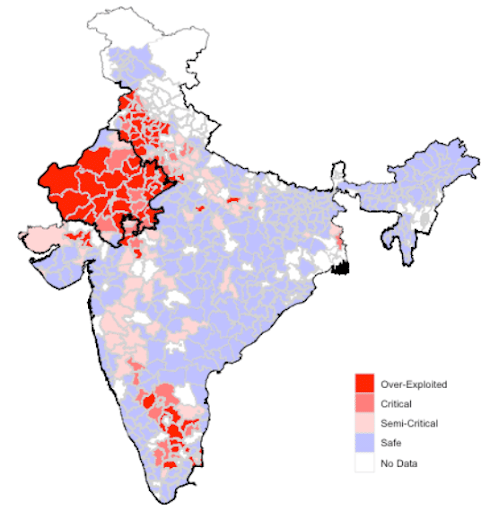
(Groundwater exploitation by district, as classified by the Central Groundwater Board, Government of India in 2020)
Other causes of groundwater depletion in India
- Climate change: Adverse events associated with climate change such as flash floods, droughts, and disrupted monsoon rainfall have severely impacted India’s groundwater reserves.
- Inefficient management: Poor infrastructure like taps and pipelines, and inefficient management of equipment and strategies for water storage have led to a decline in groundwater resources.
- Deforestation: The increase in the rate of deforestation has lowered the rate of natural recharge of groundwater reserves. This has led to soil erosion and affects the ability of the aquifers to retain water.
What are the recommendations of the Report?
- Electricity rationing: Governments must implement policies that regulate the supply of power and electricity usage to impose controls on the extraction of groundwater.
- Regional-level water management: Responsible usage of groundwater can be encouraged by developing and allocating water resources on a regional basis.
- Incentivization: The government must reward farmers who invest in initiatives for groundwater recharge and adopt sustainable practices.
- Technological advancements: The use of efficient irrigation technologies such as drip or sprinkler systems must be popularized to reduce water consumption.
- Crop Diversification: The government should raise awareness about water-intensive crops and encourage their cultivation which will reduce the pressure on groundwater systems in the country.
- Additional Irrigation: Supplemental methods of irrigation such as canal-based irrigation should be introduced and popularized to reduce the dependence on groundwater.
Government initiatives related to groundwater
- Pradhan Mantri Krishi Sinchayee Yojana: It aims to improve water system inclusion through Har Khet ko Pani and productively utilize water through More Crop Per Drop.
- Jal Shakti Abhiyan: It is a time-bound, mission-mode water conservation campaign that was launched to encourage water conservation at the grassroots level via people’s participation.
- Atal Bhujal Yojana: It is a Central Sector scheme of the Ministry of Jal Shakti that aims to tackle water resource depletion, improve groundwater management, and foster behavioral changes to promote conservation and efficient use of water.
- Aquifer Mapping and Management Programme: It is a scheme implemented by the Central Ground Water Board (CGWB) that aims to map aquifers, and develop Aquifer Management Plans to facilitate sustainable management of groundwater resources.
- Atal Mission for Rejuvenation and Urban Transformation (AMRUT): It aims to develop basic urban infrastructure in AMRUT cities, including water supply, sewerage and septage management, stormwater drainage, green spaces and parks, and non-motorized urban transportation.
Conclusion
- Although it is difficult to implement these policies across the millions of households facing groundwater depletion, groundwater depletion rates will continue to accelerate due to climate change if they are not implemented.
- At present, water-saving policies and interventions are focused on northwest India and not south and central India.
- Targeted water-saving policies and interventions in these regions will help farmers continue irrigation and cope with warming before substantial groundwater depletion occurs.
To know more about groundwater depletion in the country click the link.
(*Click this link to read prelims specific weekly current affairs articles)
FAQs
Question: What are aquifers?
Answer:
Aquifers are underground water-bearing permeable rocks or rock formations such as sand, gravel, or silt. This makes it a suitable water absorber. Rainwater enters the aquifer through the soil and then resurfaces from springs and wells.
Question: What is sprinkler and drip irrigation?
Answer:
- Sprinkler irrigation: It is a method of irrigation water that is similar to natural rainfall. It distributes water through a system of pipes and sprays water into the air through sprinklers.
- Drip irrigation: In drip irrigation, tubes with emitters are placed on the ground alongside the plants. Water drips into the soil near the roots of the plant slowly via the emitters.
UPSC Mains Practice Question:
|
MCQs
Question: Consider the following statements.
- According to the United Nations 'World Water Development Report, 2022', India extracts more than a quarter of the world's groundwater withdrawal each year.
- India needs to extract more than a quarter of the world's groundwater each year to satisfy the drinking water and sanitation needs of almost 18% of the world's population living in its territory.
Which of the above statements is/are correct? (UPSC CSE 2023)
(a) Both Statement 1 and Statement 2 are correct and Statement 2 is the correct explanation for Statement 1.
(b) Both Statement 1 and Statement 2 are correct and Statement 2 is not the· correct explanation for Statement 1.
(c) Statement 1 is correct but Statement 2 is incorrect
(d) Statement 1 is incorrect but Statement 2 is correct
Answer: (c) See the Explanation
- According to the United Nations World Water Development Report 2022, India is the world’s greatest user of groundwater in the world.
- India accounts for more than one-fourth of the total groundwater extracted internationally. Hence statement 1 is correct.
- About 89% of the groundwater extracted in India is used for irrigation and not for other activities such as drinking and sanitation purposes. Hence statement 2 is incorrect.
Therefore, option (c) is the correct answer.
Question: What are the benefits of implementing the 'Integrated Watershed Development Programme'? (UPSC CSE 2014)
- Prevention of soil runoff
- Linking the country's perennial rivers with seasonal rivers
- Rainwater harvesting and recharge of groundwater table
- Regeneration of natural vegetation
Select the correct answer using the code given below.
(a) 1 and 2 only
(b) 2, 3, and 4 only
(c) 1, 3 and 4 only
(d) 1, 2, 3 and 4
Answer: (c) See the Explanation
- The Integrated Watershed Management Programme (IWMP) has been implemented by the Ministry of Rural Development.
- It aims to restore the ecological balance by conserving and developing degraded natural resources such as soil, vegetative cover, and water.
- The projected outcomes of the Programme are the prevention of soil runoff, regeneration of natural vegetation, rainwater harvesting, and recharge of ground water table. Hence statements 1, 3, and 4 are correct.
- The Integrated Watershed Development Programme does not aim to link perennial rivers and seasonal rivers in India. Hence statement 2 is incorrect.
Therefore, option (c) is the correct answer.
Download the PREPP App and attempt FREE IAS Exam Mock Tests and get complete study material!

Full Test - 04: UPSC CSE Prelims CSAT (Paper-II)
Full Test - 03: UPSC CSE Prelims CSAT (Paper-II)
UPSC CSE Prelims 2026 GS Paper 1 Question Paper (24-May-2026)
UPSC CSE Prelims 2026 CSAT Paper 2 Question Paper (24-May-2026)

17 February 2025 | The Hindu Must Read Articles | Current Affairs

16 February 2026 | The Hindu Must Read Articles | Current Affairs

13 February 2026 | The Hindu Must Read Articles | Current Affairs









Comments