Centre’s DIKSHA E-Education Platform To Offer AI Help
Relevance: GS2 - Education; E-Governance; Prelims
(Source: The Hindu, 09/04/2023)
Click here for Daily Current Affairs
Why in the news?
- Recently, the National eGovernance Division (NeGD) under the Ministry of Electronics and Information Technology (MeitY) plans to incorporate Personalised Adaptive Learning (PAL) into its existing Digital Infrastructure for Knowledge Sharing (DIKSHA) platform.
- PAL utilizes software-based methods to provide personalized learning experiences to students based on their unique abilities and needs.
Table of Contents

About DIKSHA
- DIKSHA (Digital Infrastructure for Knowledge Sharing) is a national platform for school education, an initiative of National Council for Educational Research and Training (NCERT), under the aegis of the Ministry of Education.
- It was developed based on the core principles of open architecture, open access, open licensing diversity, choice and autonomy as outlined in the Strategy and Approach Paper for the National Teacher Platform released in 2017.
- Under the PM eVidya initiative of the Government of India, which was declared as part of the Atma Nirbhar Bharat, DIKSHA has been declared as ‘One Nation, One Digital Platform’.
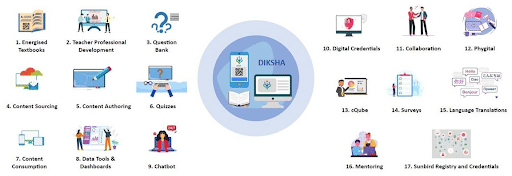
Its Features
- DIKSHA is built on open source technology which incorporates internet scale technologies and enables several use-cases and solutions for teaching and learning.
- It offers a dynamic online platform and mobile application that delivers educational content to schools.
- This platform not only provides a rich repository of e-content but also incorporates assistive technologies tailored to support learners with visual or hearing impairments.
- DIKSHA can be accessed by learners and teachers across the country and currently supports 36 Indian languages.
- DIKSHA is built using MIT licensed open source technology called Sunbird, which is a digital infrastructure for learning and solutions and offers over a 100 micro services as building blocks for the development of platforms and solutions.
- DIKSHA hosts 2.43 lakh contributions by 11,624 academicians by way of teaching videos, explainers, and practice questions.
PAL’s Implementation
- The National Council of Educational Research and Training (NCERT) seeks MeitY's assistance in implementing Personalized Adaptive Learning (PAL) on DIKSHA.
- PAL employs AI to tailor learning experiences.
- Example of how PAL works: If a Class 9 student makes a mistake while learning the Pythagoras theorem, the AI system identifies it and directs the student to a basic video for correction.
- MeitY intends to commence PAL development for the most challenging subjects among Classes 9 to 12, such as Chemistry, Mathematics, and Physics.
- Apart from PAL’s implementation, MeitY is also considering the introduction of voice commands in DIKSHA 2.0 as a part of AI-enabled learning.
- Like ChatGPT, the student can access summaries of chapters by giving voice commands.
Initiatives of the States
- Andhra Pradesh's EdTech Contracts and Initiative: Andhra Pradesh has entered into contracts with three private edtech companies, namely Reliance Jio Platform's startup Embibe, ConveGenius, and Mindspark. The collaboration aims to enhance teacher training in IT applications, provide remedial learning analytics, and improve students' conceptual understanding through technology.
- Project Implementation: The pilot project, known as PAL (Personalized Adaptive Learning), is currently being implemented in 20 schools in Prakasam district, targeting students in Classes 6 to 9.
- Madhya Pradesh is considering introducing PAL for students in Classes 6 to 10 on its flagship State education portal, CM-RISE.
Challenges and Discontinuation
- In Assam, PAL was adopted in 200 schools for Classes 6 to 10, with each school having approximately 200 students. However, the project was discontinued after two years due to a lack of funds.
- In Haryana, the state government halted the adoption of PAL after deeming Embibe's content streaming costs too high. The estimated yearly streaming cost of ₹27 crore was considered excessive.
(*Click this link to read prelims specific weekly current affairs articles)
FAQs
Question: What is DIKSHA?
Answer:
DIKSHA (Digital Infrastructure for Knowledge Sharing) is a national platform for school education, an initiative of National Council for Educational Research and Training (NCERT), under the aegis of the Ministry of Education. It offers a dynamic online platform and mobile application that delivers educational content to schools.
Question: What is NCERT?
Answer:
The National Council of Educational Research and Training (NCERT) is a government organisation that has been set up to assist in the qualitative improvement of school education in India.
Question: What is PAL?
Answer:
Personalized adaptive learning (PAL) is a software platform approach that provides each student with an individualized learning experience by allowing them to progress along their unique learning path through the course content based on their knowledge, skills, and learning needs.
MCQ
Question: Consider the following statements: (UPSC 2022)
- Aarogya Setu
- CoWIN
- DigiLocker
- DIKSHA
Which of the above are built on to open-source digital platforms?
(a) 1 and 2 only
(b) 2, 3 and 4 only
(c) 1, 3 and 4 only
(d) 1, 2, 3 and 4
Answer: (d) See the Explanation
Open-source software (OSS) is computer software that is released under a license in which the copyright holder grants users the rights to use, study, change, and distribute the software and its source code to anyone and for any purpose.
- DIKSHA (Digital Infrastructure for Knowledge Sharing) is a national platform for school education, an initiative of National Council for Education Research and Training (NCERT), Ministry of Education.
- DigiLocker is an initiative by the government to offer Indian citizens a free platform to store and access important documents. The platform uses several open source technologies to deliver a mass solution and contributes back to the ever-growing community.
- CoWIN is an Indian government web portal for COVID-19 vaccination registration, owned and operated by India's Ministry of Health and Family Welfare.
- Aarogya Setu: On 2nd April 2020, India launched Aarogya Setu mobile App for helping augment the efforts of limiting the spread of COVID19, with an objective of enabling Bluetooth based contact tracing, mapping of likely hotspots and dissemination of relevant information about COVID19. It is open source now.
Therefore, option (d) is the correct answer.
Download the PREPP App and attempt FREE IAS Exam Mock Tests and get complete study material!

Full Test - 04: UPSC CSE Prelims CSAT (Paper-II)
Full Test - 03: UPSC CSE Prelims CSAT (Paper-II)
UPSC CSE Prelims 2026 GS Paper 1 Question Paper (24-May-2026)
UPSC CSE Prelims 2026 CSAT Paper 2 Question Paper (24-May-2026)

17 February 2025 | The Hindu Must Read Articles | Current Affairs

16 February 2026 | The Hindu Must Read Articles | Current Affairs

13 February 2026 | The Hindu Must Read Articles | Current Affairs









Comments