Incremental Capital Output Ratio (ICOR) - Indian Economy Notes
The incremental capital-output ratio (ICOR) is a commonly used tool for explaining the relationship between the level of investment made in the economy and the subsequent increase in the Gross Domestic Product (GDP). The additional unit of capital or investment required to produce an additional unit of output is denoted by ICOR. “Incremental Capital Output Ratio (ICOR)” is one of the important concepts in the UPSC/IAS 2023 Economy syllabus which is discussed in this article in detail.
Table of Contents
ICOR as Economic Factor in Economic Growth
- The incremental capital-output ratio (ICOR) describes the relationship between the amount of investment made in the economy and the resulting increase in GDP.
- The marginal amount of investment capital required for a country or other entity to generate the next unit of production is measured by ICOR.
- Lower ICORs are preferred because they indicate that a country's production is more efficient.
- Some critics of ICOR have suggested that its use is limited because it favors developing countries that can increase infrastructure and technology use over developed countries that are operating at the highest level possible.
- Any further advancements in a developed country would have to come from more expensive research and development (R&D), whereas a developing country can improve its situation by implementing existing technology.
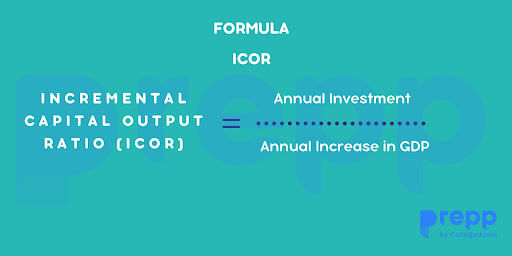
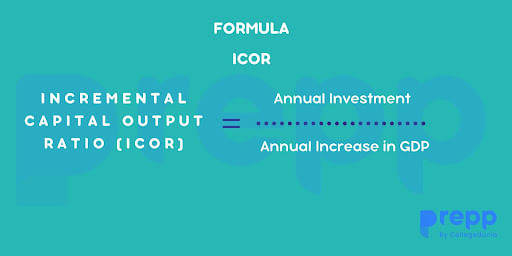
- ICOR can be calculated as follows:
- ICOR = Annual Investment / Annual Increase in GDP
- Example: Assume that Country X has an incremental capital-output ratio (ICOR) of 10. This means that a ₹10 capital investment is required to generate a ₹1 increase in output. Furthermore, if Country X's ICOR was 12 last year, it means that Country X has become more efficient in its capital use.
| Other Relevant Links | |
|---|---|
| Savings | Investment |
| Capital Formation | Population Growth |
| Natural Resources | Technological Progress |
| Entrepreneurship | Human Resources Development |
Incremental Capital Output Ratio (ICOR) - Example

Incremental Capital Output Ratio (ICOR) - Benefits
- Investment Efficiency: ICOR offers information on how effectively investments are made in a given economy. A lower ICOR indicates greater capital usage productivity and efficiency because less capital is needed to produce the same amount of increased output.
- Economic Growth Analysis: ICOR is frequently used to examine how investment and economic growth are related. Policymakers and economists can evaluate the efficiency of investment strategies and policies in promoting economic expansion by looking at how changes in investment levels affect production.
- Resource Allocation: ICOR assists investors and politicians in making knowledgeable choices about resource allocation. They can determine regions where investment is more efficient by comparing ICORs across various projects or industries, and they can then allocate resources in those areas to maximise output and growth.
- Planning and Development: It helps decision-makers determine the amount of money needed to invest in order to reach particular growth targets and enables the evaluation of the viability and sustainability of such programmes.
- Infrastructure Development: It aids in evaluating the effectiveness of infrastructure development investments and enables policymakers to give priority to initiatives with lower ICORs, resulting in a more efficient use of funds and better infrastructure outcomes.
- Comparative Analysis: ICOR enables comparisons between various nations or regions. Policymakers and economists can evaluate the relative effectiveness of investment across economies and pinpoint best practises or areas for development by comparing ICORs.
- Policy Evaluation: ICOR enables comparisons between various nations or regions. Policymakers and economists can evaluate the relative effectiveness of investment across economies and pinpoint best practises or areas for development by comparing ICORs.
- Productivity and Competitiveness: ICOR assesses both productivity and competitiveness in an indirect manner. Higher productivity is implied by a lower ICOR since it shows that more output is being produced for a given level of investment. This in turn could improve an economy's ability to compete on the world market.
Incremental Capital Output Ratio (ICOR) - Limitations
- One of its main criticisms is its inability to adapt to the new economy, which is increasingly driven by intangible assets such as design, branding, research and development (R&D), and software, which are difficult to measure or record.
- Intangible assets, such as machinery, buildings, and computers, are more difficult to account for in investment levels and GDP.
- On-demand options, such as software-as-a-service (SaaS), have significantly reduced the need for fixed-asset investments.
- All of this adds up to businesses increasing their output with items that are now expensed rather than capitalised, and thus considered an investment.
Conclusion
From the above example, we can see that there are factors other than savings and investment rates that could explain the slowing rate of growth in the Indian economy. Otherwise, the economy is becoming more inefficient.
FAQs
Question: What does Incremental Capital Output Ratio (ICOR) measure?
Answer: ICOR measures the amount of additional capital required to produce an additional unit of output. It reflects the efficiency of capital utilization in an economy.
Question: How is ICOR calculated?
Answer: ICOR is calculated using the formula: ICOR = ΔK / ΔY, where ΔK represents the change in capital investment and ΔY represents the change in output or GDP.
Question: What does a high ICOR indicate about an economy?
Answer: A high ICOR suggests that more capital is needed to produce additional output, indicating inefficiencies in capital utilization. Conversely, a low ICOR reflects more efficient use of capital.
Question: Why is ICOR important for economic growth?
Answer: ICOR is important because it helps policymakers determine how much capital investment is needed to achieve a specific growth rate and assess the overall efficiency of investment in the economy.
Question: How can a country reduce its ICOR?
Answer: A country can reduce its ICOR by improving technology, enhancing the quality of labor, developing infrastructure, and implementing economic policies that promote efficient use of capital.
MCQs
1. What does a low ICOR indicate in an economy?
A. Low efficiency of capital utilization
B. High inefficiency of capital utilization
C. High efficiency of capital utilization
D. No relation to capital efficiency
Answer: (C) See the Explanation
A low ICOR means that the economy uses its capital more efficiently to generate output, requiring less capital for additional production.
2. If the ICOR is 4, what does it imply about capital requirements for growth?
A. 4 units of capital produce 1 unit of output
B. 1 unit of capital produces 4 units of output
C. 1 unit of output requires 4 units of capital
D. Capital and output are unrelated
Answer: (C) See the Explanation
An ICOR of 4 implies that 4 units of capital are required to produce 1 unit of output.
3. Which of the following factors can reduce a country’s ICOR?
A. Poor infrastructure
B. Technological advancements
C. Political instability
D. Declining labor productivity
Answer: (B) See the Explanation
Technological advancements can improve capital productivity, leading to a reduction in ICOR.
4. ICOR is primarily used in the context of:
A. Measuring inflation
B. Measuring investment efficiency
C. Measuring labor productivity
D. Calculating GDP growth
Answer: (B) See the Explanation
ICOR is used to measure investment efficiency, indicating how much capital is required to generate additional output in an economy.
5. A country’s ICOR can be improved by which of the following strategies?
A. Decreasing investment in education
B. Increasing reliance on imports
C. Improving infrastructure
D. Increasing dependence on foreign aid
Answer: (C) See the Explanation
Improving infrastructure allows better utilization of capital, leading to a more efficient economy and a lower ICOR.
GS Mains Questions and Model Answers
1. Explain the concept of Incremental Capital Output Ratio (ICOR) and its relevance in assessing the investment efficiency of a developing economy like India.
Answer: The Incremental Capital Output Ratio (ICOR) is a key economic metric used to assess the efficiency of capital investments in generating output. It is calculated as the ratio of the increase in capital investment to the increase in output. In a developing economy like India, ICOR plays a significant role in determining how effectively capital is being utilized to drive economic growth. A lower ICOR indicates efficient use of capital, while a higher ICOR points to inefficiencies. Factors such as underdeveloped infrastructure, low labor productivity, and outdated technology can increase ICOR. Conversely, investment in technology, skill development, and infrastructure can lower ICOR, leading to more rapid economic growth. ICOR helps policymakers plan investments and prioritize sectors where capital can be used more efficiently.
2. Discuss the challenges faced by India in reducing its Incremental Capital Output Ratio (ICOR) and the steps that can be taken to improve capital efficiency.
Answer: India faces several challenges in reducing its ICOR, including inadequate infrastructure, low levels of technological adoption, and bureaucratic inefficiencies. High ICOR in certain sectors, such as agriculture and manufacturing, indicates that significant capital is needed to achieve modest output growth. Furthermore, poor labor productivity and delays in project implementation contribute to inefficiencies in capital use. To reduce ICOR, India needs to invest heavily in infrastructure development, particularly in transportation, energy, and digital infrastructure. Technological advancements in automation and innovation can improve productivity, while skill development programs can enhance labor efficiency. Additionally, improving the ease of doing business and reforming bureaucratic processes will help ensure that capital is utilized more effectively.
3. Analyze the impact of technological advancements and infrastructure development on reducing the ICOR in emerging economies.
Answer: Technological advancements and infrastructure development are crucial factors that can significantly reduce the Incremental Capital Output Ratio (ICOR) in emerging economies. Technology increases the productivity of capital by enabling more output from the same level of investment. For example, the introduction of automation and artificial intelligence in manufacturing processes can improve efficiency and reduce the capital required for production. Infrastructure development, particularly in transportation, energy, and communication, enhances the ability of businesses to operate more efficiently. Well-developed infrastructure reduces operational costs, enhances connectivity, and boosts productivity, all of which contribute to lowering ICOR. Emerging economies that invest in technology and infrastructure are better positioned to achieve higher growth rates with less capital investment, leading to sustainable development.
Previous Year Questions on ICOR
1. UPSC CSE Prelims 2020
Question: Which of the following best describes the Incremental Capital Output Ratio (ICOR)?
A. It measures the efficiency of capital used to generate additional output.
B. It measures the output generated by a given amount of labor.
C. It calculates the inflation rate in an economy.
D. It is used to determine the balance of payments.
Answer: A
Explanation: The Incremental Capital Output Ratio (ICOR) measures how efficiently capital is used to generate additional output in an economy.
2. UPSC CSE Mains 2017 (GS Paper 3)
Question: Explain how the Incremental Capital Output Ratio (ICOR) influences economic growth in developing countries like India. Discuss the factors that affect ICOR and the challenges in reducing it.
Answer: The Incremental Capital Output Ratio (ICOR) directly influences economic growth by determining how much capital is needed to generate additional output. In developing countries like India, a high ICOR indicates inefficiencies, meaning more capital is required to achieve the same level of output. Factors such as poor infrastructure, low labor productivity, and bureaucratic delays contribute to a high ICOR. Reducing ICOR requires investment in infrastructure, technology, and education to improve productivity. However, challenges such as lack of resources, political instability, and regulatory hurdles make it difficult to reduce ICOR in developing economies.
Download the PREPP App and attempt FREE IAS Exam Mock Tests and get complete study material!

Full Test - 04: UPSC CSE Prelims CSAT (Paper-II)
Full Test - 03: UPSC CSE Prelims CSAT (Paper-II)
UPSC CSE Prelims 2026 GS Paper 1 Question Paper (24-May-2026)
UPSC CSE Prelims 2026 CSAT Paper 2 Question Paper (24-May-2026)

17 February 2025 | The Hindu Must Read Articles | Current Affairs

16 February 2026 | The Hindu Must Read Articles | Current Affairs

13 February 2026 | The Hindu Must Read Articles | Current Affairs









Comments