Population Growth – Indian Economy Notes
Population Growth is the increase in the number of people on Earth. The actual annual increase in the human population is about 83 million, or 1.1%. Population growth is an important factor in overall economic growth and, in some cases, may even contribute to higher per capita output growth. “Population Growth” is one of the important concepts in the UPSC/IAS 2023 Economy syllabus which is discussed in this article in detail.
| To Read update on this topic: |
|
Table of Contents |
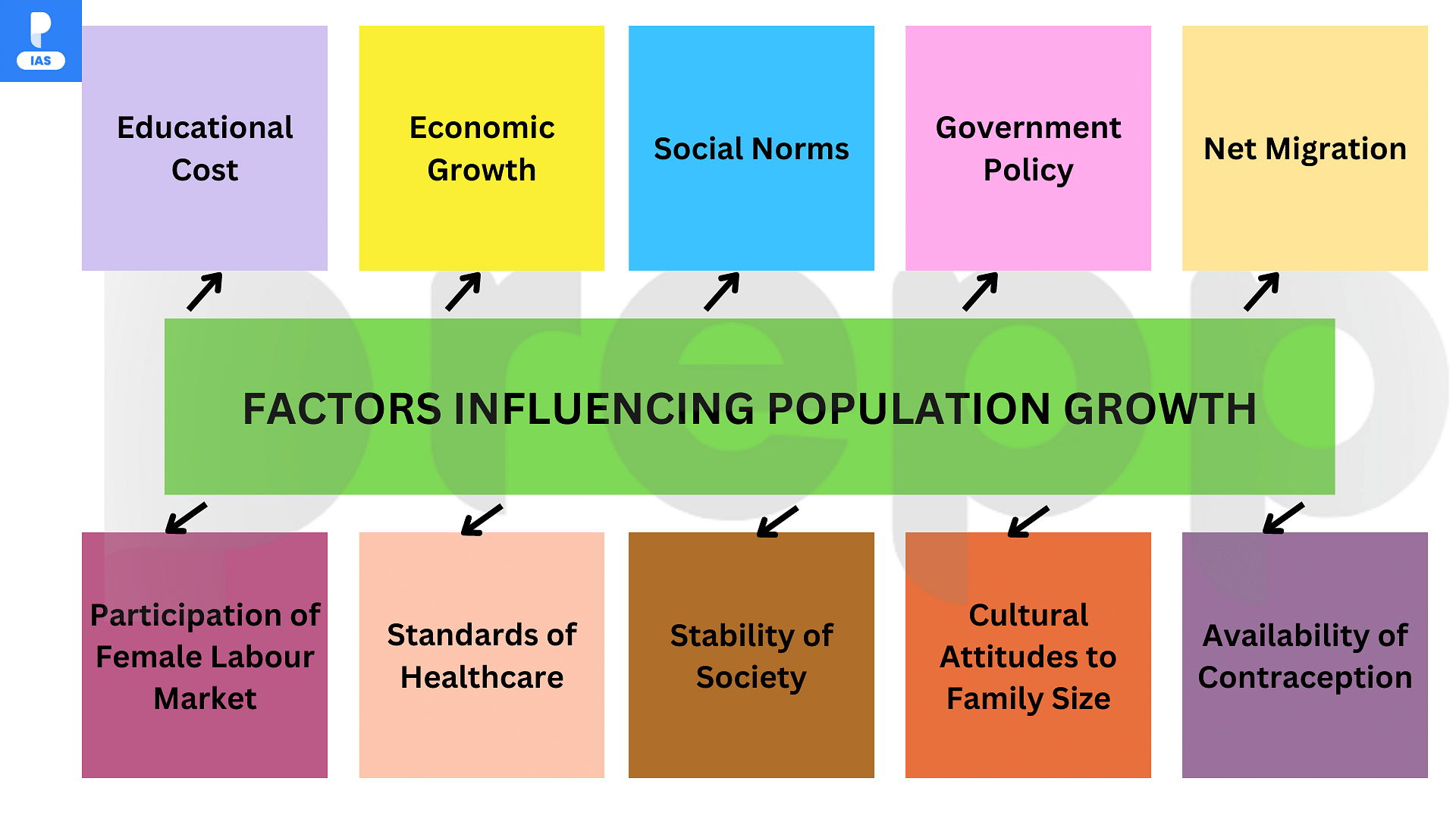
Factors Influencing Population Growth
What is Population Growth?
- Population growth is the increment in the size of a population or a dispersed group.
- The availability and dependability of energy, food, water, and medical care increased with invention and industrialisation.
- As a result, the human population has rapidly expanded and is still growing, having a significant impact on the planet's ecosystems and climate.
- Rapid population growth in low-income countries is likely to be detrimental in the short and medium term because it results in a large number of dependent children.
- Population is a labour force resource. The labour force will grow in proportion to the size of the population.
- Labour alone is incapable of producing anything. A labour force is a productive asset for a country if other resources required for production are also available in sufficient quantity.
- If other resources are in short supply, a large labour force may become an impediment to faster economic growth.
Population Growth as Economic Factor in Economic Growth
- The increase in labor supply is a result of population growth, which creates a larger market for goods and services. As a result, more labour produces more output, which a larger market absorbs.
- Output, income, and employment continue to rise as a result of this process, and economic growth improves.
- However, population growth should be expected to be normal. A galloping rise will stifle the economic progress.
- Only in a sparsely populated country is population growth desirable. It is, however, unjustified in a densely populated country like India.
|
|
|
|---|---|
| Natural Resources | Capital Formation |
| Technological Progress | Savings |
| Human Resources Development | Investment |
Measures Taken to Ensure Economic Growth
- An increasing population means a greater number of working people who can participate actively in the process of economic growth and development. Population growth leads to an increase in total output.
- A growing population means a larger market for most goods and services, and we all know that the size of the market limits the division of labor.
- Higher population growth rates would clearly lead to higher economic growth rates if population growth and per capita GDP growth were completely independent.
- On the other hand, if population growth affects per capita output growth, then the higher population growth rates will contribute to either higher or lower overall economic growth, depending on the nature of its effects on per capita GDP.
- Although the world's population is larger than ever, a large proportion of humanity's standard of living is also much higher than at any time in recorded human history.
- Similarly, looking ahead, the potential for economic growth appears to be far greater than the potential for population growth.
- For example, new strains of wheat, rice, and other foods, for example, have been discovered that have the potential to increase yields by two to five times in a short period of time.
- In comparison, the world population would only double in about 35 years.
- Of course, utilizing this potential would necessitate significant social changes, but the potential exists and is enormous.
Recent News Related to Population
- Awareness On Population Control: Recently, a private members' bill to restrict India's population was introduced in the Lok Sabha by two Bharatiya Janata Party lawmakers, Ravi Kishan and Nishikant Dubey.
- The Bill makes the case that population growth is the main factor slowing India's rate of progress and that population control is urgently required.
*To know more about the topic, click this link India Must Build Awareness On Population Control
- India to Cross China’s Population in the Coming Year: Manish Sabharwal and Ashish Dhawan, co-founders of Ashoka University discussed the strategy going forward as India’s population is on track to exceed China’s in the next year via an article published in Indian Express.
- They argue that for long-term gains, human capital, and formal jobs should be focussed on rather than fiscal or monetary policy exercises.
*To know more about the topic, click this link With India Crossing China’s Population Next Year, How We Can Create Mass Prosperity
- Depopulation: China’s population has begun to decline, while India’s population is expected to grow for another 40 years.
- According to current United Nations estimates, India’s population will begin to decline only in 2063, by which time it will be just shy of 1.7 billion.
- The world’s population is expected to grow until 2086.
*To know more about the topic, click this link It’s Time To Discuss Depopulation
Conclusion
There exists a conflicting role between population growth and economic development. It has the potential to be both a stimulant and an impediment to growth and development. Such opposing roles imply that the relationship between population and economic development is intricate, complex, and fascinating.
FAQs
Question: What factors contribute to population growth in India?
Answer: Population growth in India is influenced by factors such as high birth rates, declining mortality rates due to advancements in healthcare, lack of education on family planning, and socio-economic factors like poverty, which often leads to larger family sizes.
Question: How does population growth impact the Indian economy?
Answer: Population growth places pressure on resources, infrastructure, and services. It can hinder economic development by increasing demand for jobs, housing, and healthcare. However, if managed properly, it can also create a large workforce that contributes to economic growth.
Question: What is the current population growth rate in India?
Answer: As of the latest data, India’s population growth rate has been gradually declining but remains significant. Efforts to further reduce the rate include increased access to family planning, education, and healthcare improvements.
Question: What are some government initiatives to control population growth in India?
Answer: Initiatives include the National Population Policy, awareness campaigns promoting family planning, and programs aimed at improving women’s health and education, as well as incentives for small family norms.
Question: How does population density vary across India?
Answer: Population density varies significantly across India, with states like Bihar and West Bengal having high densities, while states like Arunachal Pradesh and Sikkim have much lower densities. This variation affects resource distribution and development across regions.
MCQs
1. Which of the following factors does NOT directly contribute to population growth?
A) High birth rates
B) Improved healthcare
C) Environmental pollution
D) Lack of family planning
Answer: (C) See the Explanation
Explanation: Environmental pollution does not directly contribute to population growth, though it may affect health. High birth rates, improved healthcare, and lack of family planning directly contribute to population increase.
2. What is a significant challenge posed by rapid population growth in India?
A) Increased job opportunities
B) Pressure on natural resources
C) Lower birth rates
D) Decreased urbanization
Answer: (B) See the Explanation
Explanation: Rapid population growth creates substantial pressure on natural resources, leading to scarcity and environmental degradation, which poses challenges for sustainable development in India.
3. Which policy initiative primarily addresses population control in India?
A) National Urban Policy
B) National Population Policy
C) Skill India Initiative
D) Make in India
Answer: (B) See the Explanation
Explanation: The National Population Policy is specifically aimed at controlling and stabilizing India’s population growth through measures such as family planning, healthcare, and awareness campaigns.
4. Which Indian state has the highest population density as per recent data?
A) Uttar Pradesh
B) Maharashtra
C) Bihar
D) Kerala
Answer: (C) See the Explanation
Explanation: Bihar has the highest population density in India, making resource management and service delivery a significant challenge in the state.
5. Which age group contributes most significantly to India’s demographic dividend?
A) 0-14 years
B) 15-24 years
C) 25-59 years
D) 60+ years
Answer: (C) See the Explanation
Explanation: The age group of 25-59 years contributes most to India’s demographic dividend, offering a productive workforce that can drive economic growth if appropriately harnessed.
GS Mains Questions and Model Answers
Q1: Discuss the implications of rapid population growth on India’s economic development. How can policy interventions address these issues?
Answer: Rapid population growth in India has profound implications for economic development, including increased demand for jobs, housing, and healthcare. It can lead to resource depletion, environmental degradation, and hindered quality of life if not managed. Policy interventions like family planning programs, education on reproductive health, and incentives for smaller families are crucial. Government schemes like the National Population Policy focus on stabilizing population growth, improving health, and raising awareness about family planning, which collectively contribute to sustainable economic growth.
Q2: Analyze the demographic dividend in India. What strategies can help maximize its benefits?
Answer: India’s demographic dividend refers to the economic advantage arising from a youthful population with a higher working-age ratio. To harness this, India needs strategies focusing on skill development, education, and employment generation. Initiatives like Skill India and increased investment in education can enhance workforce capabilities. Furthermore, promoting entrepreneurship and creating job opportunities in sectors like technology and manufacturing will maximize the demographic dividend’s economic impact, fostering sustainable growth.
Q3: Evaluate the role of education in controlling population growth in India. Discuss how it contributes to better population management.
Answer: Education plays a crucial role in controlling population growth as it promotes awareness about family planning, reproductive health, and the benefits of smaller families. Educated individuals are more likely to make informed decisions about family size, health, and resource management. Women's education, in particular, has a strong impact on reducing birth rates. Government initiatives that enhance access to education, especially in rural areas, contribute significantly to population management and economic stability by fostering a more informed and aware population.
Previous Year Questions on Population Growth
1. UPSC CSE Prelims 2019:
Question: Which of the following policies is primarily aimed at controlling population growth in India?
A) National Health Policy
B) National Education Policy
C) National Population Policy
D) National Urban Policy
Answer: (C)
Explanation: The National Population Policy specifically targets the stabilization of population growth in India through measures related to family planning, reproductive health, and awareness programs.
2. UPSC CSE Mains 2021 (GS Paper 2):
Question: "Examine the challenges of population growth in India and suggest solutions to achieve population stabilization."
Answer: Population growth in India poses challenges including strain on resources, environmental degradation, and increased demand for infrastructure and services. To achieve population stabilization, solutions include robust family planning initiatives, widespread reproductive health education, and economic incentives for smaller families. Government policies should focus on enhancing access to healthcare and education, especially for women, which can reduce birth rates and promote sustainable population levels. By integrating these measures with socio-economic policies, India can address the challenges of population growth effectively.
Download the PREPP App and attempt FREE IAS Exam Mock Tests and get complete study material!

Full Test - 04: UPSC CSE Prelims CSAT (Paper-II)
Full Test - 03: UPSC CSE Prelims CSAT (Paper-II)
UPSC CSE Prelims 2026 GS Paper 1 Question Paper (24-May-2026)
UPSC CSE Prelims 2026 CSAT Paper 2 Question Paper (24-May-2026)

17 February 2025 | The Hindu Must Read Articles | Current Affairs

16 February 2026 | The Hindu Must Read Articles | Current Affairs

13 February 2026 | The Hindu Must Read Articles | Current Affairs









Comments