Capital Formation – Indian Economy Notes
Capital formation means the net accumulation of capital goods of a country over an accounting period. The capital goods include equipment, tools, transportation assets, and electricity. Countries require capital goods to replace older ones used in the production of goods and services. Production falls if a country is unable to replace capital goods as they reach the end of their useful lives. In general, the higher an economy's capital formation, the faster it can grow its aggregate income. “Capital Formation ” is one of the important concepts in the UPSC/IAS 2023 Economy syllabus which is discussed in this article in detail.
|
Table of Contents |

Capital Formation as Economic Factor in Economic Growth
- Capital formation is the process by which a community's savings are channeled into investments in capital goods such as plant, equipment, and machinery.
- Capital Formation increases a country's productive capacity and worker efficiency by ensuring a greater flow of goods and services in a country.
- The process of capital formation implies that a community does not spend its entire income on goods for current consumption, but rather saves a portion of it and uses it to produce or acquire capital goods that significantly increase the nation's productive capacity.
- More goods and services produced can lead to an increase in national income levels.
- A country must generate savings and investments from household savings or from government policy in order to accumulate additional capital.
- Countries with high household savings rates can accumulate funds to produce capital goods more quickly, and a government that runs a surplus can invest the surplus.
- Capital formation refers not only to the creation of physical goods but also to the creation of human capital such as education, health, skill development, etc.
| Other Relevant Links | |
|---|---|
| Savings | Investment |
| Incremental Capital Output Ratio | Population Growth |
| Natural Resources | Technological Progress |
| Entrepreneurship | Human Resources Development |
Components of Capital Formation
There are two components of capital accumulation:
- Gross Capital Formation (GCF): It refers to an economy's total investment, which includes net and replacement investments. Therefore, capital accumulation is calculated before depreciation costs are subtracted.
- Net Capital Formation (NCF): It is only the growth of net investment, which is calculated by deducting depreciation value from the gross investment. Investments are often referred to as gross fixed capital formation (GFCF).
Process of Capital Formation
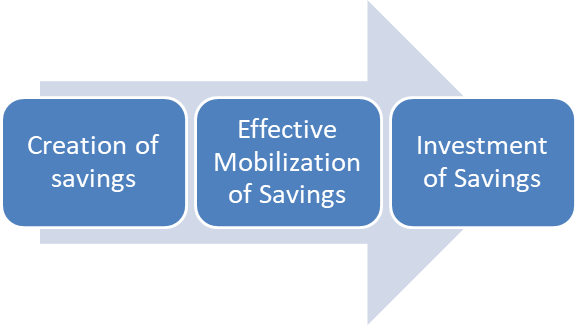
The process of capital formation occurs in three stages, which are:
- Creation of Savings - It is savings that are converted into capital. Individuals generate savings by deferring their current consumption by reducing their expenditures on consumer goods.
- Effective Mobilization of Savings - It is not enough to simply have more savings. Capital formation cannot occur unless people's savings are actually used (i.e., invested) to produce capital goods.
- However, in order to achieve this goal, the savings of various households and individuals must be effectively mobilized and made available for investment to businessmen and entrepreneurs.
- Investment of Savings - People's savings must be properly invested in order for a large number of honest and risk-taking entrepreneurs to produce capital goods in various productive systems such as agriculture, industry, trade, public works, transportation, communication, and improved technological know-how.
Measures Taken to Ensure Economic Growth
- Capital formation increases the availability of capital per worker, which raises the capital/labor ratio even further. As a result, labour productivity rises, leading to an increase in output and economic growth.
- One fundamental aspect that must be kept in mind, is that in order to accumulate capital goods (capital formation), a portion of current consumption must be sacrificed.
- Savings are created by deferring a portion of current consumption, which is then invested to increase capital goods. As a result, both savings and investments are required for capital formation.
- Individuals' ability to save is directly related to their income and the government's taxation policy. Higher-income combined with low taxation results in a higher rate of capital formation.
- A public sector enterprise is an essential type of business organization. Since these are owned by the government rather than individuals, all profits can be used for capital formation by the government.
- When people are given more opportunities to mobilize their savings, they save and invest more.
- Commercial banks, mutual funds, and other financial institutions encourage people to save more. Saving more leads to more capital formation.
- The government may stimulate capital formation by assisting potential investors in a variety of ways.
- For example, by conducting techno-economic surveys of various lines of production, providing tax benefits to newly established production units, or granting income tax benefits to people who wish to save.
- Commodity taxation can also be used to boost the rate of savings.
- If items of consumption, particularly items of luxury consumption, are subjected to high rates of sales tax, the prices of the consumption goods will rise and as a result, the consumption in the country will be reduced.
- Savings will naturally increase if income remains constant.
- Capital formation boosts investment, which has the following two effects on economic development:
- It raises per capita income and purchasing power, which leads to more effective demand.
- Investment leads to increased output. As a result of capital formation, economic activities in developing countries can be expanded, thereby assisting in the abolition of poverty and the attainment of economic development.
- Another important economic function of capital formation is the creation of job opportunities in the country. Employment is created in two stages:
- First, when capital is produced, some workers must be employed to produce capital such as machinery, factories, dams, irrigation works, and so on.
- Second, more men must be employed when capital is used to produce additional goods.
Importance of Capital Formation
- In general, capital formation increases the amount of money moving around the economy.
- Investment and the creation of more goods and services resulting from the accumulation of capital goods. This in turn increases the population's income and increases demand.
- Capital formation or accumulation is considered a primary driver of an economy's economic growth.
- Prof. Nurkse claims that through capital production, the cycle of poverty in less developed nations may be readily broken.
- Capital formation quickens the speed of development by making better use of the resources already at hand.
- As a matter of fact, it leads to an increase in the size of national employment, income, and output thereby the grave problems of inflation and balance of payment.
Conclusion
It should, however, be noted, that capital formation does not refer to an increase in monetary capital, but rather to an increase in physical capital, such as machinery, factories, transportation equipment, bridges, power projects, dams, irrigation systems, and so on. To summarise, capital formation entails the creation of physical assets.
FAQs
Q1: What is capital formation?
Answer: Capital formation refers to the process of building up the capital stock of a country through investing in productive plants and equipment. It is crucial for economic growth and development.
Q2: Why is capital formation important for the Indian economy?
Answer: Capital formation is essential for increasing the productive capacity of the economy, leading to higher output, employment generation, and overall economic growth.
Q3: What are the main sources of capital formation in India?
Answer: The primary sources of capital formation in India include domestic savings, foreign direct investment (FDI), and government investments in infrastructure and public services.
Q4: How does capital formation affect employment levels in India?
Answer: Increased capital formation leads to the establishment of new industries and expansion of existing ones, resulting in job creation and higher employment levels in the economy.
Q5: What role does the government play in capital formation?
Answer: The government facilitates capital formation by investing in infrastructure, providing incentives for private investments, and implementing policies that promote savings and investment.
MCQs
- What does capital formation primarily contribute to?
a) Inflation control
b) Economic growth
c) Reducing unemployment
d) Government revenue
Answer: (B) See the Explanation
- Which of the following is NOT a source of capital formation?
a) Domestic savings
b) Foreign Direct Investment (FDI)
c) Government expenditure
d) Consumer spending
Answer: (D) See the Explanation
- How can capital formation impact productivity?
a) It decreases productivity due to overcapacity.
b) It has no impact on productivity.
c) It increases productivity by enhancing resources and technology.
d) It leads to lower productivity through excess labor.
Answer: (C) See the Explanation
- Which sector is most affected by capital formation?
a) Agricultural sector
b) Industrial sector
c) Services sector
d) All sectors equally
Answer: (B) See the Explanation
- What is a major challenge to capital formation in India?
a) Excess savings
b) Low interest rates
c) Poor infrastructure and savings rate
d) High levels of foreign investment
Answer: (C) See the Explanation
GS Mains Questions and Model Answers
Q1. Discuss the significance of capital formation in economic development.
Answer: Capital formation plays a vital role in economic development as it enhances the productive capacity of a nation. By investing in infrastructure, machinery, and technology, capital formation leads to increased output and efficiency across various sectors. In the context of India, capital formation is essential for achieving sustainable economic growth, reducing poverty, and improving living standards. Moreover, it creates employment opportunities, fostering a positive cycle of income generation and consumption. A robust capital formation process supports innovation and technological advancement, further driving economic progress. Overall, it lays the groundwork for long-term economic stability and growth.
Q2. Analyze the impact of government policies on capital formation in India.
Answer: Government policies significantly influence capital formation in India by creating a conducive environment for investment. Policies promoting infrastructure development, such as highways, railways, and power supply, directly enhance capital formation by facilitating industrial growth. Additionally, fiscal policies, including tax incentives for savings and investments, encourage private sector participation. The government's focus on attracting foreign direct investment (FDI) through liberalization and deregulation has also led to increased capital inflows, bolstering domestic capital formation. However, challenges such as bureaucratic hurdles, regulatory constraints, and inadequate infrastructure remain obstacles to effective capital formation. Therefore, continued policy reforms are crucial for enhancing capital formation and driving sustainable economic growth.
Q3. Evaluate the role of savings in capital formation.
Answer: Savings are a fundamental component of capital formation as they provide the necessary funds for investment. Higher savings rates enable individuals and businesses to allocate resources toward productive investments, such as purchasing machinery, constructing buildings, or expanding operations. In India, a higher rate of domestic savings is crucial for funding infrastructure projects and supporting economic development without relying excessively on foreign capital. Additionally, promoting savings among the population can lead to increased financial stability and resilience. However, low savings rates can hinder capital formation, making it imperative for policymakers to encourage savings through financial literacy programs and favorable interest rates. By enhancing the savings culture, India can strengthen its capital formation process and ensure sustainable economic growth.
Previous Year Questions on Capital Formation
1. UPSC CSE 2022
Question: Discuss the relationship between savings and capital formation in the Indian economy.
Answer: The relationship between savings and capital formation in the Indian economy is crucial, as savings provide the necessary funds for investments that constitute capital formation. A higher savings rate leads to an increase in the pool of capital available for investment in productive activities. In India, low domestic savings historically limited capital formation, making it challenging to finance large-scale infrastructure projects and industrial growth. The government has implemented various policies, such as tax incentives and financial inclusion initiatives, to encourage savings. These measures aim to boost the savings rate, thereby facilitating increased capital formation and promoting sustainable economic growth. Moreover, effective capital formation leads to job creation and improves overall living standards, establishing a direct link between savings and the nation’s economic development.
2. UPSC CSE 2021
Question: Analyze the challenges of capital formation in the Indian economy and suggest measures to overcome them.
Answer: Capital formation in the Indian economy faces several challenges, including low domestic savings rates, inadequate infrastructure, and bureaucratic hurdles. Low savings limit the available funds for investment, while poor infrastructure hampers industrial growth. Additionally, regulatory complexities often deter both domestic and foreign investments. To overcome these challenges, the government must implement comprehensive reforms that promote a savings culture through financial education and incentives. Investing in infrastructure development is crucial to facilitating industrial growth and attracting investments. Simplifying regulatory processes can enhance the business environment and encourage entrepreneurship. Moreover, fostering public-private partnerships can leverage private capital for public projects. Addressing these challenges will enable India to strengthen its capital formation process and achieve sustained economic growth
*email: contactus@prepp.in
Download the PREPP App and attempt FREE IAS Exam Mock Tests and get complete study material!

Full Test - 04: UPSC CSE Prelims CSAT (Paper-II)
Full Test - 03: UPSC CSE Prelims CSAT (Paper-II)
UPSC CSE Prelims 2026 GS Paper 1 Question Paper (24-May-2026)
UPSC CSE Prelims 2026 CSAT Paper 2 Question Paper (24-May-2026)

17 February 2025 | The Hindu Must Read Articles | Current Affairs

16 February 2026 | The Hindu Must Read Articles | Current Affairs

13 February 2026 | The Hindu Must Read Articles | Current Affairs









Comments