How Invasive Species Are Costing Global Economy Billions Annually
Relevance: Prelims- Environment
(Source: Indian Express, 09/05/2023)
Click here for Daily Current Affairs
Why in the news?
- Invasive species are causing unprecedented disruption to ecosystems, outpacing human efforts to halt their proliferation.
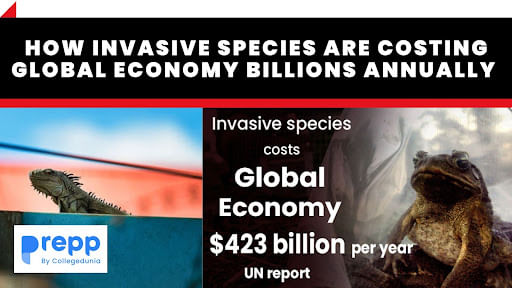
- A United Nations Intergovernmental Science-Policy Platform on Biodiversity and Ecosystem Services (IPBES) report reveals that these invasive species are inflicting an annual economic toll exceeding $400 billion on the global economy.
Table of Contents
Findings of the Report
- Number of Alien Species: There are approximately 37,000 alien species, including plants and animals, introduced to various regions and biomes around the world through human activities. Among these, more than 3,500 are invasive alien species.
- Global Extinctions: Invasive alien species have played a significant role in 60% of global plant and animal extinctions recorded. They are identified as one of the five major direct drivers of biodiversity loss, alongside land and sea use change, direct exploitation of organisms, climate change, and pollution.
- Global Impact: The annual costs associated with invasive alien species have quadrupled every decade since 1970 due to increased global trade, human travel, and economic expansion. In 2019, the global economic cost of invasive alien species exceeded $423 billion annually.
- Negative Impacts: Nearly 80% of the documented impacts of invasive species on nature's contribution to people are negative. Invasive alien species can have detrimental effects on ecosystems, native species, and human livelihoods.
- Modes of Introduction: Many invasive alien species have been intentionally introduced for perceived benefits, such as forestry, agriculture, horticulture, aquaculture, or as pets, without consideration of their negative impacts.
- Common Impacts: The most common impact of alien invasive species is the reduction of food supply, affecting local fisheries and agriculture. Invasive species can also spread diseases and disrupt ecosystems.
- Geographic Distribution: Invasive alien species are reported from various regions, with 34% of impacts in the Americas, 31% in Europe and Central Asia, 25% in Asia and the Pacific, and about 7% in Africa. Islands are particularly vulnerable, with over 25% of islands now having more alien plants than native plants.
- Climate Change: Climate change may facilitate the expansion of invasive species by increasing their competitive ability and expanding suitable habitats. Invasive species can also exacerbate the impacts of climate change, particularly through promoting more intense fires.
What are Invasive Species?
- Invasive species are non-native organisms such as animals, plants, fungi, and microorganisms that grow and spread quickly, endangering native organisms, ecosystems, and human health.
- Invasive species once established, they can disrupt the balance of the ecosystem, leading to negative consequences such as the displacement of native species, harm to infrastructure, and potential risks to both human well-being and livelihoods.
- They can manifest as destructive crop or forest pests, for example, destroying native plants and animals.
- Invasive mosquitos can spread diseases such as dengue fever, malaria, Zika, and West Nile, endangering human health.
- Examples of the havoc caused by invasive species include wildfires in Hawaii fueled by invasive grasses, invasive mosquitoes spreading diseases like dengue and Zika, and the depletion of fishing grounds due to water hyacinths.
How is the Global Response?
- Most countries (80%) have included targets related to managing invasive alien species in their national biodiversity plans.
- However, only 17% specifically address the issue in national legislation, while more (69%) include it as a part of legislation in other areas.
- Alarmingly, nearly half of all countries (45%) do not invest in the management of biological invasions.
Preventive Measures and Global Commitment
- Border biosecurity measures and import controls can significantly reduce the introduction of these harmful species.
- Governments worldwide pledged to reduce the introduction of priority invasive species by 50% by 2030 as part of the Kunming-Montreal Global Biodiversity Framework.
(*Click this link to read prelims specific weekly current affairs articles)
FAQs
Question: What is IPBES?
Answer:
IPBES is an independent intergovernmental body established to strengthen the science-policy interface for biodiversity and ecosystem services, working in a similar way to the IPCC, which is the UN’s climate science body.
Question: What are Invasive Species?
Answer:
Invasive species refer to organisms, whether plants or animals, that have been inadvertently introduced to new habitats due to human activities. Once established, they can disrupt the balance of the ecosystem, leading to negative consequences such as the displacement of native species, harm to infrastructure, and potential risks to both human well-being and livelihoods.
MCQ
Question: The Himalayan Range is very rich in species diversity. Which one among the following is the most appropriate reason for this phenomenon? (UPSC 2011)
(a) It has a high rainfall that supports luxuriant vegetative growth.
(b) It is a confluence of different bio-geographical zones.
(c) Exotic and invasive species have not been introduced in this region.
(d) It has less human interference.
Answer: (b) See the Explanation
- The Himalayan Range is the meeting point of many biogeographical zones.
- It has a high level of species variety since the Himalayan area as a whole is quite diversified bio-geographically.
- The segmentation of India based on biogeographic traits is known as biogeographic characterization.
- Biogeography is the study of the movement of species (science), organisms, and biological systems over geographic space and time. India has a rich heritage of distinctive variation.
Therefore, option (b) is the correct answer.
Download the PREPP App and attempt FREE IAS Exam Mock Tests and get complete study material!

Full Test - 04: UPSC CSE Prelims CSAT (Paper-II)
Full Test - 03: UPSC CSE Prelims CSAT (Paper-II)
UPSC CSE Prelims 2026 GS Paper 1 Question Paper (24-May-2026)
UPSC CSE Prelims 2026 CSAT Paper 2 Question Paper (24-May-2026)

17 February 2025 | The Hindu Must Read Articles | Current Affairs

16 February 2026 | The Hindu Must Read Articles | Current Affairs

13 February 2026 | The Hindu Must Read Articles | Current Affairs









Comments