G20 Nations Agree To Triple Renewable Energy Capacity By 2030
Relevance: GS2 - Global Groupings & Agreements Involving India and/or Affecting India's Interests; GS3 - Growth and Development; Conservation, Environmental Pollution and Degradation
(Source: Down to Earth, 09/12/2023)
Click here for Daily Current Affairs
Why in the news?
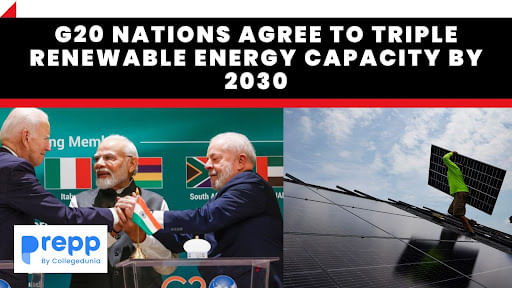
- Recently, leaders from the G20 nations endorsed a declaration that promotes the ambitious goal of increasing renewable energy capacity threefold by the year 2030.
- The G20 member countries together account for over 80% of global emissions and a cumulative effort by the group to decarbonise is crucial in the global fight against climate change.
Table of Contents
Key Points from G20’s Global Renewable Energy Capacity
- G20 leaders have committed to the goal of tripling global renewable energy capacity by 2030, aligning with recommendations from the International Renewable Energy Agency (IRENA) to meet the Paris Agreement's targets.
- IRENA's "World Energy Transitions Outlook 2023" emphasizes the need to reach just over 11,000 GW of renewable power capacity by 2030 to stay on track for limiting global warming to 1.5°C, and the G20 agreement supports this objective.
- The declaration stated that developing countries require approximately $5.8-5.9 trillion before 2030 to meet their Nationally Determined Contributions (NDCs) related to climate goals.
- It was stated that the tripling target cannot be achieved without the rapid growth in demand from other developing countries, mainly in Africa.
- The addition of the African Union in the G20 is expected to provide the right impetus for a greater penetration of renewable energy in these countries .
What is Renewable Energy?
- Renewable energy is energy generated from naturally replenished and non-depleting sources such as the sun and wind.
- Renewable energy can be used to generate power, heat and cool buildings and water, and transport.
- Nonrenewable energy, on the other hand, is derived from finite resources that may be depleted over time, such as fossil fuels such as coal and oil.
- Renewable energy accounts for more than 20% of global energy supply, with certain countries generating more than half of their electricity from renewables.
Global Growth of Renewable Energy
- Renewable energy is already growing rapidly worldwide, with annual capacity additions increasing by approximately 10% each year.
- Both developed and developing countries, including India and China, see renewable energy as a preferred way to combat climate change and reduce reliance on fossil fuels.
- The current global installed capacity of renewable energy is just short of 3,400 GW. In 2022, about 295 GW of new capacity was added.
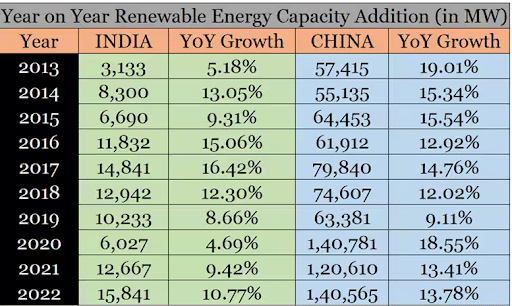
- India and China together account for more than 50% of global capacity additions in each of the last five years.
- In 2022, out of the 295 GW of additional capacity installed throughout the world, China alone added 140 GW, or nearly 48%.
- Solar energy constitutes more than 50% of new renewable energy capacity additions every year and is pivotal to the growth of renewables.
- In 2022, out of the 295 GW of new renewable capacity created, 191 GW, 65 per cent, came from solar energy.
India’s Journey Towards Renewable Energy
- Ranking: India is the 3rd largest energy consuming country in the world and has a massive demand for energy to fuel its rapidly growing economy.
- India stands 4th globally in Renewable Energy Installed Capacity (including Large Hydro), 4th in Wind Power capacity & 4th in Solar Power capacity (as per REN21 Renewables 2022 Global Status Report).
- India is working towards clean energy with ambitious targets like 500GW of non-fossil, including 450 GW renewable energy (RE) capacity addition and 43% Renewable Energy (RE) purchase obligation by 2030.
- Policies: These targets are supported by various policies such as (Energy Conservation (Amendment) Act), missions (National Green Hydrogen Mission), fiscal incentives (production-linked incentives) and market mechanisms (upcoming national carbon market).
- Solar energy capacity: As of July 2023, the installed solar energy capacity has increased by 24.4 times in the last 9 years and stands at 67.07 GW. The installed Renewable energy capacity (including large hydro) has increased by around 128 % since 2014.
India’s Initiatives towards Power Generation from Renewable Energy
- National Solar Mission
- International Solar Alliance
- PM Kisan Urja Suraksha evam Utthaan Mahabhiyan (PM-KUSUM)
- National Wind-Solar Hybrid Policy
- National Offshore Wind Energy Policy
- National Hydroelectricity Policy
- National Hydrogen Energy Mission
- National Green Hydrogen Mission
(*Click this link to read prelims specific weekly current affairs articles)
FAQs
Question: What is Renewable Energy?
Answer:
Renewable energy is energy derived from natural sources that is replenished at a faster rate than it is consumed. Sunlight and wind are two examples of such sources that are constantly replenished.
Question: What is solar energy?
Answer:
Solar energy is any type of energy that is produced by the sun. Solar energy can be directly or indirectly harnessed for human use. Solar panels mounted on a rooftop harvest solar energy and convert it to electricity.
Question: What is G20?
Answer:
The G20 is an informal group:19 countries and the European Union, with representatives of the International Monetary Fund and the World Bank. The G20 Presidency rotates annually.
UPSC Mains Practice Question:
|
MCQ
Question: With reference to solar power production in India, consider the following statements: (UPSC 2018)
- India is the third-largest in the world in the manufacture of silicon wafers used in photovoltaic units.
- The solar power tariffs are determined by the Solar Energy Corporation of India.
Which of the statements given above is/are correct?
(a) 1 only
(b) 2 only
(c) Both 1 and 2
(d) Neither 1 nor 2
Answer: (d) See the Explanation
- India does not produce a single silicon chip for solar energy. Every solar panel manufactured in India is assembled, with all materials sourced from other nations. India has not yet established semiconductor clusters. India is to invest $480 million in its first solar silicon cell production facility, which will feed a project to construct the world's largest solar power plant. Hence, statement 1 is incorrect.
- The tariffs of producing businesses owned or controlled by the Central Government are regulated by the Central Electricity Regulatory Commission. Hence, statement 2 is incorrect.
- A power trading licence has been granted to Solar Energy Corporation of India Limited (SECI).
Therefore, option (d) is the correct answer.
Download the PREPP App and attempt FREE IAS Exam Mock Tests and get complete study material!

Full Test - 04: UPSC CSE Prelims CSAT (Paper-II)
Full Test - 03: UPSC CSE Prelims CSAT (Paper-II)
UPSC CSE Prelims 2026 GS Paper 1 Question Paper (24-May-2026)
UPSC CSE Prelims 2026 CSAT Paper 2 Question Paper (24-May-2026)

17 February 2025 | The Hindu Must Read Articles | Current Affairs

16 February 2026 | The Hindu Must Read Articles | Current Affairs

13 February 2026 | The Hindu Must Read Articles | Current Affairs









Comments