Electoral Reforms - Indian Polity Notes
Electoral reforms in India refer to the evolution and positive change in election processes in order to promote greater democracy, clean politics, ideal members of legislative chambers, and equal representation, among other things. Elections and electoral reforms are covered in Articles 324-329. Electoral reforms are essential to fulfill our forefathers' dream, to realize our constitution's goals, and to have a true democracy in text and spirit by conducting fair elections. The UPSC Indian Polity and Governance Syllabus include the Electoral Reforms which is described in this article.
|
Table of Contents |

Electoral Reforms
Major Challenges In The Indian Electoral System
- Money Power: Electioneering is a costly process in any democratic government, but it is especially so in India.
- Money power has a negative impact on our electoral system, substantially undermining the functioning of periodic elections. It leads to widespread corruption and is a major contributor to the black money economy.
- Muscle Power: Pre-election intimidation, post-election victimization, most riggings of any kind, and silent and brutal booth capturing are all fruits of physical power.
- Criminalization of politics and criminalization of criminals, both of which are now freely practiced, are two sides of the same coin and are primarily responsible for the display of brute power at elections. Criminals are able to win elections for their benefactors through the use of violence.
- Misuse of Government Machinery: It is commonly said that the government in power at the time of an election abuses official machinery to help its party's candidates win elections.
- Misuse of official machinery takes many forms, including the publication of advertising at the expense of the government and the public exchequer publiciing their accomplishments, disbursements from ministerial discretionary funds, and the use of government cars for canvassing.
Criminalization Of Politics
The criminals' motivation for entering politics is to obtain influence and ensure that cases against them are dropped or not pursued. Because of their financial clout, they are able to make it big in politics. Political parties solicit funds from criminals in exchange for political privilege and protection.
Non-serious Candidates In Political Parties
Serious candidates frequently run non-serious candidates in order to cut a significant number of votes from opposing candidates, split votes along caste lines, or have more physical force at polling stations and counting centers.
Election Management Volume
A large number of candidates makes election management difficult for election authorities. The voters are also hampered in identifying their preferred candidates. The sanctity of elections is jeopardized as a result of this. This barrage of irresponsibility must be halted.
Incentives To Entice Voters (Freebies)
- Freebies have actually compounded the problem of money power in politics. Free liquor or some goods or services to voters are acts of enticing voters.
- Paid and Fake News: Paid news is published as a news item in the form of an advertisement. Fake news is news, stories or hoaxes created to deliberately misinform or deceive readers. Both are the threats to the free and fair electoral system.
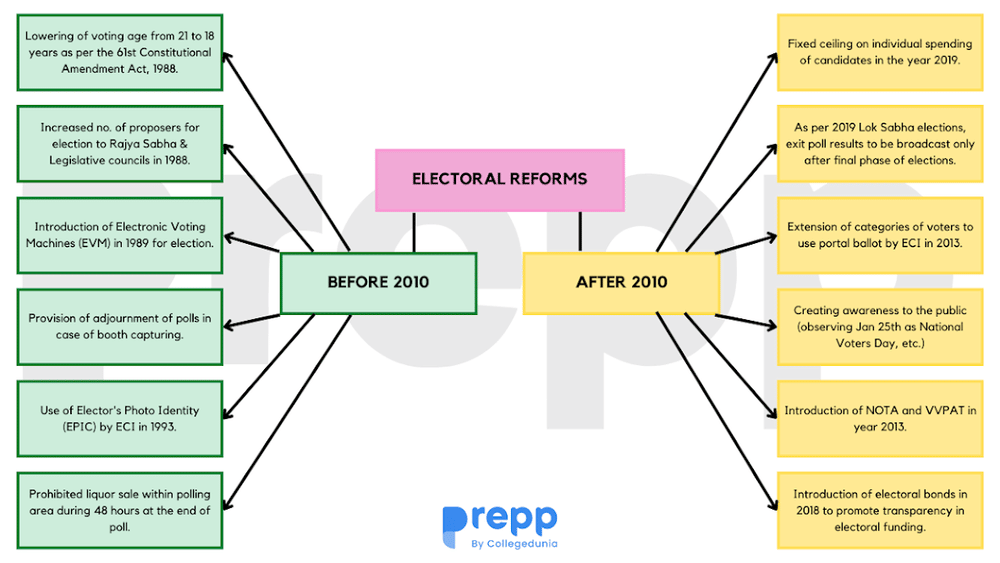
Electoral Reforms Before 2010
- Lowering of Voting Age – The 61st Constitutional Amendment Act(1988) reduced the voting age from 21 years to 18 years for the Lok Sabha and assembly elections.
- Deputation to Election Commission – A provision was made in 1988 which said that the officers and the staff engaged in preparation, revision and correction of electoral rolls for elections will be considered to be on deputation to the Election. Commission for the period of such employment.
- Increase in Number of Proposers – There was an increase in the number of proposers for election to Rajya Sabha and Legislative councils in 1988.
- Electronic Voting Machines (EVM) – The use of EVMs in elections was enabled by a provision in 1989. The EVMs were used for the first time in the general elections (entire state) to the Assembly of Goa in 1999.
- Booth Capturing – A provision was made in 1989 for adjournment of poll or countermanding of elections in case of booth capturing.
- Elector’s Photo Identity Card (EPIC) -The use of electors’ photo identity cards by the Election Commission is surely making the electoral process simple, smoother and quicker. A decision was taken by the Election Commission in 1993 to issue photo identity cards to electors throughout the country to check bogus voting and impersonation of electors at elections.
- Prohibition on sale of liquor: No liquor or other intoxicants shall be sold or given or distributed at any shop, eating place, or any other place, whether private or public, within a polling area during the period of 48 hours ending with the hour fixed for the conclusion of poll.
- Disqualification on conviction for violating the National Honours Act, 1971: This shall lead to disqualification of the person for 6 years from contesting to the Parliament and the state legislatures.
Electoral Reforms After 2010
- The ceiling on election expenditure: The Commission has put a cap on individual candidates’ spending. For the Lok Sabha elections, it is Rs. 50 – 70 lakh (depending on the state they are contesting the Lok Sabha seat from), and Rs. 20 – 28 lakh for an assembly election.
- Restriction on exit polls: The EC issued a statement before the 2019 Lok Sabha elections saying that exit poll results could be broadcast only after the final phase of the elections were over. This was done to avoid prospective voters from being misguided or prejudiced in any manner.
- Voting through postal ballot: In 2013, the EC decided to expand the ambit of postal ballot voting in the country. Previously, only Indian staff in missions abroad and defence personnel in a limited way, could vote via postal ballots. Now, there are 6 categories of voters who can use the postal ballot: service voters; special voters; wives of service voters and special voters; voters subjected to preventive detention; voters on election duty and Notified voters.
- Awareness Creation: The government decided to observe January 25th as ‘National Voters Day’ to mark the EC’s founding day. Political parties need to report any contribution in excess of Rs 20000 to the EC for claiming income tax benefit.
- Declaring of criminal antecedents, assets, etc. by the candidates is required and declaring false information in the affidavit is now an electoral offence punishable with imprisonment up to 6 months or fine or both.
- Introduction of NOTA - None Of The Above (NOTA) is a ballot option designed to allow the voter to indicate disapproval of all of the candidates in a voting system. It was introduced in India following the 2013 Supreme Court directive in the People’s Union for Civil Liberties v. Union of India judgment. However, NOTA in India does not provide for a ‘right to reject’. The candidate with the maximum votes wins the election irrespective of the number of NOTA votes polled
- Introduction of VVPAT ( Voter Verified Paper Audit Trail ) Voter verifiable paper audit trail (VVPAT) is a method of providing feedback to voters using EVMs. A VVPAT is intended as an independent verification system for voting machines designed to allow voters to verify that their vote was cast correctly, and to provide a means to audit the stored electronic results. It contains the name of the candidate for whom vote has been cast and symbol of the party/individual candidate.
- Transparency in election funding: Electoral bonds Government introduced an Electoral Bond Scheme in January 2018, purportedly with a view to cleansing the prevailing culture of political sponsorship. An electoral bond is designed to be a bearer instrument like a Promissory Note — in effect, it will be similar to a bank note that is payable to the bearer on demand and free of interest. It can be purchased by any citizen of India or a body incorporated in India.
Measures Taken By ECI For Electoral Reforms
Political Parties Registration Tracking Management System (PPRTMS): To allow an applicant to track the progress of his/her application.
Systematic Voters' Education and Electoral Participation Programme (SVEEP): ECI organizes voter awareness campaigns in order to educate the voters.
Measures taken by the Judiciary for electoral reforms
Supreme Court in the following cases recommended various reforms:
- In the Union of India versus Association of Democratic Reforms 2002 case: Contesting candidates need to disclose all their assets and liabilities, criminal convictions, etc. at the time of filing their nomination paper.
- In Ramesh Dalal versus Union of India 2005 case: A legislator is disqualified from contesting elections if, on the day of filing the nomination papers, he/she stands convicted in a Court of law.
- In Lily Thomas versus Union of India 2013 case: The nature of disqualification for being a member of the House as provided under Article 101(3) & 190(3) is automatic and takes place with immediate effect.
- In People’s Union of Civil Liberties versus Union of India 2013 case: Voters enjoy “Right to Negative Vote” in the election process and directed the ECI to include the choice of “NOTA” in the ballot paper.
Various Committees On Electoral Reforms
DINESH GOSWAMI COMMITTEE
- The ordering of re-poll or countermanding should not only be on the report of the returning officer, but also otherwise and, also to give the Election Commission the requisite powers to appoint investigating agencies, prosecuting agencies and constitution of special courts.
- The question of disqualification of members should not be decided by the speaker or the Chairman of the concerned House.
- Changes in the voting pattern and shift to proportional representation of the list system, instead of present voting system should be made (However, this matter was to be further discussed amongst exports
- There should be fresh delimitation on the basis of 1981 census and there should be a provision for rotation of reserved seats for Scheduled Castes and Scheduled Tribes.
- No candidates should be allowed to contest an election from more than two constituencies. The age of Candidates for assembly seats should be reduced to21 and for the Council to 25.
- A model code of conduct be framed which would include issues relating to-the use of official machinery, transport, media, funds etc
- Extensive restructuring of the accounting of election expenses is needed.
- Speedy trial of election disputes through the help of ad-hoc judges should be ensured.
- EVM should be used to put an end to manipulating and tempering.
JEEVAN REDDY COMMITTEE
- The Commission advocated a total ban on splits and mergers of political parties during the term of the Lok Sabha or Legislative Assembly.
- Once a member has been elected on a ticket of a particular recognized party, then he should remain in that party till the dissolution of the House or till the end of his membership by resignation or otherwise.
- The Commission has recommended adequate representation.
- To curb the criminalization of politics, the Commission has suggested that a person should be disqualified from contesting elections to the Lok Sabha or an Assembly if a court has ordered framing of charges in respect of offences listed in the Representation of the People Act, 1951.
TARKUNDE COMMITTEE
- The Election Commission should be a three-member body.
- The minimum age for voting should be 18 years.
- The TV and Radio should be placed under the control of autonomous statutory corporations.
- The committee recommended the formation of a voter’s council in as many constituencies as possible which can help in free and fair elections.
Conclusion
- It is an accepted fact that the electoral process in the country has developed certain shortcomings over the years which need to be corrected. But this should be done through extensive debate and discussion and in a gradual and continuous manner.
- Successive governments at the Centre have realized the importance of the issues relating to electoral reforms. Suggestions made either by the Election Commission or by the various committees on electoral reforms from time to time, have been regularly considered and also implemented.
- The government recognized that electoral reforms is a continuous process and it shall be the endeavor of all the stakeholders including Government, Election Commission of India, Law commission, etc. to implement such proposals on electoral reforms on which consensus emerges, from time to time.
| Other Relevant Links | |
|---|---|
| Indian Polity UPSC Notes | Elections |
| Electoral System | Election Process |
| Pressure Groups | Elections in India |
FAQs
Question: What are electoral reforms?
Answer: Electoral reforms refer to the changes made in the electoral system to improve its efficiency, fairness, and transparency. These reforms aim to enhance the integrity of the electoral process, encourage higher voter participation, and ensure that elections are conducted in a free and fair manner. Key aspects include changes in electoral laws, introduction of new voting technologies, and measures to prevent electoral fraud.
Question: Why are electoral reforms necessary in India?
Answer: Electoral reforms are necessary to address persistent issues such as corruption, vote-buying, and the influence of money and muscle power in elections. They also aim to increase voter confidence in the electoral process, enhance accountability among political representatives, and promote a more robust democratic framework, ensuring that elections truly reflect the will of the people.
Question: What are some significant electoral reforms implemented in India?
Answer: Significant electoral reforms in India include the introduction of the Election Commission of India (ECI) in 1950 to oversee free and fair elections, the implementation of the Model Code of Conduct to regulate political parties during elections, and the introduction of electronic voting machines (EVMs) to enhance the voting process. Other reforms involve the recommendation of the Law Commission on electoral funding and the proposal for state funding of elections.
Question: How has technology impacted electoral reforms in India?
Answer: Technology has significantly impacted electoral reforms by improving the transparency and efficiency of the electoral process. The introduction of electronic voting machines (EVMs) has streamlined voting, while the use of technology for voter registration and information dissemination has made it easier for citizens to participate. Additionally, the deployment of online platforms for filing nominations and disclosures of assets by candidates has enhanced accountability.
Question: What challenges do electoral reforms face in India?
Answer: Electoral reforms in India face several challenges, including resistance from political parties that benefit from the current system, lack of public awareness regarding the reforms, and issues related to the implementation of technology. Furthermore, socio-economic disparities can hinder equal access to the electoral process, affecting the overall effectiveness of reforms aimed at promoting inclusivity and fairness.
MCQs
1. What is the primary objective of electoral reforms in India?
A) To increase political representation
B) To enhance electoral integrity and fairness
C) To promote political parties
D) To reduce government expenditure
Answer: (B) See the Explanation
Explanation: The primary objective of electoral reforms in India is to enhance electoral integrity and fairness. These reforms are aimed at ensuring free and fair elections, reducing corruption, and increasing public confidence in the electoral process.
2. Which body is responsible for overseeing elections in India?
A) The Supreme Court
B) The Election Commission of India
C) The Parliament of India
D) The President of India
Answer: (B) See the Explanation
Explanation: The Election Commission of India (ECI) is responsible for overseeing elections in India. It is an autonomous constitutional authority that administers election processes at both the national and state levels, ensuring that elections are conducted in a free and fair manner.
3. What technology has been introduced to improve the voting process in India?
A) Paper ballots
B) Electronic Voting Machines (EVMs)
C) Postal voting
D) Direct recording electronic systems
Answer: (B) See the Explanation
Explanation: Electronic Voting Machines (EVMs) have been introduced to improve the voting process in India. EVMs enhance the speed and accuracy of vote counting and help reduce electoral fraud associated with traditional paper ballots.
4. Which reform aims to regulate the conduct of political parties during elections?
A) Right to Information Act
B) Model Code of Conduct
C) Anti-Defection Act
D) Representation of People Act
Answer: (B) See the Explanation
Explanation: The Model Code of Conduct is a set of guidelines issued by the Election Commission to regulate the conduct of political parties during elections. It ensures that political parties adhere to ethical standards and maintain a level playing field.
5. Which of the following is a significant challenge faced by electoral reforms in India?
A) High voter turnout
B) Resistance from political parties
C) Increased public awareness
D) Effective implementation of technology
Answer: (B) See the Explanation
Explanation: Resistance from political parties is a significant challenge faced by electoral reforms in India. Many political parties may be reluctant to support reforms that would undermine their electoral advantages or affect their control over the electoral process.
GS Mains Questions and Model Answers
Q1: Analyze the significance of electoral reforms in enhancing the democratic framework of India. Discuss major reforms and their impact on the electoral process.
Answer: Electoral reforms are crucial for enhancing the democratic framework of India by ensuring that elections are conducted in a fair and transparent manner. These reforms address issues such as corruption, vote-buying, and unequal access to the electoral process. Major reforms, such as the establishment of the Election Commission of India, introduction of Electronic Voting Machines (EVMs), and the Model Code of Conduct, have significantly improved the integrity of elections.
The introduction of EVMs has streamlined the voting process and reduced instances of electoral fraud. Furthermore, the Model Code of Conduct has regulated the behavior of political parties, promoting ethical standards during elections. Overall, these reforms have contributed to increased public confidence in the electoral process, fostering a more vibrant democracy.
Q2: Discuss the challenges faced in implementing electoral reforms in India. How can these challenges be addressed to strengthen democracy?
Answer: Implementing electoral reforms in India faces several challenges, including resistance from political parties benefiting from the existing system, lack of public awareness about the reforms, and technical issues related to the use of EVMs. To address these challenges, there should be widespread public education campaigns to raise awareness of the importance of electoral reforms and the benefits they bring to democracy.
Additionally, political will is essential for enacting reforms. Engaging civil society and independent organizations can foster dialogue and create pressure on political leaders to support necessary changes. Strengthening the capacities of the Election Commission can also enhance the implementation of reforms, ensuring that they are enforced effectively.
Q3: Evaluate the role of technology in modernizing the electoral process in India. What further advancements are necessary for future elections?
Answer: Technology plays a vital role in modernizing the electoral process in India by enhancing the efficiency, transparency, and security of elections. The introduction of EVMs has reduced the time taken to count votes and minimized human errors. Online voter registration and the use of digital platforms for campaigning and information dissemination have made participation more accessible.
Further advancements are necessary to enhance security and trust in the electoral process. Implementing biometric verification for voters and adopting blockchain technology for secure voting records can significantly mitigate fraud risks. Additionally, continuous training and upgrading of technology for election officials are crucial to ensure smooth operations during elections.
Previous Year Questions on Electoral Reforms
1. UPSC CSE Prelims 2021:
Question: Which of the following is a primary goal of electoral reforms in India?
A) To promote coalition governments
B) To ensure free and fair elections
C) To increase political party funding
D) To reduce the voting age
Answer: (B)
Explanation: The primary goal of electoral reforms in India is to ensure free and fair elections. This involves measures to curb electoral malpractices and enhance the integrity of the electoral process, which is fundamental for a thriving democracy.
2. UPSC CSE Mains 2020:
Question: Discuss the impact of the electoral reforms undertaken in India on the conduct of free and fair elections.
Answer: Electoral reforms in India have significantly impacted the conduct of free and fair elections by establishing mechanisms to enhance transparency, accountability, and voter participation. Measures such as the introduction of EVMs, the establishment of the Election Commission, and the enforcement of the Model Code of Conduct have collectively strengthened the electoral framework. However, challenges remain, necessitating continuous efforts to improve the electoral process further.
Download the PREPP App and attempt FREE IAS Exam Mock Tests and get complete study material!

Full Test - 04: UPSC CSE Prelims CSAT (Paper-II)
Full Test - 03: UPSC CSE Prelims CSAT (Paper-II)
UPSC CSE Prelims 2026 GS Paper 1 Question Paper (24-May-2026)
UPSC CSE Prelims 2026 CSAT Paper 2 Question Paper (24-May-2026)

17 February 2025 | The Hindu Must Read Articles | Current Affairs

16 February 2026 | The Hindu Must Read Articles | Current Affairs

13 February 2026 | The Hindu Must Read Articles | Current Affairs









Comments