Delimitation Commission – Indian Polity Notes
Delimitation Commission is a high-level body established under the Delimitation Act, 2002. The primary responsibility of the commission is to redesign the boundaries of the various assembly and Lok Sabha constituencies based on the results of a census (2001). Under Article 82 of the Constitution, the Parliament passes a Delimitation Act, and the President of India appoints an independent high-powered panel known as the Delimitation Commission to carry out the task.
This article explains the Delimitation Commission, Functions and Delimitation act 2002 are useful for Prelims 2023 preparation and UPSC Mains 2023 as well.
To Read update on this topic:
- EC To Begin Delimitation Exercise In Assam, To Use Census Figures Of 2001
- SC upholds the constitution of the J&K Delimitation Commission, extension of tenure of its chairperson
|
Table of Contents |
Delimitation Commission
- The Delimitation Act of 2002 established a Delimitation Commission to perform delimitation on the basis of the 2001 census in order to remedy the aforementioned distortion in the sizes of electoral seats.
- The Delimitation Commission will re-calculate the number of seats for Scheduled Castes and Scheduled Tribes based on the 2001 census, without changing the overall number of seats based on the 1971 census.
|
Constitutional Provisions |
|
|
Appointment |
|
|
Composition |
|
|
Additional members |
|
- In India, such Delimitation Commissions were established four times:
- in 1952 under the Delimitation Commission Act of 1952;
- in 1963 under the Delimitation Commission Act of 1962;
- in 1973 under the Delimitation Act of 1972;
- in 2002 under the Delimitation Act of 2002.
- Delimitation Act of 2002: The Act was enacted to oversee the allocation and adjustment of seats in the House of People.
- This Act has also contributed to the correct allotment of seats to states.
- According to this Act, the Delimitation Commission should establish its own processes and have all the powers of a civil court.
- Under the provisions of the Delimitation Act of 2002, the current delimitation of parliamentary seats within states was done on the basis of the 2001 census.
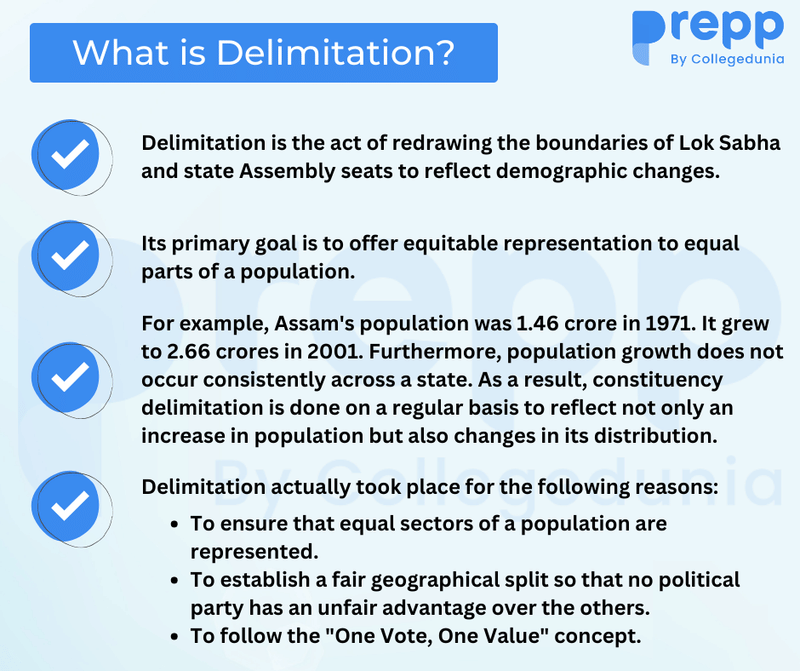
Delimitation Commission - Functions
- Determine the boundaries: To select the number of constituencies and their boundaries so that the population of all constituencies is nearly equal.
- The Commission shall be responsible for readjusting the representation of the various territorial constituencies in the House of People and the various territorial constituencies in the Legislative Assembly of each state based on the most recent population census statistics.
- Allocation of seats to ST and SC: The Commission also determines whether seats should be allocated for scheduled castes and scheduled tribes groups in places where their populations are large (Articles 330 and 332).
- Majority decision: If the members of the Commission have opposing viewpoints, the majority decision will be considered.
- Recommendations: The Commission makes draft recommendations available to the public through the Gazette of India, state gazettes, and regional language media.
- It also holds public hearings when the public's views are heard through written or spoken submissions. If appropriate, modifications are made to the draft proposal.
- The final order is published in the Gazettes and takes effect on the date specified by the President.
84th Constitutional Amendment Act
- The 84th Amendment to the Constitution, adopted in 2002, froze the delimitation of Lok Sabha and State Assembly seats until the first Census after 2026.
- The present borders were established based on the 2001 Census, however the number of Lok Sabha seats and State Assembly seats remained unchanged based on the 1971 Census.
- The population was 50 crore at the time of the freeze, but it has increased to 130 crore in 50 years, generating a major disparity in political representation in the country.
Delimitation Commission - Significance
- The Delimitation Commission of India has been regarded to have absolute jurisdiction, and rulings set by this commission can never be challenged by any courts or legislation.
- However, these directives of the Indian Delimitation Commission have been shown to be implemented as of a certain date indicated by the President of India.
- The Delimitation Commission is a panel with legislative backing that operates independently of the government and political parties.
- It determines the number and boundaries of constituencies in order to have a population that is nearly equal in all constituencies.
- Identifies seats reserved for Scheduled Castes and Scheduled Tribes in areas with a sizable population.
Delimitation Commission - Criticism
- States that are not concerned about population control may end up with more seats in Parliament. The southern states that promoted family planning risked having their seats reduced.
- Delimitation was done in 2008 based on the 2001 census, but the total number of seats in the Assemblies and Parliament decided in 1971 was not changed.
- The constitution also limits the number of Lok Sabha and Rajya Sabha seats to a maximum of 550 and 250, respectively, and growing populations are represented by a single representative.
Way Forward
- To resolve issues before 2026, a national consensus exercise should be launched.
- The weightage given to the population by the Finance Commission can be reduced to 10% or even 5%.
- Based on 2011 Census data, it is estimated that when parliamentary constituency boundaries are redrawn, the Lok Sabha's strength will increase from 543 to 888.
- The Rajya Sabha's number could rise to 384 from the current 245.
Delimitation in Jammu and Kashmir
- The Jammu and Kashmir area was viewed by the Delimitation Commission as a single Union Territory.
- As a result, one of the Parliamentary Constituencies has been created.
- The Jammu and Kashmir Reorganisation Act, 2019 and the Delimitation Act, 2002 established the general criteria for the delimitation procedure.
- The Commission stated in its final ruling that it recognised the "Jammu & Kashmir area as a single Union Territory," and amalgamated Rajouri and Poonch (from the Jammu division) with the Anantnag constituency in the Kashmir region. The new seat is now known as Kishtwar-Rajouri.
- Jammu and Kashmir are divided into two divisions, with Jammu having 37 Assembly seats and Kashmir having 46. Following the final draft of the Commission, six extra Assembly seats are slated for Jammu (revised to 43) and one for Kashmir (revised to 47).
Conclusion
The Delimitation Commission of India, also known as the Boundary Commission of India, is a commission formed by the Indian government under the provisions of the Delimitation Commission Act. The commission's principal responsibility is to redesign the borders of the different assembly and Lok Sabha seats based on a recent census. Although the cap on the number of Lok Sabha and Assemblies seats was expected to be lifted following the 2001 Census, another amendment pushed it back until 2026. This was justified by the fact that the country will have reached a uniform population growth rate by 2026.
|
|
|
|---|---|
| Indian Polity UPSC Notes | Elections |
| Electoral System | Electoral Reforms |
| Right to Information act, 2005 | Anti-Defection Law |
| Election Process | Pressure Groups |
FAQs
Q1: What is the Delimitation Commission?
Answer: The Delimitation Commission is a high-power body established by the Government of India to demarcate the boundaries of parliamentary and legislative assembly constituencies based on the population census. Its primary objective is to ensure fair representation by adjusting the seats in proportion to the population.
Q2: What is the role of the Delimitation Commission?
Answer: The Delimitation Commission's role is to redraw the boundaries of constituencies in a manner that ensures uniform population representation. This is done to maintain equal and fair representation for every constituency in the Lok Sabha and state legislative assemblies.
Q3: When was the last Delimitation Commission set up in India?
Answer: The last Delimitation Commission was set up in 2002, and it completed its work in 2008. Its recommendations were implemented based on the 2001 Census, and the Commission's orders were published in the official gazette.
Q4: Who constitutes the Delimitation Commission?
Answer: The Delimitation Commission is chaired by a retired judge of the Supreme Court, with the Chief Election Commissioner and the respective State Election Commissioners as its members. The decisions of the Commission are final and cannot be challenged in court.
Q5: What is the significance of the Delimitation Commission in the electoral process?
Answer: The Delimitation Commission ensures that each constituency has roughly the same number of voters, thereby promoting equality in representation and making elections more democratic. It helps prevent any imbalances in representation due to population shifts over time.
MCQs
- The Delimitation Commission is established under which article of the Indian Constitution?
a) Article 82
b) Article 324
c) Article 356
d) Article 370
Answer: (A) See the Explanation
- Who chairs the Delimitation Commission?
a) The Chief Justice of India
b) A retired Supreme Court judge
c) The Prime Minister
d) The President of India
Answer: (B) See the Explanation
- How often is the Delimitation Commission set up?
a) Every 5 years
b) After every Census
c) Every 10 years
d) Once in 50 years
Answer: (B) See the Explanation
- The orders of the Delimitation Commission can be challenged in which court?
a) Supreme Court
b) High Court
c) No court
d) Tribunal
Answer: (C) See the Explanation
- The latest Delimitation Commission used data from which Census?
a) 1991 Census
b) 2001 Census
c) 2011 Census
d) 1981 Census
Answer: (B) See the Explanation
GS Mains Questions and Model Answers
Q1: Discuss the importance of the Delimitation Commission in maintaining electoral integrity and fair representation in India.
Answer: The Delimitation Commission plays a crucial role in ensuring that electoral constituencies across India are fairly represented. It redraws the boundaries of Lok Sabha and legislative assembly constituencies based on population shifts, ensuring that each constituency has roughly the same number of voters. This is vital for maintaining electoral integrity, as over time, population growth and migration can lead to imbalances in representation. By adjusting constituencies according to the latest Census data, the Delimitation Commission helps to prevent over-representation or under-representation of certain areas, which can distort democratic representation. The Commission's impartiality, independence, and finality of its decisions ensure that the process remains transparent and fair, which strengthens the democratic process in India.
Q2: Explain how the decisions of the Delimitation Commission contribute to ensuring uniform population representation across constituencies.
Answer: The Delimitation Commission’s decisions directly contribute to ensuring uniform population representation by redrawing constituency boundaries based on the latest population data from the Census. This process ensures that each parliamentary or assembly constituency has a similar number of voters, preventing disproportionate representation where some constituencies may have significantly more or fewer voters than others. By aligning representation with population, the Commission helps preserve the principle of "one person, one vote." This ensures that every citizen's vote has equal weight in elections, promoting fairness and democratic equality across all constituencies.
Q3: Analyze the challenges faced by the Delimitation Commission in the context of India's growing population and political complexities.
Answer: The Delimitation Commission faces several challenges in the context of India's growing population and political complexities. One major challenge is ensuring equitable representation in areas with rapidly shifting populations due to urbanization and migration. Large urban centers may experience population surges, while rural areas may see population decline, making it difficult to maintain balance. Additionally, the political landscape can sometimes create resistance to boundary adjustments, as changes in constituency lines can affect political power dynamics. Moreover, the freeze on the total number of seats in the Lok Sabha and state assemblies until 2026 complicates the task of ensuring proportional representation based on population changes. Despite these challenges, the Delimitation Commission’s work remains critical to maintaining the integrity of India's electoral system.
Previous Year Questions on Delimitation Commission
1. UPSC CSE 2016
Question: Explain the role of the Delimitation Commission in India's electoral process.
Answer: The Delimitation Commission plays a pivotal role in India's electoral process by ensuring that constituencies for the Lok Sabha and state legislative assemblies are adjusted based on population changes reflected in the Census. Its primary objective is to maintain equitable representation, ensuring that each constituency has roughly the same number of voters. This helps prevent imbalances in representation, where certain areas may be over-represented or under-represented due to population growth or decline. The Commission's independence ensures that constituency boundaries are redrawn impartially, without political interference. The orders of the Delimitation Commission are final and cannot be challenged in court, providing a definitive framework for elections. This process ensures the democratic principle of equal representation is upheld in India's parliamentary and legislative assembly elections.
2. UPSC CSE 2019
Question: What are the constitutional provisions related to the Delimitation Commission? Discuss its importance in the Indian political system.
Answer: The Delimitation Commission in India is constituted under Article 82 of the Constitution, which mandates the readjustment of seats in the Lok Sabha and state legislative assemblies based on the population census. Additionally, Article 170 provides for the readjustment of constituencies for state legislative assemblies. The Delimitation Commission ensures that constituencies are redrawn periodically to reflect changes in population, thereby maintaining balanced and fair representation in Parliament and state legislatures. Its importance lies in upholding the democratic principle of "one person, one vote," ensuring that each constituency has an equal number of voters. This prevents the over-representation or under-representation of any area, which could distort electoral outcomes. The Commission’s decisions are final and immune from judicial review, which helps maintain the sanctity of the electoral process.
Download the PREPP App and attempt FREE IAS Exam Mock Tests and get complete study material!

Full Test - 04: UPSC CSE Prelims CSAT (Paper-II)
Full Test - 03: UPSC CSE Prelims CSAT (Paper-II)
UPSC CSE Prelims 2026 GS Paper 1 Question Paper (24-May-2026)
UPSC CSE Prelims 2026 CSAT Paper 2 Question Paper (24-May-2026)

17 February 2025 | The Hindu Must Read Articles | Current Affairs

16 February 2026 | The Hindu Must Read Articles | Current Affairs

13 February 2026 | The Hindu Must Read Articles | Current Affairs









Comments