Contempt of Court - Indian Polity Notes
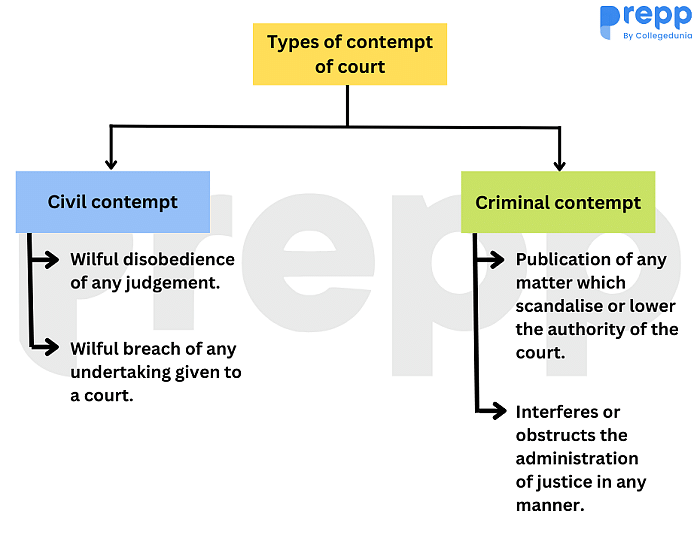
Contempt of court means it is an act of disrespect or disobedience toward a court, as well as interference with its orderly process. Article 129 declares the supreme court to be a "Court of record," with all the powers of a court of record, including the right to punish itself for contempt. The Contempt of Courts Act of 1971 does not define contempt; rather, it discusses the two categories of contempt: civil and criminal.
This article explains the Contempt of court, types and significance are useful for UPSC IAS exam preparation.
|
Table of Contents |
Contempt Of Court – Concept
- Contempt of court is a legal offence committed by someone who disobeys a judge or otherwise interrupts the legal process in court.
- Contempt of court can be either civil or criminal, according to the Contempt of Courts Act of 1971.
- The term "contempt of court" is not defined in the Constitution.
- Article 129 of the Constitution, on the other hand, gives the Supreme Court the authority to penalise itself for contempt.
- Furthermore, Article 142(2) enables the Supreme Court to investigate and punish any contempt of the Supreme Court of itself.
- For example: Justice C.S. Karnan v. The Honourable Supreme Court Of India (2017) - Justice C.S. Karnan, a sitting judge of the Calcutta High Court, was sentenced to six years in jail for contempt of court and the Indian judiciary.
- Similarly, Article 215 declares High Courts to be a "Court of record," with all the powers of such a court, including the authority to penalise for contempt of court.
- The Constitution and the Contempt of Courts Act, 1971 both grant the power to penalise for contempt of both the High Court and the Supreme Court.
- The 2006 amendment to the 1971 Contempt of Courts Act clarifies that a court can only apply a contempt penalty if it is satisfied that the conduct substantially interferes, or is likely to substantially interfere, with the right course of justice.
Punishment For Contempt Of Court
- Contempt of court is punishable by the Supreme Court and High Courts with either simple imprisonment for up to six months or a fine of up to Rs. 2,000, or both.
- The Supreme Court determined in 1991 that it has the authority to penalize for contempt not only itself, but also all other high courts, subordinate courts, and tribunals in the country.
- According to Section 10 of the Contempt of Courts Act of 1971, High Courts have been given unique powers to punish contempt of subordinate courts.
Significance Of Contempt Law In A Free Society
- In a free society, judicial criticism is unavoidable.
- The contempt power is necessary to punish deliberate disobedience of court orders (civil contempt), as well as interference with the administration of justice and overt threats to judges.
- The idea of contempt exists to protect the judiciary from unwarranted criticism and to prevent a public perception of the judiciary from deteriorating.
- Judges have enormous influence, and the public will not remain silent when such power is exercised.
- Similar to how other parts of government make choices, court decisions will attract criticism.
- The law of contempt should only be used to allow the court to function, not to protect the court from criticism.
- However, in the age of social media, there is a conflict between the section of contempt law that criminalizes anything that "scandalizes or tends to scandalize" the judiciary and freedom of speech and expression (under article 19).
Contempt Of Court – Criticism
- Legislation punishing criminal contempt runs counter to India's democratic system, which recognizes freedom of speech and expression as a basic right.
- In this way, the judiciary resembles the executive branch in its use of laws to stifle freedom of expression.
- The definition of criminal contempt in India is quite broad and can be readily used. Furthermore, the Court's suo motu authority to begin such procedures merely adds to the complication.
- In addition, the Contempt of Courts Act was revised in 2006 to include truth and good faith as viable defenses to contempt, but the courts rarely consider them.
- Contempt has nearly gone defunct in foreign democracies, with authorities recognizing that it is an antiquated rule.
- In England, for example, the crime of "scandalizing the court" was abolished in 2013.
- Canada's contempt standard is based on real, substantial, and urgent threats to the administration.
Arguments In Favour
- Several civil and criminal contempt cases are still pending in various High Courts and the Supreme Court. The significant number of cases show that the law of contempt of court is still relevant.
- Changing the meaning of contempt could lower the law's overall impact and reduce people's respect for courts, their authority, and how they operate. In addition, eliminating the offence in India would result in a legislative void.
- Contempt powers are derived from the Constitution by the Supreme Court and the High Courts. The 1971 Contempt of Court Act merely defines the procedure for investigating and punishing contempt of court.
- As a result, the removal of the offence from the Act will have no effect on the superior courts' inherent constitutional rights to punish anyone who violates the Act.
- These authorities will remain intact even if the 1971 Act is repealed.
- The Constitution grants superior courts the authority to penalise subordinate courts for contempt. The Contempt of Court Act also permits the High Court to punish subordinate courts for contempt.
- Subordinate courts will suffer if the definition of contempt is deleted because there will be no way to resolve situations of their contempt.
- The act has a number of safeguards in place to prevent it from being abused.
- for example, specifies which situations do not constitute contempt and which are not penalised by contempt.
- These provisions imply that not all cases of contempt will be prosecuted.
Contempt of Court - Other Examples
Prashant Bhushan case
- In Prashant Bhushan & Anr, the Supreme Court found Senior Advocate Prashant Bhushan guilty of contempt.
- It ruled that the Senior Advocate's two tweets were in contempt of court because they jeopardised the court's authority.
Aditya Kashyap v. Rachita Taneja (2020)
- Rachita Taneja, a cartoonist, was charged in this case with tweeting inappropriate information against the court in the form of cartoons.
- The aforementioned post got viral, and it was extensively shared and subscribed to.
- According to the Attorney General, such posts are meant to undermine the Supreme Court's authority in the eyes of the public, and so the drawings were in contempt of the top court.
Criminal Contempt Proceedings against Vigilance
- The Delhi High Court has instituted criminal contempt proceedings against defendants in a suit after an investigation by the Registrar (Vigilance) revealed that they included a forged Intellectual Property Appellate Board (IPAB) order in a compilation of documents handed over to the court during a recent hearing.
Conclusion
The Indian Law Commission concluded that the rule relating to judicial contempt should be preserved. However, it was also suggested that the meaning of contempt under the Contempt of Court Act be limited to civil contempt, which is defined as willful disobedience of a court's judgment Furthermore, in the age of social media, not only does the law on criminal contempt need to be revisited, but the test for contempt also has to be assessed.
FAQs
Q1: What is Contempt of Court?
Answer: Contempt of Court refers to any act or behavior that disrespects or disobeys the authority, justice, or dignity of the court. It is categorized into two types: civil contempt and criminal contempt.
Q2: What is the difference between civil and criminal contempt?
Answer: Civil contempt occurs when there is a willful disobedience of court orders or judgments, while criminal contempt refers to acts that scandalize the court, prejudices judicial proceedings, or interferes with the administration of justice.
Q3: Under which law is contempt of court governed in India?
Answer: In India, contempt of court is governed by the Contempt of Courts Act, 1971, which outlines the types of contempt and the powers of the court to punish for contempt.
Q4: Can contempt of court affect freedom of speech?
Answer: Yes, the court has the power to limit freedom of speech if such speech obstructs the due process of law or disrespects the court, though this is balanced with Article 19(1)(a) of the Constitution which guarantees freedom of speech and expression.
Q5: How can one defend against charges of contempt of court?
Answer: Defenses against contempt charges include truth, if it is in public interest and published in good faith, fair criticism of judicial acts, and a bona fide apology accepted by the court.
MCQs
- Which law governs the contempt of court in India?
a) Indian Penal Code, 1860
b) Contempt of Courts Act, 1971
c) Code of Criminal Procedure, 1973
d) Code of Civil Procedure, 1908
Answer: (B) See the Explanation
- Which of the following is considered civil contempt?
a) Scandalizing the court
b) Interference with judicial proceedings
c) Willful disobedience of court orders
d) Prejudicing the administration of justice
Answer: (C) See the Explanation
- Which Article of the Indian Constitution guarantees freedom of speech and expression?
a) Article 14
b) Article 19(1)(a)
c) Article 21
d) Article 32
Answer: (B) See the Explanation
- Which of the following can be a defense against contempt of court charges?
a) Absolute freedom of speech
b) Willful defiance of court orders
c) Truth published in good faith
d) Ignorance of the law
Answer: (C) See the Explanation
- Which body has the power to punish for contempt of court in India?
a) Parliament
b) Supreme Court
c) Executive
d) State High Courts
Answer: (B) See the Explanation
GS Mains Questions and Model Answers
Q1. Analyze the significance of contempt of court in maintaining judicial integrity in India.
Answer: Contempt of court is essential for maintaining the dignity, authority, and integrity of the judicial system in India. By ensuring that courts are respected and their orders are followed, contempt provisions help uphold the rule of law. The power to punish for contempt, vested in the Supreme Court and High Courts under the Contempt of Courts Act, 1971, serves as a deterrent against actions that undermine the court's authority or interfere with judicial proceedings.
Contempt provisions also balance freedom of speech with the need to maintain the court's sanctity. While fair criticism of judicial decisions is allowed, scandalizing the court or obstructing justice can lead to criminal contempt charges. Therefore, contempt of court plays a critical role in ensuring the independence of the judiciary and reinforcing public confidence in the legal system.
Q2. Discuss the balance between freedom of speech and contempt of court in India.
Answer: In India, freedom of speech is guaranteed under Article 19(1)(a) of the Constitution, but this right is not absolute. One of the reasonable restrictions on this freedom is contempt of court, which is essential to maintain the dignity and authority of the judiciary.
Balancing these two rights is crucial, as the judiciary must not be criticized to the point of scandalizing or prejudicing judicial proceedings, but at the same time, courts should not use contempt to suppress legitimate criticism. The Contempt of Courts Act, 1971 allows truth as a defense if published in good faith and in the public interest, ensuring that freedom of expression is protected while safeguarding the court’s authority. This balance ensures both accountability of the judiciary and the protection of democratic rights.
Q3. Evaluate the scope and limitations of the Contempt of Courts Act, 1971.
Answer: The Contempt of Courts Act, 1971, plays a vital role in maintaining the dignity and authority of courts in India. The Act defines civil contempt as the willful disobedience of court orders and criminal contempt as acts that scandalize the court or obstruct justice. These provisions empower the judiciary to maintain decorum and prevent disruptions in judicial processes.
However, the Act has faced criticism for being vague, particularly in its definition of what constitutes scandalizing the court, which can sometimes be used to suppress legitimate criticism. Additionally, the balance between protecting the court's dignity and ensuring freedom of speech is delicate. The Act allows for truth as a defense if published in good faith, but there is a need for clearer guidelines on what constitutes contempt to prevent misuse. Strengthening judicial accountability mechanisms while ensuring that contempt provisions are not abused is essential for the effective functioning of the legal system.
Previous Year Questions on Contempt of Court
1. UPSC CSE Mains 2017
Question. Discuss the role of contempt of court in upholding judicial independence in India.
Answer: Contempt of court plays a crucial role in upholding the independence of the judiciary by ensuring that its authority is respected and that its judgments are adhered to. By empowering courts to punish for both civil and criminal contempt, the Contempt of Courts Act, 1971, helps to maintain the integrity of judicial processes and prevents individuals from disobeying court orders or scandalizing the court.
This power is essential to safeguard the rule of law and ensure that courts can function without external pressures or disruptions. However, it is also essential to ensure that this power is not misused to suppress legitimate public criticism of judicial decisions, which is a vital part of judicial accountability in a democracy.
2. UPSC CSE Mains 2018
Question. How does the Contempt of Courts Act, 1971, balance freedom of expression and the need to protect judicial authority?
Answer: The Contempt of Courts Act, 1971, balances the need to protect judicial authority with freedom of expression, a fundamental right under Article 19(1)(a) of the Indian Constitution. While the Act allows courts to punish individuals for contempt that disrespects the judiciary or interferes with the administration of justice, it also includes provisions to protect freedom of speech.
For instance, the Act permits truth to be used as a defense if it is published in good faith and is in the public interest, allowing for fair criticism of judicial acts. This balance ensures that while courts maintain their authority, individuals can still voice concerns or criticisms about judicial decisions in a responsible and constructive manner. This approach upholds the rule of law while protecting democratic freedoms.
Download the PREPP App and attempt FREE IAS Exam Mock Tests and get complete study material!
UPSC IAS : CSAT - Mini Live Test

Live Test : UPSC CSE Prelims CSAT (Paper-II) (Oct 20 - 23)
Full Test - 04: UPSC CSE Prelims CSAT (Paper-II)
Full Test - 03: UPSC CSE Prelims CSAT (Paper-II)
UPSC CSE Prelims 2026 GS Paper 1 Question Paper (24-May-2026)
UPSC CSE Prelims 2026 CSAT Paper 2 Question Paper (24-May-2026)

17 February 2025 | The Hindu Must Read Articles | Current Affairs

16 February 2026 | The Hindu Must Read Articles | Current Affairs

13 February 2026 | The Hindu Must Read Articles | Current Affairs









Comments