
Which statement of the following is incorrect?
Primary data collection requires less amount of resources such as time, cost and manpower.
Understanding Primary and Secondary Data Collection
The question asks us to identify the incorrect statement among the given options regarding primary and secondary data. Let's analyze each statement carefully to determine its accuracy in the context of data collection and research methods.
Analyzing Each Statement about Data Collection
Let's break down each statement provided in the options:
- Statement 1: Secondary data is attained when statistical methods are applied to the primary data.
- Statement 2: Primary data collection requires less amount of resources such as time, cost and manpower.
- Statement 3: Primary data is always precise to the researcher’s needs.
- Statement 4: Data poised through primary sources are more reliable.
Now, let's evaluate the correctness of each statement based on standard definitions and characteristics of primary and secondary data.
Evaluation of Statements
Statement 1: Secondary data is attained when statistical methods are applied to the primary data.
This statement is generally incorrect. Secondary data refers to data that has already been collected by someone else for a purpose other than the current research. Applying statistical methods to data, whether primary or secondary, is part of data analysis. It transforms raw data into information or findings, but it doesn't turn primary data into secondary data. Secondary data exists prior to the current research project.
Statement 2: Primary data collection requires less amount of resources such as time, cost and manpower.
This statement is incorrect. Primary data is collected directly by the researcher or their team specifically for the purpose of their current research. This process typically involves designing surveys, conducting interviews, running experiments, or making direct observations. These activities are generally time-consuming, expensive, and require significant human effort compared to collecting secondary data, which often involves simply accessing existing publications, databases, or records.
Statement 3: Primary data is always precise to the researcher’s needs.
This statement is generally correct. Since primary data is collected specifically for the research question at hand, the researcher has control over the data collection instruments (like questionnaire design) and methods, ensuring that the data collected directly addresses their specific objectives and needs. It is tailored to the research requirements.
Statement 4: Data poised through primary sources are more reliable.
This statement is generally correct. Data collected directly from primary sources is often considered more reliable because the researcher is aware of the data collection process, potential limitations, and the context in which the data was gathered. They can verify the source and methodology, unlike secondary data where the original collection process and potential biases might be unknown or less transparent.
Identifying the Incorrect Statement
Based on our analysis:
- Statement 1 is incorrect.
- Statement 2 is incorrect.
- Statement 3 is correct.
- Statement 4 is correct.
The question asks for the *incorrect* statement. Both Statement 1 and Statement 2 are incorrect. However, Statement 2 is a more fundamental and widely recognized distinction between primary and secondary data collection resources. Statement 1's wording is less precise regarding the definition of secondary data vs. data analysis. Let's re-examine the options and typical exam contexts. Often, questions focus on the core differences in collection effort and cost.
Considering the common characteristics emphasized in distinguishing primary vs. secondary data, the resource requirements (time, cost, manpower) are key. Primary data collection is resource-intensive, while secondary data collection is typically less so.
Therefore, the statement "Primary data collection requires less amount of resources such as time, cost and manpower" is factually wrong and represents a clear distinction between primary and secondary data collection methods. It is a definitively incorrect statement about primary data collection.
Statement 1, while potentially misleading in how it defines secondary data attainment, describes applying methods *to* primary data, which is analysis, not the process of obtaining secondary data itself. The core definition of secondary data is data *already existing*. The wording makes it incorrect, but perhaps Statement 2 is intended as the primary incorrect statement based on typical comparisons.
Let's assume Statement 2 is the intended incorrect statement for this question, as it directly contradicts a major characteristic of primary data collection.
Statement 2 explicitly states that primary data collection requires *less* resources, which is the opposite of reality. Primary data collection demands *more* resources.
Conclusion
Comparing the statements, Statement 2 is clearly and unequivocally incorrect based on the standard understanding of data collection methods.
The incorrect statement is: Primary data collection requires less amount of resources such as time, cost and manpower.
Revision Table: Primary vs. Secondary Data
| Feature | Primary Data | Secondary Data |
|---|---|---|
| Definition | Collected directly by the researcher for the current study. | Data already collected by someone else for a different purpose. |
| Source | First-hand sources (surveys, interviews, experiments, observations). | Existing sources (publications, databases, reports, records). |
| Collection Effort & Cost | High (requires more time, money, manpower). | Low (requires less time, money, manpower). |
| Relevance to Needs | Highly precise and specific to the researcher's needs. | May or may not perfectly fit the researcher's specific needs; may require filtering or adjustment. |
| Reliability & Accuracy | Generally higher as researcher controls collection process; potential for bias is known. | Reliability and accuracy depend on the original collector and purpose; quality control is less certain. |
| Availability | Not readily available; must be created. | Readily available from various sources. |
Additional Information on Data Collection Methods
Understanding the difference between primary and secondary data is crucial for designing effective research. The choice between collecting primary data or using secondary data depends on several factors, including the research objectives, available resources, time constraints, and the required level of accuracy and control.
- Primary Data Advantages: Specificity, control over quality, current information.
- Primary Data Disadvantages: High cost, time-consuming, requires expertise.
- Secondary Data Advantages: Cost-effective, quick access, can provide historical context, large datasets may be available.
- Secondary Data Disadvantages: May not fit specific needs, accuracy and reliability may be questionable, data definition or units may differ, available to competitors.
Researchers often use a combination of both primary and secondary data in their studies to leverage the benefits of both types.
Similar Questions
Following histogram shows certain frequency distribution against class intervals.
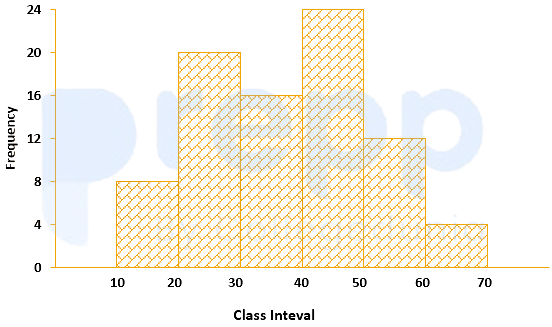
The approximated mean of this distribution is:
The annual vehicles production (in lacs) in india is given in the pie chart.
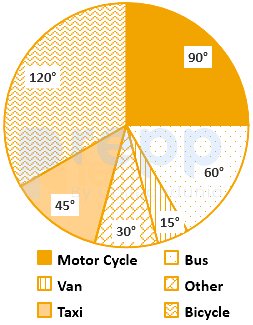
If the annual production of motor cycle is 1.80 lacs, the annual production of Bicycle is
For determination of mode and median graphically, one considers:
The curve obtained by joining the points, whose x-coordinates are the upper limits of the class interval and y-coordinates are corresponding cumulative frequencies is called:
The variation among the observations of each specific class is known as:
For making frequency distribution, the number of classes used depends upon:
When the collected data is grouped with reference to time, we have
Mutual and unique variances among multiple factors can be embodied in a diagram that comprises overlapping circles. The diagram is known as:
The graphical representation of the time series is known as:
Which of the following is a method of collection of primary data?
Important Questions from Classification of Data
The class marks in a frequency table are given to be 5, 10, 15, 20, 25, 30, 35, 40, 45, 50. The class limits of the first five classes are
In a test in Mathematics, 20% of the students obtained “first class”. If the data are represented by a Pie-Chart, what is the central angle corresponding to “first class”?
The following table gives the monthly expenditure of two families:
Expenditure (in Rs.)
Items
Family A
Family B
Food
3,500
2,700
Clothing
500
800
Rent
1,500
1,000
Education
2,000
1,800
Miscellaneous
2,500
1,800
In constructing a pie diagram to the above data, the radii of the circles are to be chosen by which one of the following ratios?
In an examination, 40% of candidates got second class. When the data are represented by a pie chart, what is the angle corresponding to second class?
Following histogram shows certain frequency distribution against class intervals.
The approximated mean of this distribution is:



