
When the junction temperature of a transistor increases, its ______ increases.
Collector current
Understanding Transistor Junction Temperature Effects
A transistor is a semiconductor device used to amplify or switch electronic signals and electrical power. It is one of the fundamental building blocks of modern electronics. Transistors have junctions (like PN junctions in diodes) between different semiconductor materials. The temperature of these junctions, known as the junction temperature, significantly impacts the transistor's performance characteristics.
When a transistor is operating, current flows through its junctions, which generates heat. This heat causes the junction temperature to rise above the ambient temperature. Changes in this junction temperature affect various electrical properties of the transistor.
How Junction Temperature Affects Transistor Parameters
Several parameters of a transistor are sensitive to changes in temperature. Let's explore how increasing junction temperature impacts some key characteristics:
- Base-Emitter Voltage (\(V_{BE}\)): For a constant collector current, the base-emitter voltage required to maintain that current decreases by about 2 mV for every degree Celsius increase in junction temperature. This is due to the intrinsic carrier concentration increasing with temperature.
- Collector-Base Leakage Current (\(I_{CBO}\)): This is the small current that flows when the collector-base junction is reverse-biased. It increases significantly (roughly doubles for every 10°C rise) with increasing temperature due to the increased thermal generation of electron-hole pairs.
- Current Gain (\(\beta\) or \(h_{FE}\)): The current gain, which is the ratio of collector current to base current (\(I_C / I_B\)), generally increases with increasing junction temperature. This is primarily because the minority carrier lifetime and diffusion length in the base region increase with temperature.
- Collector Current (\(I_C\)): This is the main output current in many transistor configurations. Its behavior with temperature is influenced by multiple factors, but the increase in current gain (\(\beta\)) and leakage currents (\(I_{CBO}\)) are the dominant effects leading to an increase in collector current, especially for a fixed base current or base-emitter voltage.
Analyzing the Options
Let's consider the given options in the context of increasing transistor junction temperature:
- Emitter voltage: This is not a fundamental parameter that simply "increases" with temperature. Emitter voltage is usually relative to ground or another reference point and depends heavily on the external circuit configuration and the base-emitter voltage (\(V_{BE}\)). While \(V_{BE}\) decreases with temperature, emitter voltage itself doesn't have a simple direct increase.
- Collector current: As discussed above, the collector current typically increases when the junction temperature rises. This is a well-known characteristic of transistors, driven by increased current gain and leakage currents.
- Collector voltage: Similar to emitter voltage, collector voltage depends on the external circuit and the collector current flowing through the load resistance. It doesn't inherently just "increase" with temperature; its change is a consequence of the change in collector current and the surrounding circuit.
- Collector resistance: The internal bulk resistance of the semiconductor material in the collector region does have a temperature dependence (it generally increases slightly for silicon). However, this is not the primary or most significant parameter that is said to "increase" in the context of overall transistor behavior with temperature compared to the change in currents and gain.
Based on the analysis, the most direct and significant effect listed that increases when the junction temperature of a transistor increases is its collector current.
Detailed Explanation of Collector Current Increase
When the junction temperature increases, two main factors contribute to the increase in collector current:
- Increase in \(\beta\): The current gain \(\beta\) increases with temperature. Since \(I_C = \beta \cdot I_B\) (in the active region, ignoring leakage), an increase in \(\beta\) directly leads to a higher collector current for a given base current.
- Increase in Leakage Current (\(I_{CBO}\)): The leakage current between the collector and base (\(I_{CBO}\)) increases significantly with temperature. Although this leakage is small, it adds to the collector current. The total collector current is more accurately given by \(I_C = \beta \cdot I_B + (1+\beta) \cdot I_{CBO}\). The term \((1+\beta) \cdot I_{CBO}\) is often called the collector-emitter leakage current with the base open (\(I_{CEO}\)), and it increases substantially with temperature.
Both these effects combine to cause the collector current to increase as the junction temperature rises.
| Parameter | Effect of Increased Temperature | Reason |
|---|---|---|
| Base-Emitter Voltage (\(V_{BE}\)) | Decreases | Increased intrinsic carrier concentration |
| Collector-Base Leakage (\(I_{CBO}\)) | Increases (significantly) | Increased thermal generation of carriers |
| Current Gain (\(\beta\)) | Increases | Increased minority carrier lifetime and diffusion length |
| Collector Current (\(I_C\)) | Increases | Combined effect of increased \(\beta\) and increased leakage currents |
Conclusion
An increase in the junction temperature of a transistor leads to several changes in its operating characteristics. Among the given options, the most direct and prominent effect is the increase in collector current, resulting from the rise in current gain and leakage currents.
Revision Table: Transistor Temperature Effects
| Parameter | How it Changes with Increasing Junction Temperature |
|---|---|
| \(V_{BE}\) (for constant \(I_C\)) | Decreases (approx. 2 mV/°C) |
| \(I_{CBO}\) | Increases (doubles approx. every 10°C) |
| \(\beta\) (\(h_{FE}\)) | Increases |
| \(I_C\) (for fixed \(I_B\) or \(V_{BE}\)) | Increases |
Additional Information: Thermal Runaway in Transistors
The increase in collector current with temperature can sometimes lead to a phenomenon called thermal runaway. This occurs when an increase in junction temperature causes the collector current to increase, which in turn generates more heat, further increasing the temperature and current. If not controlled by the circuit design (like using negative feedback or proper biasing), this positive feedback loop can lead to the transistor overheating and being destroyed. Understanding the temperature dependency of transistor parameters like collector current is crucial for designing stable and reliable electronic circuits.
Similar Questions
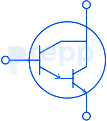
Identify the component shown in the image below:
The emitter current of a transistor is 1 mA. If 1% of the emitted current carriers are lost in the base recombination, what is the value β? Identify from the given options.
Which of the following shows the proper biasing of a PNP transistor?
The output impedance of a MOSFET is:
In a bipolar transistor, alpha is the ratio of:
Heat sink of a power transistor can be used for:
In case of an AC input signal in CE Transistor Load line can be given by a plot of
Which set of terminals is commonly used to connect a Field Effect Transistor in a circuit?
In an n-channel enhancement mode MOSFET, what must be applied to the gate terminal relative to the source to turn the device on?
What is the configuration called when the emitter terminal of a transistor is common to both input and output circuits?
Important Questions from Transistors
Transistors used as power amplifiers are generally mounted on a metallic plate so as to-
A transistor has ______ PN junctions
Which of the following is not true for a BJT?
A transistor amplifier with proper biasing has the following measured parameters:
Input resistance = 1 kΩ, Output resistance = 10 kΩ, Current gain = 90.
Identity the biasing configuration.
MOSFET can be used as a



