
The emitter current of a transistor is 1 mA. If 1% of the emitted current carriers are lost in the base recombination, what is the value β? Identify from the given options.
99
Understanding Transistor Currents and Beta Calculation
In a bipolar junction transistor (BJT), the emitter current (\(I_E\)) is the total current flowing into the emitter terminal. This current splits into two parts: the base current (\(I_B\)) and the collector current (\(I_C\)). The relationship between these currents is given by:
\[I_E = I_C + I_B\]
The base current (\(I_B\)) is primarily due to the recombination of charge carriers in the base region. The collector current (\(I_C\)) is the current that successfully crosses the collector-base junction and flows out of the collector terminal.
The current gain of a transistor in the common-emitter configuration is denoted by β (beta). It is defined as the ratio of the collector current (\(I_C\)) to the base current (\(I_B\)):
\[\beta = \frac{I_C}{I_B}\]
Calculating Transistor Currents and Beta
We are given the emitter current and the percentage of emitter current carriers that are lost due to recombination in the base. This loss represents the base current.
- Given Emitter Current, \(I_E = 1 \text{ mA}\).
- Given percentage loss in base recombination = 1% of \(I_E\).
The current lost in the base recombination is the base current, \(I_B\).
\[I_B = 1\% \text{ of } I_E\]
\[I_B = \frac{1}{100} \times I_E\]
Substituting the value of \(I_E\):
\[I_B = \frac{1}{100} \times 1 \text{ mA} = 0.01 \text{ mA}\]
Now we can find the collector current (\(I_C\)) using the relationship \(I_E = I_C + I_B\):
\[I_C = I_E - I_B\]
Substituting the values of \(I_E\) and \(I_B\):
\[I_C = 1 \text{ mA} - 0.01 \text{ mA} = 0.99 \text{ mA}\]
Finally, we can calculate the value of β using the formula \(\beta = \frac{I_C}{I_B}\):
\[\beta = \frac{0.99 \text{ mA}}{0.01 \text{ mA}}\]
\[\beta = \frac{0.99}{0.01}\]
To simplify the division, we can multiply both the numerator and the denominator by 100:
\[\beta = \frac{0.99 \times 100}{0.01 \times 100} = \frac{99}{1} = 99\]
So, the value of β is 99.
Summary of Transistor Current Calculations
| Parameter | Value |
|---|---|
| Emitter Current (\(I_E\)) | 1 mA |
| Base Current (\(I_B\)) (1% of \(I_E\)) | 0.01 mA |
| Collector Current (\(I_C = I_E - I_B\)) | 0.99 mA |
| Beta (\(\beta = I_C / I_B\)) | 99 |
Revision Table: Key Transistor Current Formulas
| Formula | Description |
|---|---|
| \(I_E = I_C + I_B\) | Total emitter current is the sum of collector and base currents. |
| \(\beta = \frac{I_C}{I_B}\) | Beta (common-emitter current gain) is the ratio of collector current to base current. |
| \(\alpha = \frac{I_C}{I_E}\) | Alpha (common-base current gain) is the ratio of collector current to emitter current. |
| \(\beta = \frac{\alpha}{1 - \alpha}\) | Relationship between Beta and Alpha. |
| \(\alpha = \frac{\beta}{1 + \beta}\) | Relationship between Alpha and Beta. |
Additional Information on Transistor Operation
A Bipolar Junction Transistor (BJT) is a three-layer semiconductor device. It has three terminals: Emitter (E), Base (B), and Collector (C). The operation of a BJT relies on the flow of both electrons and holes, hence the name 'bipolar'.
When the transistor is forward-biased in the active region (emitter-base junction forward-biased, collector-base junction reverse-biased), charge carriers (majority carriers from the emitter) are injected into the base. The base region is typically very thin and lightly doped. Most of these carriers diffuse across the base into the collector region and constitute the collector current (\(I_C\)). A small fraction of these carriers recombine with the majority carriers in the base, forming the base current (\(I_B\)). The emitter current (\(I_E\)) is the total current entering the base region.
β is a key parameter for BJTs used in common-emitter configurations. It indicates how much the collector current changes in response to a change in base current. A higher β generally means a smaller base current is needed to control a larger collector current, leading to higher current amplification.
Similar Questions
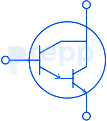
Identify the component shown in the image below:
Heat sink of a power transistor can be used for:
In case of an AC input signal in CE Transistor Load line can be given by a plot of
How does the construction of a MOSFET help to achieve high input impedance?
While diagnosing an NPN BJT in a SOT-23 package, your multimeter positive probe (+) is locked on the Base (Pin 1). Measuring to Pin 3 reads 0.6 V, while measuring to Pin 2 reads 0.68 V. Which pin is the Emitter?
Which type of charge carriers mainly control current in a Field Effect Transistor (FET)?
What is the purpose of the base region in an NPN transistor?
Why are transistors preferred over mechanical switches for rapid switching operations?
In the output characteristics of a common-emitter configuration, a family of curves is obtained by varying VCE while keeping which quantity fixed? (Symbols have their usual meaning.)
The common-emitter (CE) configuration of a transistor is most widely used as a/an:
Important Questions from Transistors
A transistor has ______ PN junctions
Which of the following is not true for a BJT?
A transistor amplifier with proper biasing has the following measured parameters:
Input resistance = 1 kΩ, Output resistance = 10 kΩ, Current gain = 90.
Identity the biasing configuration.
The change of output wave shape from the input wave shape of an amplifier is known as
Identify the component shown in the image below:



