
In an n-channel enhancement mode MOSFET, what must be applied to the gate terminal relative to the source to turn the device on?
A positive voltage
To turn on an n-channel enhancement mode MOSFET, a positive voltage must be applied to the gate terminal relative to the source. This positive gate voltage induces a strong electric field that attracts electrons towards the gate, forming an n-type channel between the source and drain. Here is the step-by-step explanation:
- In an enhancement mode MOSFET, the device is normally off when there is no gate voltage applied. The gate-to-source voltage needs to be increased to a positive value above a certain threshold voltage to create the conduction channel.
- The gate of an n-channel MOSFET is usually made of a material like polysilicon, separated from the channel by a thin silicon dioxide layer. This configuration makes the gate an insulated gate.
- When a positive voltage is applied to the gate relative to the source, it establishes an electric field across the oxide layer.
- This field induces a channel of mobile electrons in the p-type substrate beneath the gate, allowing current to flow from the drain to the source when a voltage is applied across them.
- Options such as 'a zero voltage' or 'a negative voltage' would not create the necessary channel for conduction in an n-channel enhancement MOSFET. 'A gate current' does not apply since the gate current in a MOSFET (ideally) is zero due to the insulating oxide layer.
Therefore, the correct answer is: A positive voltage.
Similar Questions
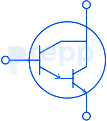
Identify the component shown in the image below:
The emitter current of a transistor is 1 mA. If 1% of the emitted current carriers are lost in the base recombination, what is the value β? Identify from the given options.
Heat sink of a power transistor can be used for:
In case of an AC input signal in CE Transistor Load line can be given by a plot of
How does the construction of a MOSFET help to achieve high input impedance?
While diagnosing an NPN BJT in a SOT-23 package, your multimeter positive probe (+) is locked on the Base (Pin 1). Measuring to Pin 3 reads 0.6 V, while measuring to Pin 2 reads 0.68 V. Which pin is the Emitter?
Which type of charge carriers mainly control current in a Field Effect Transistor (FET)?
What is the purpose of the base region in an NPN transistor?
Why are transistors preferred over mechanical switches for rapid switching operations?
In the output characteristics of a common-emitter configuration, a family of curves is obtained by varying VCE while keeping which quantity fixed? (Symbols have their usual meaning.)
Important Questions from Transistors
A transistor has ______ PN junctions
Which of the following is not true for a BJT?
A transistor amplifier with proper biasing has the following measured parameters:
Input resistance = 1 kΩ, Output resistance = 10 kΩ, Current gain = 90.
Identity the biasing configuration.
The change of output wave shape from the input wave shape of an amplifier is known as
Identify the component shown in the image below:



