
Which of the following is not true for a BJT?
Voltage controlled device
BJT Basics: Identifying Incorrect Characteristics
This question asks us to identify the statement that is NOT true for a Bipolar Junction Transistor (BJT). Let's analyze the fundamental properties of a BJT:
Understanding BJT Operation
A BJT is a type of transistor that uses both electrons and holes as charge carriers. It's a semiconductor device typically used to amplify or switch electronic signals and electrical power. Key features include its terminals and control mechanism.
Analyzing the Options
-
Statement 1: Current controlled device
This statement is true. A BJT is primarily considered a current-controlled device because the current flowing through the collector terminal ($I_C$) is controlled by the small current flowing into the base terminal ($I_B$). The relationship is often expressed as $I_C = \beta \times I_B$, where $\beta$ (beta) is the common-emitter current gain.
-
Statement 2: Voltage controlled device
This statement is generally considered not true in the primary classification of transistors. While the base-emitter voltage ($V_{BE}$) does influence the base current ($I_B$) and thus the collector current ($I_C$), the fundamental control mechanism is the base current itself. Devices like Field-Effect Transistors (FETs) are voltage-controlled, where the gate-source voltage ($V_{GS}$) directly controls the drain current. Therefore, classifying a BJT as a voltage-controlled device is inaccurate.
-
Statement 3: Has two PN junctions
This statement is true. A BJT structure consists of three semiconductor layers, creating two PN junctions. For an NPN transistor, there's an N-P junction (Base-Emitter) and a P-N junction (Base-Collector). Similarly, a PNP transistor has a P-N junction (Base-Emitter) and an N-P junction (Base-Collector).
-
Statement 4: Three terminal device
This statement is true. BJTs have three terminals: the Base (B), the Collector (C), and the Emitter (E). These terminals are used to connect the transistor into an electronic circuit.
Conclusion
Based on the analysis, the statement that is not true for a BJT is that it is a voltage-controlled device. Its primary mode of operation is current control.
Important Questions from Transistors
A transistor has ______ PN junctions
A transistor amplifier with proper biasing has the following measured parameters:
Input resistance = 1 kΩ, Output resistance = 10 kΩ, Current gain = 90.
Identity the biasing configuration.
The change of output wave shape from the input wave shape of an amplifier is known as
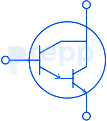
Identify the component shown in the image below:
The emitter current of a transistor is 1 mA. If 1% of the emitted current carriers are lost in the base recombination, what is the value β? Identify from the given options.


