
In a bipolar transistor, alpha is the ratio of:
Understanding Alpha in Bipolar Transistors
A bipolar junction transistor (BJT) is a semiconductor device used for amplifying or switching electronic signals. It has three terminals: the base, the collector, and the emitter. The current flow within a BJT is primarily due to both electrons and holes, hence the term 'bipolar'.
Bipolar Transistor Current Ratios: Alpha and Beta
In the context of bipolar transistors, specific ratios of currents flowing through these terminals are defined to characterize the transistor's current gain. Two important current gain parameters are alpha (\(\alpha\)) and beta (\(\beta\)).
- Alpha (\(\alpha\)) relates the collector current to the emitter current, typically in a common-base configuration.
- Beta (\(\beta\)) relates the collector current to the base current, typically in a common-emitter configuration.
Defining Alpha (\(\alpha\))
Alpha (\(\alpha\)) is formally defined as the ratio of the change in collector current (\(\Delta I_C\)) to the change in emitter current (\(\Delta I_E\)) when the collector-base voltage (\(V_{CB}\)) is kept constant. For DC currents, it is often approximated as the ratio of the DC collector current (\(I_C\)) to the DC emitter current (\(I_E\)).
The formula for alpha is:
\(\alpha = \frac{I_C}{I_E}\)
Where:
- \(I_C\) is the collector current.
- \(I_E\) is the emitter current.
The emitter current (\(I_E\)) is the total current entering the emitter. It consists of the current flowing into the base (\(I_B\)) and the current flowing into the collector (\(I_C\)). This relationship is given by:
\(I_E = I_B + I_C\)
Since some current flows into the base, the collector current (\(I_C\)) is always slightly less than the emitter current (\(I_E\)). Therefore, the value of alpha (\(\alpha\)) is typically very close to, but less than, 1 (e.g., 0.95 to 0.99).
Analyzing the Options
Let's examine the given options based on the definition of alpha:
-
Option 1: collector current to emitter current
This ratio is \(I_C / I_E\). This exactly matches the definition of alpha (\(\alpha\)).
-
Option 2: emitter current to collector current
This ratio is \(I_E / I_C\). This is the inverse of alpha, \(1/\alpha\). Alpha is \(I_C / I_E\).
-
Option 3: base current to collector current
This ratio is \(I_B / I_C\). This is the inverse of beta, \(1/\beta\). Beta is \(I_C / I_B\).
-
Option 4: collector current to base current
This ratio is \(I_C / I_B\). This is the definition of beta (\(\beta\)), which is the common-emitter current gain.
Based on the standard definition, alpha in a bipolar transistor is the ratio of collector current to emitter current.
Revision Table: Bipolar Transistor Current Ratios
| Parameter | Ratio | Formula | Typical Value | Configuration |
|---|---|---|---|---|
| Alpha (\(\alpha\)) | Collector current to emitter current | \(\alpha = \frac{I_C}{I_E}\) | 0.95 - 0.99 | Common Base |
| Beta (\(\beta\)) | Collector current to base current | \(\beta = \frac{I_C}{I_B}\) | 50 - 300 | Common Emitter |
Additional Information: Alpha and Beta Relationship
Alpha (\(\alpha\)) and Beta (\(\beta\)) are related to each other. Knowing one allows you to calculate the other. The relationship comes from the current equation \(I_E = I_B + I_C\).
-
To find \(\alpha\) from \(\beta\):
Start with \(\beta = \frac{I_C}{I_B}\), so \(I_B = \frac{I_C}{\beta}\).
Substitute \(I_B\) into \(I_E = I_B + I_C\):
\(I_E = \frac{I_C}{\beta} + I_C = I_C \left(\frac{1}{\beta} + 1\right) = I_C \left(\frac{1 + \beta}{\beta}\right)\)
Now, find \(\alpha = \frac{I_C}{I_E}\):
\(\alpha = \frac{I_C}{I_C \left(\frac{1 + \beta}{\beta}\right)} = \frac{\beta}{1 + \beta}\)
So, the relationship is \(\alpha = \frac{\beta}{1 + \beta}\).
-
To find \(\beta\) from \(\alpha\):
Rearrange \(\alpha = \frac{\beta}{1 + \beta}\):
\(\alpha(1 + \beta) = \beta\)
\(\alpha + \alpha\beta = \beta\)
\(\alpha = \beta - \alpha\beta = \beta(1 - \alpha)\)
\(\beta = \frac{\alpha}{1 - \alpha}\)
So, the relationship is \(\beta = \frac{\alpha}{1 - \alpha}\).
These relationships highlight that alpha and beta are dependent parameters, characterizing the current gain of the bipolar transistor in different circuit configurations.
Similar Questions
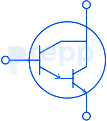
Identify the component shown in the image below:
The emitter current of a transistor is 1 mA. If 1% of the emitted current carriers are lost in the base recombination, what is the value β? Identify from the given options.
When the junction temperature of a transistor increases, its ______ increases.
Which of the following shows the proper biasing of a PNP transistor?
The output impedance of a MOSFET is:
Heat sink of a power transistor can be used for:
In case of an AC input signal in CE Transistor Load line can be given by a plot of
Which set of terminals is commonly used to connect a Field Effect Transistor in a circuit?
In an n-channel enhancement mode MOSFET, what must be applied to the gate terminal relative to the source to turn the device on?
What is the configuration called when the emitter terminal of a transistor is common to both input and output circuits?
Important Questions from Transistors
Transistors used as power amplifiers are generally mounted on a metallic plate so as to-
A transistor has ______ PN junctions
Which of the following is not true for a BJT?
A transistor amplifier with proper biasing has the following measured parameters:
Input resistance = 1 kΩ, Output resistance = 10 kΩ, Current gain = 90.
Identity the biasing configuration.
MOSFET can be used as a



