
The area of a ΔABC is one unit. DE is a straight line parallel to BC, joining the points D and E on AB and AC respectively such that AD : DB = 1 : 6. The ratio of the areas of ΔADE and ΔABC is:
1 : 49
Understanding the Problem: Triangle Area Ratio with Parallel Lines
The question asks for the ratio of the areas of two triangles, ΔADE and ΔABC, given that DE is a straight line parallel to BC, with points D on AB and E on AC. We are also given the ratio of segments on side AB, AD : DB = 1 : 6.
We know that when a line is drawn parallel to one side of a triangle intersecting the other two sides, it divides the two sides proportionally, and it creates a smaller triangle that is similar to the original triangle.
Analyzing the Triangle Similarity
In ΔABC, the line segment DE is parallel to BC, with D on AB and E on AC.
Consider ΔADE and ΔABC:
- ∠DAE is common to both triangles (∠DAE = ∠BAC).
- Since DE || BC, the corresponding angles are equal: ∠ADE = ∠ABC and ∠AED = ∠ACB.
Because two pairs of corresponding angles are equal, by the Angle-Angle (AA) similarity criterion, ΔADE is similar to ΔABC.
We can write this as: $\Delta ADE \sim \Delta ABC$.
Using Side Ratios in Similar Triangles
For similar triangles, the ratio of corresponding sides is constant. The corresponding sides are AD and AB, AE and AC, and DE and BC.
We are given the ratio AD : DB = 1 : 6. This means that for every 1 unit length of AD, DB has a length of 6 units. Therefore, the total length of AB is AD + DB. If we let AD be $k$ units, then DB is $6k$ units. So, AB = $k + 6k = 7k$ units.
The ratio of the corresponding sides AD and AB is:
$\frac{AD}{AB} = \frac{k}{7k} = \frac{1}{7}$
Since $\Delta ADE \sim \Delta ABC$, the ratio of all corresponding sides is 1/7.
$\frac{AD}{AB} = \frac{AE}{AC} = \frac{DE}{BC} = \frac{1}{7}$
Ratio of Areas of Similar Triangles
A fundamental property of similar triangles states that the ratio of their areas is equal to the square of the ratio of their corresponding sides.
Area($\Delta$ADE) / Area($\Delta$ABC) = (Ratio of corresponding sides)$^2$
Using the ratio of sides we found (1/7):
$\frac{\text{Area}(\Delta ADE)}{\text{Area}(\Delta ABC)} = \left(\frac{AD}{AB}\right)^2 = \left(\frac{1}{7}\right)^2$
$\frac{\text{Area}(\Delta ADE)}{\text{Area}(\Delta ABC)} = \frac{1^2}{7^2} = \frac{1}{49}$
Calculating the Final Ratio
The ratio of the areas of ΔADE and ΔABC is 1/49, which can be written as 1 : 49.
The fact that the area of ΔABC is one unit is additional information that isn't needed to find the ratio of the areas. If we needed the area of ΔADE, we would use this information: Area(ΔADE) / 1 = 1/49, so Area(ΔADE) = 1/49 square units.
Conclusion
Based on the similarity of ΔADE and ΔABC due to DE || BC, and the given ratio AD : DB = 1 : 6 leading to a side ratio AD : AB = 1 : 7, the ratio of their areas is the square of the side ratio.
Ratio of areas = $(1/7)^2 = 1/49$.
| Step | Description | Calculation/Reason |
|---|---|---|
| 1 | Identify similar triangles | ΔADE $\sim$ ΔABC (AA Similarity, DE || BC) |
| 2 | Determine side ratio AD:AB | AD:DB = 1:6 ⇒ AD = 1 part, DB = 6 parts ⇒ AB = AD + DB = 7 parts. Ratio AD:AB = 1:7. |
| 3 | Relate area ratio to side ratio | Ratio of areas = (Ratio of corresponding sides)$^2$ |
| 4 | Calculate area ratio | Area(ΔADE) : Area(ΔABC) = (AD/AB)$^2$ = $(1/7)^2 = 1/49$. |
Revision Table: Key Concepts for Triangle Area Questions
| Concept | Description | Relevance |
|---|---|---|
| Similar Triangles | Triangles with the same shape but potentially different sizes. Corresponding angles are equal, corresponding sides are proportional. | Essential for relating ΔADE and ΔABC. |
| AA Similarity Criterion | If two angles of one triangle are equal to two angles of another triangle, the triangles are similar. | Used to prove ΔADE $\sim$ ΔABC. |
| Basic Proportionality Theorem (Thales's Theorem) | If a line parallel to one side of a triangle intersects the other two sides, it divides the two sides proportionally. | Confirms AE/EC = AD/DB, reinforcing proportionality. |
| Ratio of Areas of Similar Triangles | The ratio of the areas of two similar triangles is equal to the square of the ratio of their corresponding sides. | The core theorem used to solve the problem. |
Additional Information: Extensions and Related Concepts
Understanding triangle similarity and the properties of parallel lines within triangles is crucial for many geometry problems. Here are a few related ideas:
- Converse of BPT: If a line divides two sides of a triangle proportionally, then the line is parallel to the third side.
- Midpoint Theorem: A special case of BPT where the line segment connects the midpoints of two sides. The segment is parallel to the third side and half its length. The area of the small triangle formed is 1/4th the area of the original triangle.
- Altitude Ratio: In similar triangles, the ratio of corresponding altitudes is equal to the ratio of corresponding sides.
- Perimeter Ratio: In similar triangles, the ratio of their perimeters is equal to the ratio of their corresponding sides.
These concepts build upon the fundamental understanding of similarity and proportionality, allowing you to solve a wider range of geometry problems involving triangles and parallel lines.
Similar Questions
If sides of a triangle are 12 cm, 15 cm and 21 cm, then what is the inradius (in cm) of the triangle?
In ΔPQR, PQ = PR and S is a point on QR such that ∠PSQ = 96° + ∠QPS and ∠QPR = 132°. What is the measure of ∠PSR?
If ∆ABC ~ ∆EDF such that AB = 6 cm, DF = 16 cm and DE = 8 cm, then the length of BC is:
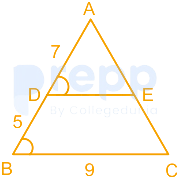
In ΔABC, D and E are the points on sides AB and AC, respectively such that ∠ADE = ∠B. If AD = 7 cm, BD = 5cm and BC = 9 cm, then DE (in cm) is equal to:
In triangle ABC, P and Q are the mid points of AB and AC, respectively. R is a point on PQ such that PR : RQ = 3 : 5 and QR = 20 cm, then what is the length (in cm) of BC?
ΔABC is similar to ΔPQR and AB : PQ = 2 : 3. AD is the median to the side BC in ΔABC and PS is the median to the side QR in ΔPQR. What is the value of (BD/QS) 2?
In a triangle ABC, AB = 12, BC = 18 and AC = 15. The medians AX and BY intersect sides BC and AC at X and Y respectively. If AX and BY intersect each other at O, then what is the value of OX?
Let Δ ABC ∼ Δ RPQ and \(\frac{ar(\Delta ABC)}{ar(\Delta RPQ)}=\frac{16}{25}\) . If PQ = 4 cm, QR = 6 cm and PR = 7 cm, then AC (in cm) is equal to:
In ΔABC, ∠C = 90°, Point P and Q are on the sides AC and BC, respectively, such that AP : PC = BQ : QC = 1 : 2 then, \(\frac{AQ^2+BP^2}{AB^2}\) is equal to:
The area of ΔABC is 44 cm 2. If D is the midpoint of BC and E is the midpoint of AB, then the area (in cm 2) of ΔBDE is:
Important Questions from Triangles, Congruence and Similarity
G is the centroid of the equilateral triangle ABC. If AB = 8√ 3 cm, then the length of AG is equal to:
If sides of a triangle are 12 cm, 15 cm and 21 cm, then what is the inradius (in cm) of the triangle?
What is the area of quadrilateral ABCD?
It is given that ΔABC ~ ΔXYZ and Area ΔABC : Area ΔXYZ = 81 : 25. If AB = 18 cm, BC = 10 cm, CA = 15 cm, then what is the side XZ (in cm)?
Sides of two similar triangles are in the ratio 4 ∶ 9. Area of these triangles are in the ratio:



