
ΔABC is similar to ΔPQR and AB : PQ = 2 : 3. AD is the median to the side BC in ΔABC and PS is the median to the side QR in ΔPQR. What is the value of (BD/QS) 2?
4/9
Since \(\triangle ABC\sim\triangle PQR\), corresponding sides share the ratio \(\dfrac{AB}{PQ}=\dfrac{BC}{QR}=\dfrac{2}{3}\).
AD and PS are medians, so D and S are midpoints, giving \(BD=\tfrac{1}{2}BC\) and \(QS=\tfrac{1}{2}QR\). Therefore:
\[\frac{BD}{QS}=\frac{BC}{QR}=\frac{2}{3}\]
\[\left(\frac{BD}{QS}\right)^2=\left(\frac{2}{3}\right)^2=\frac{4}{9}\]
Similar Questions
If sides of a triangle are 12 cm, 15 cm and 21 cm, then what is the inradius (in cm) of the triangle?
In ΔPQR, PQ = PR and S is a point on QR such that ∠PSQ = 96° + ∠QPS and ∠QPR = 132°. What is the measure of ∠PSR?
If ∆ABC ~ ∆EDF such that AB = 6 cm, DF = 16 cm and DE = 8 cm, then the length of BC is:
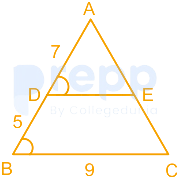
In ΔABC, D and E are the points on sides AB and AC, respectively such that ∠ADE = ∠B. If AD = 7 cm, BD = 5cm and BC = 9 cm, then DE (in cm) is equal to:
In triangle ABC, P and Q are the mid points of AB and AC, respectively. R is a point on PQ such that PR : RQ = 3 : 5 and QR = 20 cm, then what is the length (in cm) of BC?
In a triangle ABC, AB = 12, BC = 18 and AC = 15. The medians AX and BY intersect sides BC and AC at X and Y respectively. If AX and BY intersect each other at O, then what is the value of OX?
Let Δ ABC ∼ Δ RPQ and \(\frac{ar(\Delta ABC)}{ar(\Delta RPQ)}=\frac{16}{25}\) . If PQ = 4 cm, QR = 6 cm and PR = 7 cm, then AC (in cm) is equal to:
In ΔABC, ∠C = 90°, Point P and Q are on the sides AC and BC, respectively, such that AP : PC = BQ : QC = 1 : 2 then, \(\frac{AQ^2+BP^2}{AB^2}\) is equal to:
The area of a ΔABC is one unit. DE is a straight line parallel to BC, joining the points D and E on AB and AC respectively such that AD : DB = 1 : 6. The ratio of the areas of ΔADE and ΔABC is:
The area of ΔABC is 44 cm 2. If D is the midpoint of BC and E is the midpoint of AB, then the area (in cm 2) of ΔBDE is:
Important Questions from Triangles, Congruence and Similarity
G is the centroid of the equilateral triangle ABC. If AB = 8√ 3 cm, then the length of AG is equal to:
If sides of a triangle are 12 cm, 15 cm and 21 cm, then what is the inradius (in cm) of the triangle?
What is the area of quadrilateral ABCD?
It is given that ΔABC ~ ΔXYZ and Area ΔABC : Area ΔXYZ = 81 : 25. If AB = 18 cm, BC = 10 cm, CA = 15 cm, then what is the side XZ (in cm)?
Sides of two similar triangles are in the ratio 4 ∶ 9. Area of these triangles are in the ratio:



