
In ΔPQR, PQ = PR and S is a point on QR such that ∠PSQ = 96° + ∠QPS and ∠QPR = 132°. What is the measure of ∠PSR?
54°
Solving the Triangle Geometry Problem: Finding ∠PSR
This problem involves calculating angles in a triangle using properties of isosceles triangles and angle relationships.
We are given a triangle ΔPQR where PQ = PR. This means ΔPQR is an isosceles triangle. In an isosceles triangle, the angles opposite the equal sides are equal. Therefore, ∠PQR = ∠PRQ.
We are also given that ∠QPR = 132°.
The sum of angles in any triangle is 180°. So, in ΔPQR:
$$ \angle QPR + \angle PQR + \angle PRQ = 180^\circ $$
Substituting the given values and using ∠PQR = ∠PRQ:
$$ 132^\circ + \angle PQR + \angle PQR = 180^\circ $$
$$ 132^\circ + 2 \angle PQR = 180^\circ $$
Subtracting 132° from both sides:
$$ 2 \angle PQR = 180^\circ - 132^\circ $$
$$ 2 \angle PQR = 48^\circ $$
Dividing by 2:
$$ \angle PQR = \frac{48^\circ}{2} $$
$$ \angle PQR = 24^\circ $$
Since ∠PQR = ∠PRQ, we have ∠PRQ = 24°.
Now, consider the triangle ΔPQS. S is a point on QR. The sum of angles in ΔPQS is 180°:
$$ \angle QPS + \angle PQS + \angle PSQ = 180^\circ $$
We know ∠PQS is the same as ∠PQR, which is 24°. So:
$$ \angle QPS + 24^\circ + \angle PSQ = 180^\circ $$
We are also given a relationship between ∠PSQ and ∠QPS:
$$ \angle PSQ = 96^\circ + \angle QPS $$
Substitute this expression for ∠PSQ into the equation for ΔPQS:
$$ \angle QPS + 24^\circ + (96^\circ + \angle QPS) = 180^\circ $$
Combine like terms:
$$ 2 \angle QPS + 120^\circ = 180^\circ $$
Subtract 120° from both sides:
$$ 2 \angle QPS = 180^\circ - 120^\circ $$
$$ 2 \angle QPS = 60^\circ $$
Divide by 2:
$$ \angle QPS = \frac{60^\circ}{2} $$
$$ \angle QPS = 30^\circ $$
Now that we have ∠QPS, we can find ∠PSQ using the given relation:
$$ \angle PSQ = 96^\circ + \angle QPS $$
$$ \angle PSQ = 96^\circ + 30^\circ $$
$$ \angle PSQ = 126^\circ $$
The points Q, S, and R lie on a straight line (QR). Therefore, ∠PSQ and ∠PSR are supplementary angles. Supplementary angles add up to 180°.
$$ \angle PSQ + \angle PSR = 180^\circ $$
Substitute the value of ∠PSQ:
$$ 126^\circ + \angle PSR = 180^\circ $$
Subtract 126° from both sides:
$$ \angle PSR = 180^\circ - 126^\circ $$
$$ \angle PSR = 54^\circ $$
Thus, the measure of ∠PSR is 54°.
Let's summarize the angles we found:
| Angle | Measure |
|---|---|
| ∠QPR | 132° |
| ∠PQR (∠Q) | 24° |
| ∠PRQ (∠R) | 24° |
| ∠QPS | 30° |
| ∠PSQ | 126° |
| ∠PSR | 54° |
We can also verify this using ΔPSR. The angles are ∠SPR, ∠SRP, and ∠PSR. We know ∠SRP = ∠PRQ = 24° and ∠PSR = 54°. ∠QPR = ∠QPS + ∠SPR. So, 132° = 30° + ∠SPR, which gives ∠SPR = 102°.
Sum of angles in ΔPSR = ∠SPR + ∠SRP + ∠PSR = 102° + 24° + 54° = 180°. This confirms our result.
Revision Table: Key Geometry Concepts
| Concept | Description |
|---|---|
| Isosceles Triangle Properties | If two sides of a triangle are equal, the angles opposite those sides are also equal. |
| Sum of Angles in a Triangle | The sum of the interior angles in any triangle is always 180°. |
| Supplementary Angles | Two angles that add up to 180° are called supplementary angles. Angles on a straight line are supplementary. |
Additional Information: Understanding Angles in Triangles
Angles play a fundamental role in geometry. In any triangle, there are three interior angles. Their sum is a constant, 180°. This property is crucial for solving many geometry problems.
When dealing with specific types of triangles, like isosceles or equilateral triangles, additional properties regarding angles simplify calculations. An isosceles triangle has at least two equal sides and two equal angles. An equilateral triangle has all three sides equal and all three angles equal (each being 60°).
Exterior angles of a triangle are also important. An exterior angle is equal to the sum of the two opposite interior angles. In our problem, ∠PSQ is an exterior angle to ΔPSR at vertex S if we consider the line segment QR as extended, but more directly, ∠PSQ and ∠PSR form a linear pair on the line QR, making them supplementary.
Breaking down complex angle problems into steps involving smaller triangles and using basic angle relationships (like supplementary angles) is a common and effective strategy.
Similar Questions
If sides of a triangle are 12 cm, 15 cm and 21 cm, then what is the inradius (in cm) of the triangle?
If ∆ABC ~ ∆EDF such that AB = 6 cm, DF = 16 cm and DE = 8 cm, then the length of BC is:
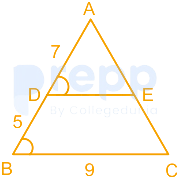
In ΔABC, D and E are the points on sides AB and AC, respectively such that ∠ADE = ∠B. If AD = 7 cm, BD = 5cm and BC = 9 cm, then DE (in cm) is equal to:
In triangle ABC, P and Q are the mid points of AB and AC, respectively. R is a point on PQ such that PR : RQ = 3 : 5 and QR = 20 cm, then what is the length (in cm) of BC?
ΔABC is similar to ΔPQR and AB : PQ = 2 : 3. AD is the median to the side BC in ΔABC and PS is the median to the side QR in ΔPQR. What is the value of (BD/QS) 2?
In a triangle ABC, AB = 12, BC = 18 and AC = 15. The medians AX and BY intersect sides BC and AC at X and Y respectively. If AX and BY intersect each other at O, then what is the value of OX?
Let Δ ABC ∼ Δ RPQ and \(\frac{ar(\Delta ABC)}{ar(\Delta RPQ)}=\frac{16}{25}\) . If PQ = 4 cm, QR = 6 cm and PR = 7 cm, then AC (in cm) is equal to:
In ΔABC, ∠C = 90°, Point P and Q are on the sides AC and BC, respectively, such that AP : PC = BQ : QC = 1 : 2 then, \(\frac{AQ^2+BP^2}{AB^2}\) is equal to:
The area of a ΔABC is one unit. DE is a straight line parallel to BC, joining the points D and E on AB and AC respectively such that AD : DB = 1 : 6. The ratio of the areas of ΔADE and ΔABC is:
The area of ΔABC is 44 cm 2. If D is the midpoint of BC and E is the midpoint of AB, then the area (in cm 2) of ΔBDE is:
Important Questions from Triangles, Congruence and Similarity
G is the centroid of the equilateral triangle ABC. If AB = 8√ 3 cm, then the length of AG is equal to:
If sides of a triangle are 12 cm, 15 cm and 21 cm, then what is the inradius (in cm) of the triangle?
What is the area of quadrilateral ABCD?
It is given that ΔABC ~ ΔXYZ and Area ΔABC : Area ΔXYZ = 81 : 25. If AB = 18 cm, BC = 10 cm, CA = 15 cm, then what is the side XZ (in cm)?
Sides of two similar triangles are in the ratio 4 ∶ 9. Area of these triangles are in the ratio:



