
The area of ΔABC is 44 cm 2. If D is the midpoint of BC and E is the midpoint of AB, then the area (in cm 2) of ΔBDE is:
11
Calculating the Area of Triangle BDE
The question asks for the area of triangle BDE, given that the area of triangle ABC is 44 cm2, D is the midpoint of BC, and E is the midpoint of AB.
Understanding the Properties of Midpoints
When D is the midpoint of side BC, it means that BD = DC, so BD is half the length of BC.
When E is the midpoint of side AB, it means that AE = EB, so BE is half the length of AB.
Relating Triangle BDE to Triangle ABC
Consider triangle BDE and triangle ABC. Both triangles share angle B.
- Side BE of $\Delta$BDE is half of side AB of $\Delta$ABC ($\text{BE} = \frac{1}{2}\text{AB}$).
- Side BD of $\Delta$BDE is half of side BC of $\Delta$ABC ($\text{BD} = \frac{1}{2}\text{BC}$).
- Angle B is common to both triangles.
Using the Area Formula for Triangles
The area of a triangle can be calculated using the formula: $\text{Area} = \frac{1}{2} \times \text{side}_1 \times \text{side}_2 \times \sin(\text{included angle})$.
For $\Delta$ABC:
$\text{Area}(\Delta\text{ABC}) = \frac{1}{2} \times \text{AB} \times \text{BC} \times \sin(\text{B})$
For $\Delta$BDE:
$\text{Area}(\Delta\text{BDE}) = \frac{1}{2} \times \text{BE} \times \text{BD} \times \sin(\text{B})$
Substituting the Midpoint Relationships
Substitute the relationships $\text{BE} = \frac{1}{2}\text{AB}$ and $\text{BD} = \frac{1}{2}\text{BC}$ into the area formula for $\Delta$BDE:
$\text{Area}(\Delta\text{BDE}) = \frac{1}{2} \times \left(\frac{1}{2}\text{AB}\right) \times \left(\frac{1}{2}\text{BC}\right) \times \sin(\text{B})$
$\text{Area}(\Delta\text{BDE}) = \frac{1}{2} \times \frac{1}{2} \times \frac{1}{2} \times \text{AB} \times \text{BC} \times \sin(\text{B})$
$\text{Area}(\Delta\text{BDE}) = \frac{1}{4} \times \left(\frac{1}{2} \times \text{AB} \times \text{BC} \times \sin(\text{B})\right)$
Notice that the term in the parenthesis is the area of $\Delta$ABC.
So, $\text{Area}(\Delta\text{BDE}) = \frac{1}{4} \times \text{Area}(\Delta\text{ABC})$.
Calculating the Area of Triangle BDE
Given that $\text{Area}(\Delta\text{ABC}) = 44 \text{ cm}^2$, we can calculate the area of $\Delta$BDE:
$\text{Area}(\Delta\text{BDE}) = \frac{1}{4} \times 44 \text{ cm}^2$
$\text{Area}(\Delta\text{BDE}) = 11 \text{ cm}^2$
Conclusion
The area of triangle BDE is 11 cm2.
Revision Table: Triangle Area and Midpoints
| Concept | Description | Relationship to $\Delta$BDE and $\Delta$ABC |
|---|---|---|
| Midpoint | A point dividing a line segment into two equal parts. | D is midpoint of BC, E is midpoint of AB. |
| Side Lengths | Lengths of corresponding sides in $\Delta$BDE vs $\Delta$ABC. | BE = $\frac{1}{2}$ AB, BD = $\frac{1}{2}$ BC. |
| Included Angle | Angle between the two sides used in area calculation. | Angle B is common to both $\Delta$BDE and $\Delta$ABC. |
| Area Formula | $\frac{1}{2} \times \text{side}_1 \times \text{side}_2 \times \sin(\text{angle})$. | Used to derive the area relationship. |
| Area Relationship | How the areas of $\Delta$BDE and $\Delta$ABC relate. | Area($\Delta$BDE) = $\frac{1}{4}$ Area($\Delta$ABC). |
Additional Information: Midpoint Theorem Context
The Midpoint Theorem states that the line segment joining the midpoints of any two sides of a triangle is parallel to the third side and is half its length.
In $\Delta$ABC, since E is the midpoint of AB and D is the midpoint of BC, the line segment ED is parallel to AC and $\text{ED} = \frac{1}{2}\text{AC}$.
If we were to also find the midpoint of AC, say F, and connect D, E, and F, the triangle ABC would be divided into four smaller triangles: $\Delta$BDE, $\Delta$AED, $\Delta$DFC, and $\Delta$EFD.
A key property is that these four triangles ($\Delta$BDE, $\Delta$AED, $\Delta$DFC, $\Delta$EFD) are congruent to each other. Therefore, they all have the same area.
Since there are four such congruent triangles that make up the original triangle ABC, the area of each smaller triangle is one-fourth the area of $\Delta$ABC.
Our specific problem focuses on $\Delta$BDE, which is indeed one of these four triangles (if we imagine the line ED being drawn, even if the midpoint of AC isn't explicitly mentioned). The relationship $\text{Area}(\Delta\text{BDE}) = \frac{1}{4} \times \text{Area}(\Delta\text{ABC})$ holds true, as proven by both the area formula method and the property arising from the Midpoint Theorem when all three midpoints are considered.
Similar Questions
If sides of a triangle are 12 cm, 15 cm and 21 cm, then what is the inradius (in cm) of the triangle?
In ΔPQR, PQ = PR and S is a point on QR such that ∠PSQ = 96° + ∠QPS and ∠QPR = 132°. What is the measure of ∠PSR?
If ∆ABC ~ ∆EDF such that AB = 6 cm, DF = 16 cm and DE = 8 cm, then the length of BC is:
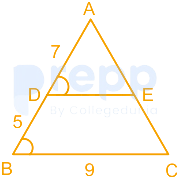
In ΔABC, D and E are the points on sides AB and AC, respectively such that ∠ADE = ∠B. If AD = 7 cm, BD = 5cm and BC = 9 cm, then DE (in cm) is equal to:
In triangle ABC, P and Q are the mid points of AB and AC, respectively. R is a point on PQ such that PR : RQ = 3 : 5 and QR = 20 cm, then what is the length (in cm) of BC?
ΔABC is similar to ΔPQR and AB : PQ = 2 : 3. AD is the median to the side BC in ΔABC and PS is the median to the side QR in ΔPQR. What is the value of (BD/QS) 2?
In a triangle ABC, AB = 12, BC = 18 and AC = 15. The medians AX and BY intersect sides BC and AC at X and Y respectively. If AX and BY intersect each other at O, then what is the value of OX?
Let Δ ABC ∼ Δ RPQ and \(\frac{ar(\Delta ABC)}{ar(\Delta RPQ)}=\frac{16}{25}\) . If PQ = 4 cm, QR = 6 cm and PR = 7 cm, then AC (in cm) is equal to:
In ΔABC, ∠C = 90°, Point P and Q are on the sides AC and BC, respectively, such that AP : PC = BQ : QC = 1 : 2 then, \(\frac{AQ^2+BP^2}{AB^2}\) is equal to:
The area of a ΔABC is one unit. DE is a straight line parallel to BC, joining the points D and E on AB and AC respectively such that AD : DB = 1 : 6. The ratio of the areas of ΔADE and ΔABC is:
Important Questions from Triangles, Congruence and Similarity
G is the centroid of the equilateral triangle ABC. If AB = 8√ 3 cm, then the length of AG is equal to:
If sides of a triangle are 12 cm, 15 cm and 21 cm, then what is the inradius (in cm) of the triangle?
What is the area of quadrilateral ABCD?
It is given that ΔABC ~ ΔXYZ and Area ΔABC : Area ΔXYZ = 81 : 25. If AB = 18 cm, BC = 10 cm, CA = 15 cm, then what is the side XZ (in cm)?
Sides of two similar triangles are in the ratio 4 ∶ 9. Area of these triangles are in the ratio:



