
In ΔABC, ∠C = 90°, Point P and Q are on the sides AC and BC, respectively, such that AP : PC = BQ : QC = 1 : 2 then, \(\frac{AQ^2+BP^2}{AB^2}\) is equal to:
13/9
Solving the Right Triangle Ratio Problem
The question asks us to find the value of a specific ratio involving side lengths in a right-angled triangle ABC. We are given that ∠C = 90°, points P and Q are on sides AC and BC respectively, and the ratios AP : PC = 1 : 2 and BQ : QC = 1 : 2.
Understanding the Ratios and Side Lengths
Let's use the given ratios to express the lengths of the segments on sides AC and BC.
- For side AC: AP : PC = 1 : 2. Let AP = \(x\) units. Then PC = \(2x\) units. The total length of AC is AP + PC = \(x + 2x = 3x\) units.
- For side BC: BQ : QC = 1 : 2. Let BQ = \(y\) units. Then QC = \(2y\) units. The total length of BC is BQ + QC = \(y + 2y = 3y\) units.
So, we have AC = \(3x\) and BC = \(3y\), where \(x\) and \(y\) are positive values representing parts of the lengths.
Applying the Pythagorean Theorem
Since ΔABC is a right-angled triangle with ∠C = 90°, we can use the Pythagorean theorem to relate the sides.
1. Finding AB²:
In ΔABC, AB² = AC² + BC².
Substituting the lengths we found:
\(AB^2 = (3x)^2 + (3y)^2\)
\(AB^2 = 9x^2 + 9y^2\)
2. Finding AQ²:
Consider the triangle ACQ. This is a right-angled triangle with ∠C = 90°. AQ is the hypotenuse.
AQ² = AC² + CQ²
We know AC = \(3x\) and QC = \(2y\).
\(AQ^2 = (3x)^2 + (2y)^2\)
\(AQ^2 = 9x^2 + 4y^2\)
3. Finding BP²:
Consider the triangle BCP. This is a right-angled triangle with ∠C = 90°. BP is the hypotenuse.
BP² = BC² + CP²
We know BC = \(3y\) and PC = \(2x\).
\(BP^2 = (3y)^2 + (2x)^2\)
\(BP^2 = 9y^2 + 4x^2\)
Calculating the Expression
We need to find the value of \(\frac{AQ^2+BP^2}{AB^2}\).
First, let's find the sum AQ² + BP²:
\(AQ^2 + BP^2 = (9x^2 + 4y^2) + (9y^2 + 4x^2)\)
\(AQ^2 + BP^2 = 9x^2 + 4x^2 + 4y^2 + 9y^2\)
\(AQ^2 + BP^2 = 13x^2 + 13y^2\)
\(AQ^2 + BP^2 = 13(x^2 + y^2)\)
Now, substitute the expressions for AQ² + BP² and AB² into the required ratio:
\(\frac{AQ^2+BP^2}{AB^2} = \frac{13(x^2 + y^2)}{9x^2 + 9y^2}\)
\(\frac{AQ^2+BP^2}{AB^2} = \frac{13(x^2 + y^2)}{9(x^2 + y^2)}\)
Assuming \(x^2 + y^2 \neq 0\) (which must be true for a non-degenerate triangle), we can cancel out the \((x^2 + y^2)\) term.
\(\frac{AQ^2+BP^2}{AB^2} = \frac{13}{9}\)
Thus, the value of the expression \(\frac{AQ^2+BP^2}{AB^2}\) is \(\frac{13}{9}\).
Let's compare this result with the given options:
- 4/9
- 8/3
- 4/3
- 13/9
Our calculated value matches the fourth option.
Revision Table: Key Concepts
| Concept | Description | Application in this problem |
|---|---|---|
| Right Triangle | A triangle with one angle equal to 90°. | ΔABC, ΔACQ, ΔBCP are right triangles at C. |
| Pythagorean Theorem | In a right triangle, the square of the hypotenuse is equal to the sum of the squares of the other two sides (\(a^2 + b^2 = c^2\)). | Used to find expressions for AB², AQ², and BP². |
| Ratio and Proportion | Expressing relative sizes of quantities. | Used to define lengths of segments AP, PC, BQ, QC in terms of variables \(x\) and \(y\). |
Additional Information: Generalization
This type of problem is a classic application of the Pythagorean theorem with ratios. Notice that the final result \(\frac{13}{9}\) does not depend on the specific values of \(x\) or \(y\), meaning it doesn't depend on the exact dimensions of the triangle, only on the ratios given for P and Q.
In a right triangle ABC (at C), if P on AC divides it in ratio m:n (AP:PC = m:n) and Q on BC divides it in ratio p:q (BQ:QC = p:q), we can find a general formula for \(\frac{AQ^2+BP^2}{AB^2}\).
- Let AC = \((m+n)k_1\) and BC = \((p+q)k_2\).
- Then PC = \(nk_1\), AP = \(mk_1\), QC = \(qk_2\), BQ = \(pk_2\).
- \(AB^2 = AC^2 + BC^2 = ((m+n)k_1)^2 + ((p+q)k_2)^2\)
- \(AQ^2 = AC^2 + CQ^2 = ((m+n)k_1)^2 + (qk_2)^2\)
- \(BP^2 = BC^2 + CP^2 = ((p+q)k_2)^2 + (nk_1)^2\)
\(AQ^2 + BP^2 = ((m+n)k_1)^2 + (qk_2)^2 + ((p+q)k_2)^2 + (nk_1)^2\)
\(AQ^2 + BP^2 = k_1^2((m+n)^2 + n^2) + k_2^2((p+q)^2 + q^2)\)
The expression becomes quite complex and usually depends on the specific ratios and possibly the relative lengths \(k_1\) and \(k_2\), unless there's a special case. In our specific problem, the ratios were the same (1:2), and the sides were defined relative to these ratios (AC = 3x, BC = 3y), which allowed simplification.
Our problem corresponds to m=1, n=2, p=1, q=2. If we let \(AC = 3k\) and \(BC = 3l\), then \(x=k\) and \(y=l\). The result \(\frac{13(k^2+l^2)}{9(k^2+l^2)} = \frac{13}{9}\) shows independence from \(k\) and \(l\).
Similar Questions
If sides of a triangle are 12 cm, 15 cm and 21 cm, then what is the inradius (in cm) of the triangle?
In ΔPQR, PQ = PR and S is a point on QR such that ∠PSQ = 96° + ∠QPS and ∠QPR = 132°. What is the measure of ∠PSR?
If ∆ABC ~ ∆EDF such that AB = 6 cm, DF = 16 cm and DE = 8 cm, then the length of BC is:
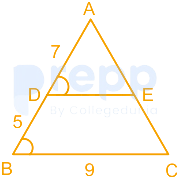
In ΔABC, D and E are the points on sides AB and AC, respectively such that ∠ADE = ∠B. If AD = 7 cm, BD = 5cm and BC = 9 cm, then DE (in cm) is equal to:
In triangle ABC, P and Q are the mid points of AB and AC, respectively. R is a point on PQ such that PR : RQ = 3 : 5 and QR = 20 cm, then what is the length (in cm) of BC?
ΔABC is similar to ΔPQR and AB : PQ = 2 : 3. AD is the median to the side BC in ΔABC and PS is the median to the side QR in ΔPQR. What is the value of (BD/QS) 2?
In a triangle ABC, AB = 12, BC = 18 and AC = 15. The medians AX and BY intersect sides BC and AC at X and Y respectively. If AX and BY intersect each other at O, then what is the value of OX?
Let Δ ABC ∼ Δ RPQ and \(\frac{ar(\Delta ABC)}{ar(\Delta RPQ)}=\frac{16}{25}\) . If PQ = 4 cm, QR = 6 cm and PR = 7 cm, then AC (in cm) is equal to:
The area of a ΔABC is one unit. DE is a straight line parallel to BC, joining the points D and E on AB and AC respectively such that AD : DB = 1 : 6. The ratio of the areas of ΔADE and ΔABC is:
The area of ΔABC is 44 cm 2. If D is the midpoint of BC and E is the midpoint of AB, then the area (in cm 2) of ΔBDE is:
Important Questions from Triangles, Congruence and Similarity
G is the centroid of the equilateral triangle ABC. If AB = 8√ 3 cm, then the length of AG is equal to:
If sides of a triangle are 12 cm, 15 cm and 21 cm, then what is the inradius (in cm) of the triangle?
What is the area of quadrilateral ABCD?
It is given that ΔABC ~ ΔXYZ and Area ΔABC : Area ΔXYZ = 81 : 25. If AB = 18 cm, BC = 10 cm, CA = 15 cm, then what is the side XZ (in cm)?
Sides of two similar triangles are in the ratio 4 ∶ 9. Area of these triangles are in the ratio:



