
Consider the following for the next three (03) items :
What is the area of quadrilateral ABCD?
306 cm 2
Calculating the Area of Quadrilateral ABCD
The problem asks us to find the area of a specific quadrilateral ABCD. We are given the lengths of its sides: AB = 9 cm, BC = 40 cm, CD = 28 cm, and DA = 15 cm. We are also told that angle ABC is a right angle, which means it measures 90 degrees.
To find the area of the quadrilateral, we can divide it into two triangles by drawing a diagonal. Since angle ABC is a right angle, drawing the diagonal AC seems logical because it creates a right-angled triangle ABC.
So, the area of quadrilateral ABCD will be the sum of the areas of triangle ABC and triangle ADC.
Step 1: Calculate the Area of Triangle ABC
Triangle ABC is a right-angled triangle with the right angle at B. The sides AB and BC are the base and height of this triangle.
The area of a right-angled triangle is given by the formula:
Area = \(\frac{1}{2} \times \text{base} \times \text{height}\)
Using AB and BC as base and height:
Area of \(\triangle\) ABC = \(\frac{1}{2} \times \text{AB} \times \text{BC}\)
Area of \(\triangle\) ABC = \(\frac{1}{2} \times 9 \text{ cm} \times 40 \text{ cm}\)
Area of \(\triangle\) ABC = \(\frac{1}{2} \times 360 \text{ cm}^2\)
Area of \(\triangle\) ABC = \(180 \text{ cm}^2\)
Step 2: Calculate the Length of Diagonal AC
We need the length of the diagonal AC to find the area of triangle ADC. Since triangle ABC is a right-angled triangle, we can use the Pythagorean theorem to find the length of the hypotenuse AC.
According to the Pythagorean theorem:
AC\(^2\) = AB\(^2\) + BC\(^2\)
AC\(^2\) = \((9 \text{ cm})^2\) + \((40 \text{ cm})^2\)
AC\(^2\) = \(81 \text{ cm}^2\) + \(1600 \text{ cm}^2\)
AC\(^2\) = \(1681 \text{ cm}^2\)
AC = \(\sqrt{1681} \text{ cm}\)
To find the square root of 1681, we can test numbers. \(40^2 = 1600\). Let's try \(41^2\). \(41 \times 41 = 1681\).
So, AC = \(41 \text{ cm}\).
Step 3: Calculate the Area of Triangle ADC
Now we have triangle ADC with side lengths AD = 15 cm, CD = 28 cm, and AC = 41 cm. This is a general triangle, and we can calculate its area using Heron's formula.
Heron's formula for the area of a triangle with sides a, b, and c is \(\sqrt{s(s-a)(s-b)(s-c)}\), where s is the semi-perimeter of the triangle, calculated as \(s = \frac{a+b+c}{2}\).
For triangle ADC, let a = AD = 15 cm, b = CD = 28 cm, and c = AC = 41 cm.
First, calculate the semi-perimeter s:
s = \(\frac{15 + 28 + 41}{2} \text{ cm}\)
s = \(\frac{84}{2} \text{ cm}\)
s = \(42 \text{ cm}\)
Now, apply Heron's formula:
Area of \(\triangle\) ADC = \(\sqrt{s(s-a)(s-b)(s-c)}\)
Area of \(\triangle\) ADC = \(\sqrt{42(42-15)(42-28)(42-41)} \text{ cm}^2\)
Area of \(\triangle\) ADC = \(\sqrt{42(27)(14)(1)} \text{ cm}^2\)
Let's simplify the terms inside the square root:
- \(42 = 2 \times 3 \times 7\)
- \(27 = 3 \times 3 \times 3 = 3^3\)
- \(14 = 2 \times 7\)
- \(1 = 1\)
Area of \(\triangle\) ADC = \(\sqrt{(2 \times 3 \times 7) \times (3^3) \times (2 \times 7) \times 1} \text{ cm}^2\)
Group the prime factors:
Area of \(\triangle\) ADC = \(\sqrt{2^2 \times 3^{(1+3)} \times 7^2} \text{ cm}^2\)
Area of \(\triangle\) ADC = \(\sqrt{2^2 \times 3^4 \times 7^2} \text{ cm}^2\)
Take the square root by halving the exponents:
Area of \(\triangle\) ADC = \(2^{\frac{2}{2}} \times 3^{\frac{4}{2}} \times 7^{\frac{2}{2}} \text{ cm}^2\)
Area of \(\triangle\) ADC = \(2^1 \times 3^2 \times 7^1 \text{ cm}^2\)
Area of \(\triangle\) ADC = \(2 \times 9 \times 7 \text{ cm}^2\)
Area of \(\triangle\) ADC = \(18 \times 7 \text{ cm}^2\)
Area of \(\triangle\) ADC = \(126 \text{ cm}^2\)
Step 4: Calculate the Total Area of Quadrilateral ABCD
The area of quadrilateral ABCD is the sum of the areas of the two triangles it was divided into:
Area of Quadrilateral ABCD = Area of \(\triangle\) ABC + Area of \(\triangle\) ADC
Area of Quadrilateral ABCD = \(180 \text{ cm}^2 + 126 \text{ cm}^2\)
Area of Quadrilateral ABCD = \(306 \text{ cm}^2\)
Thus, the area of quadrilateral ABCD is 306 cm\(^2\).
Revision Table: Key Steps for Quadrilateral Area
| Step | Description | Formula/Method Used | Result |
|---|---|---|---|
| 1 | Divide quadrilateral into triangles using diagonal AC. | Conceptual division | \(\triangle\) ABC, \(\triangle\) ADC |
| 2 | Calculate Area of \(\triangle\) ABC (Right-angled). | Area = \(\frac{1}{2} \times \text{base} \times \text{height}\) | \(180 \text{ cm}^2\) |
| 3 | Calculate length of diagonal AC. | Pythagorean Theorem (\(a^2+b^2=c^2\)) | \(41 \text{ cm}\) |
| 4 | Calculate Area of \(\triangle\) ADC (General Triangle). | Heron's Formula (\(\sqrt{s(s-a)(s-b)(s-c)}\)) | \(126 \text{ cm}^2\) |
| 5 | Sum areas of \(\triangle\) ABC and \(\triangle\) ADC. | Total Area = Area(\(\triangle\) ABC) + Area(\(\triangle\) ADC) | \(306 \text{ cm}^2\) |
Additional Information on Quadrilateral Area Calculation
A quadrilateral is a polygon with four sides and four vertices. There are many types of quadrilaterals, such as squares, rectangles, parallelograms, trapezoids, rhombuses, and kites. The method for calculating the area of a quadrilateral depends on its type and the information available.
- Simple Quadrilaterals: For basic shapes like squares or rectangles, specific formulas using side lengths are used (e.g., side\(^2\) for a square, length \(\times\) width for a rectangle).
- Parallelograms: Area = base \(\times\) height.
- Trapezoids: Area = \(\frac{1}{2} \times (\text{sum of parallel sides}) \times \text{height}\).
- General Quadrilaterals: If a quadrilateral doesn't fit a specific type, its area can often be found by dividing it into two triangles using a diagonal. The area of each triangle is then calculated (using base and height if possible, or Heron's formula if side lengths are known), and the areas are added together.
- Using Diagonals: If the lengths of the two diagonals (p and q) and the angle (\(\theta\)) between them are known, the area of a general convex quadrilateral can be found using the formula: Area = \(\frac{1}{2} pq \sin(\theta)\).
In this problem, dividing the quadrilateral into two triangles was necessary because it's not a standard type like a rectangle or parallelogram where simple formulas apply directly to the given sides and angle.
Similar Questions
AD is the median of the triangle ABC. If P is any point on AD, then which one of the following is correct?
In a triangle ABC, if 2 ∠A = 3 ∠B = 6 ∠C, then what is ∠A + ∠C equal to?
In a triangle, values of all the angles are integers (in degree measure). Which one of the following cannot be the proportion of their measures?
ABC is an equilateral triangle. The side BC is trisected at D such that BC = 3 BD. What is the ratio of AD 2to AB 2?
ABC is a triangle right angled at A and AD is perpendicular to BC, If BD = 8 cm and DC = 12.5 cm, then what is AD equal to?
If ABC is a right-angled triangle with AC as its hypotenuse, then which one of the following is correct?
In the figure given below, ABC is a triangle with AB perpendicular to BC. Further BD is perpendicular to AC. If AD = 9 cm and DC = 4 cm, then what is the length of BD?
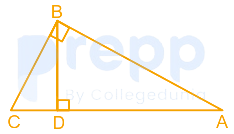
ABC is a triangle right angled at B. If AB = 5 cm and BC = 10 cm, then what is the length of the perpendicular drawn from the vertex B to the hypotenuse?
Which one of the following is correct in respect of a right-angled triangle?
Consider the following statements:
1. The perimeter of a triangle is greater than the sum of its three medians.
2. In any triangle ABC, if D is any point on BC, then AB + BC + CA > 2AD.
Which of the above statements is/are correct?
Important Questions from Triangles, Congruence and Similarity
G is the centroid of the equilateral triangle ABC. If AB = 8√ 3 cm, then the length of AG is equal to:
If sides of a triangle are 12 cm, 15 cm and 21 cm, then what is the inradius (in cm) of the triangle?
It is given that ΔABC ~ ΔXYZ and Area ΔABC : Area ΔXYZ = 81 : 25. If AB = 18 cm, BC = 10 cm, CA = 15 cm, then what is the side XZ (in cm)?
Sides of two similar triangles are in the ratio 4 ∶ 9. Area of these triangles are in the ratio:
If the ratio of corresponding sides of 2 similar triangles is 2 ∶ 3. Then the ratio of their corresponding altitude is :



