
ABC is an equilateral triangle. The side BC is trisected at D such that BC = 3 BD. What is the ratio of AD 2to AB 2?
7 ∶ 9
Understanding the Equilateral Triangle Problem
The problem involves an equilateral triangle ABC. In an equilateral triangle, all sides are equal in length, and all angles are equal to 60 degrees. We are given that the side BC is trisected at point D such that BC = 3 BD. This means point D is located on the side BC, dividing it into segments BD and DC, where BD is one-third of the total length of BC.
We need to find the ratio of the square of the length of AD to the square of the length of AB. Let's denote the side length of the equilateral triangle by \(s\). So, AB = BC = CA = \(s\).
Given BC = 3 BD, we can find the length of BD in terms of \(s\):
- BC = \(s\)
- BC = 3 BD
- Therefore, \(s\) = 3 BD
- So, BD = \(\frac{s}{3}\)
Since D is on BC, DC = BC - BD = \(s - \frac{s}{3} = \frac{2s}{3}\). However, for finding AD, we will focus on triangle ABD.
Applying the Law of Cosines to Find AD²
Consider the triangle ABD. We know the following about this triangle:
- AB = \(s\) (side of the equilateral triangle)
- BD = \(\frac{s}{3}\) (calculated from the trisection condition)
- \(\angle ABD\) = 60° (since \(\angle ABC\) is an angle of the equilateral triangle)
We want to find AD². We can use the Law of Cosines in triangle ABD, which states:
\(AD^2 = AB^2 + BD^2 - 2(AB)(BD)\cos(\angle ABD)\)
Substitute the known values into the Law of Cosines formula:
\(AD^2 = (s)^2 + \left(\frac{s}{3}\right)^2 - 2(s)\left(\frac{s}{3}\right)\cos(60°)\)
We know that \(\cos(60°) = \frac{1}{2}\). Substitute this value:
\(AD^2 = s^2 + \frac{s^2}{9} - 2\left(\frac{s^2}{3}\right)\left(\frac{1}{2}\right)\)
\(AD^2 = s^2 + \frac{s^2}{9} - \frac{s^2}{3}\)
To simplify, find a common denominator for the terms on the right side, which is 9:
\(AD^2 = \frac{9s^2}{9} + \frac{s^2}{9} - \frac{3s^2}{9}\)
\(AD^2 = \frac{(9 + 1 - 3)s^2}{9}\)
\(AD^2 = \frac{7s^2}{9}\)
Calculating the Ratio AD² : AB²
We have found AD² and we know AB².
- AD² = \(\frac{7s^2}{9}\)
- AB = \(s\), so AB² = \(s^2\)
The ratio AD² : AB² is given by \(\frac{AD^2}{AB^2}\).
Ratio = \(\frac{\frac{7s^2}{9}}{s^2}\)
Ratio = \(\frac{7s^2}{9s^2}\)
Cancel out the \(s^2\) terms:
Ratio = \(\frac{7}{9}\)
So, the ratio of AD² to AB² is 7 : 9.
Summary of the Solution
| Step | Description | Result |
|---|---|---|
| 1 | Define side length of equilateral triangle ABC | AB = BC = CA = \(s\) |
| 2 | Determine length of BD from trisection condition | BD = \(\frac{s}{3}\) |
| 3 | Identify knowns in \(\triangle ABD\) | AB = \(s\), BD = \(\frac{s}{3}\), \(\angle ABD\) = 60° |
| 4 | Apply Law of Cosines to find AD² | \(AD^2 = s^2 + \left(\frac{s}{3}\right)^2 - 2(s)\left(\frac{s}{3}\right)\cos(60°)\) |
| 5 | Simplify the expression for AD² | \(AD^2 = \frac{7s^2}{9}\) |
| 6 | Find AB² | \(AB^2 = s^2\) |
| 7 | Calculate the ratio AD² : AB² | \(\frac{AD^2}{AB^2} = \frac{7s^2/9}{s^2} = \frac{7}{9}\) |
The final ratio is 7 : 9.
Revision Table: Key Concepts
| Concept | Description | Relevance to Problem |
|---|---|---|
| Equilateral Triangle Properties | All sides equal, all angles 60°. | Used to define AB=BC=CA=\(s\) and \(\angle ABC = 60°\). |
| Trisection | Dividing a segment into three equal parts. | Used to determine BD = \(\frac{1}{3}\)BC. |
| Law of Cosines | \(c^2 = a^2 + b^2 - 2ab\cos(C)\) in a triangle. | Used to find the length of AD in \(\triangle ABD\). |
| Ratio | Comparison of two quantities by division. | The required final answer format. |
Additional Information: Exploring Related Geometry Concepts
This problem demonstrates a common type of geometry question that combines properties of specific triangles with trigonometric laws. Here are some related concepts:
- Apollonius' Theorem: This theorem relates the length of a median in a triangle to the lengths of the other two sides. While D is not the midpoint (it's a trisection point), there are generalized forms of Apollonius' theorem or related formulas for cevians (lines from a vertex to the opposite side). For a point D on side BC such that BD:DC = m:n, the length of the cevian AD can be related to the sides of triangle ABC.
- Coordinate Geometry: Alternatively, you could place the triangle on a coordinate plane. For instance, place B at the origin (0,0) and C on the x-axis at (s,0). Then the coordinates of A can be found using the side length \(s\) and the 60° angle. D would be at \((s/3, 0)\). You could then use the distance formula to find AD² and AB² and calculate their ratio. This method can sometimes be more tedious for complex setups but is very systematic.
- General Triangle Problems: Problems involving lengths of sides and angles in non-right triangles often require the Law of Sines or the Law of Cosines. Recognizing when to apply each law is crucial. The Law of Cosines is useful when you have two sides and the included angle (as in \(\triangle ABD\)) or all three sides.
Understanding how to use these tools allows you to solve a wide range of geometry problems involving lengths and angles within triangles.
Similar Questions
What is the area of quadrilateral ABCD?
AD is the median of the triangle ABC. If P is any point on AD, then which one of the following is correct?
In a triangle ABC, if 2 ∠A = 3 ∠B = 6 ∠C, then what is ∠A + ∠C equal to?
In a triangle, values of all the angles are integers (in degree measure). Which one of the following cannot be the proportion of their measures?
ABC is a triangle right angled at A and AD is perpendicular to BC, If BD = 8 cm and DC = 12.5 cm, then what is AD equal to?
If ABC is a right-angled triangle with AC as its hypotenuse, then which one of the following is correct?
In the figure given below, ABC is a triangle with AB perpendicular to BC. Further BD is perpendicular to AC. If AD = 9 cm and DC = 4 cm, then what is the length of BD?
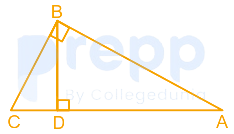
ABC is a triangle right angled at B. If AB = 5 cm and BC = 10 cm, then what is the length of the perpendicular drawn from the vertex B to the hypotenuse?
Which one of the following is correct in respect of a right-angled triangle?
Consider the following statements:
1. The perimeter of a triangle is greater than the sum of its three medians.
2. In any triangle ABC, if D is any point on BC, then AB + BC + CA > 2AD.
Which of the above statements is/are correct?
Important Questions from Triangles, Congruence and Similarity
G is the centroid of the equilateral triangle ABC. If AB = 8√ 3 cm, then the length of AG is equal to:
If sides of a triangle are 12 cm, 15 cm and 21 cm, then what is the inradius (in cm) of the triangle?
What is the area of quadrilateral ABCD?
It is given that ΔABC ~ ΔXYZ and Area ΔABC : Area ΔXYZ = 81 : 25. If AB = 18 cm, BC = 10 cm, CA = 15 cm, then what is the side XZ (in cm)?
Sides of two similar triangles are in the ratio 4 ∶ 9. Area of these triangles are in the ratio:



