
AD is the median of the triangle ABC. If P is any point on AD, then which one of the following is correct?
Area of triangle PAB equal to area of triangle PAC
Understanding Triangle Areas and Medians
The question asks about the relationship between the areas of triangle PAB and triangle PAC, given that AD is the median of triangle ABC and P is any point on AD.
Let's break this down using the property of a median in a triangle.
Property of a Median
A median of a triangle is a line segment joining a vertex to the midpoint of the opposite side. An important property of a median is that it divides the triangle into two triangles of equal area.
Applying the Median Property to Triangle ABC
Given that AD is the median of triangle ABC, D is the midpoint of BC. According to the property of a median, AD divides triangle ABC into two triangles of equal area:
- Triangle ABD
- Triangle ACD
Therefore, we can state:
\(\text{Area}(\triangle\text{ABD}) = \text{Area}(\triangle\text{ACD})\)
Let's call this Equation 1.
Applying the Median Property to Triangle PBC
Now consider triangle PBC. Since AD is the median of triangle ABC, D is the midpoint of BC. P is any point on AD. The line segment PD connects vertex P to the midpoint D of the opposite side BC in triangle PBC. This means PD is the median of triangle PBC.
Applying the same property of a median to triangle PBC, PD divides triangle PBC into two triangles of equal area:
- Triangle PBD
- Triangle PCD
Therefore, we can state:
\(\text{Area}(\triangle\text{PBD}) = \text{Area}(\triangle\text{PCD})\)
Let's call this Equation 2.
Relating Areas of Triangle PAB and Triangle PAC
Now let's look at how triangles PAB and PAC are formed.
Triangle PAB can be seen as the difference between triangle ABD and triangle PBD:
\(\text{Area}(\triangle\text{PAB}) = \text{Area}(\triangle\text{ABD}) - \text{Area}(\triangle\text{PBD})\)
Similarly, triangle PAC can be seen as the difference between triangle ACD and triangle PCD:
\(\text{Area}(\triangle\text{PAC}) = \text{Area}(\triangle\text{ACD}) - \text{Area}(\triangle\text{PCD})\)
Conclusion
From Equation 1, we know \(\text{Area}(\triangle\text{ABD}) = \text{Area}(\triangle\text{ACD})\).
From Equation 2, we know \(\text{Area}(\triangle\text{PBD}) = \text{Area}(\triangle\text{PCD})\).
Since the minuends (Area(ABD) and Area(ACD)) are equal, and the subtrahends (Area(PBD) and Area(PCD)) are also equal, the results of the subtraction must be equal.
Therefore:
\(\text{Area}(\triangle\text{PAB}) = \text{Area}(\triangle\text{PAC})\)
This shows that if AD is the median of triangle ABC and P is any point on AD, the area of triangle PAB is equal to the area of triangle PAC.
| Triangle | Area Calculation |
|---|---|
| Triangle PAB | Area(\(\triangle\)ABD) - Area(\(\triangle\)PBD) |
| Triangle PAC | Area(\(\triangle\)ACD) - Area(\(\triangle\)PCD) |
Since Area(\(\triangle\)ABD) = Area(\(\triangle\)ACD) and Area(\(\triangle\)PBD) = Area(\(\triangle\)PCD), it logically follows that Area(\(\triangle\)PAB) = Area(\(\triangle\)PAC).
Revision Table: Key Concepts
| Concept | Definition/Property | Relevance to Problem |
|---|---|---|
| Median of a Triangle | Line segment from a vertex to the midpoint of the opposite side. | AD is the median of \(\triangle\)ABC; PD is the median of \(\triangle\)PBC. |
| Area Property of Median | A median divides a triangle into two triangles of equal area. | Used to state Area(\(\triangle\)ABD) = Area(\(\triangle\)ACD) and Area(\(\triangle\)PBD) = Area(\(\triangle\)PCD). |
| Area Subtraction | Area of smaller triangle = Area of larger triangle - Area of overlapping/subtracted part. | Used to express Area(\(\triangle\)PAB) and Area(\(\triangle\)PAC) in terms of other triangle areas. |
Additional Information: Medians and Area Division
The property that a median divides a triangle into two equal areas is fundamental in triangle geometry. This property holds true regardless of the type of triangle (acute, obtuse, right-angled) or the position of the median.
If all three medians of a triangle are drawn, they intersect at a single point called the centroid. The centroid divides each median in a 2:1 ratio (vertex to centroid is twice the length of centroid to midpoint). Furthermore, the three medians divide the triangle into six smaller triangles, all of which have equal areas. This is a more advanced application of the median property but stems from the same fundamental idea that a median bisects the area.
In this specific problem, the point P being on the median AD is crucial. If P were outside the median, the relationship between Area(PAB) and Area(PAC) would generally be different.
Similar Questions
What is the area of quadrilateral ABCD?
In a triangle ABC, if 2 ∠A = 3 ∠B = 6 ∠C, then what is ∠A + ∠C equal to?
In a triangle, values of all the angles are integers (in degree measure). Which one of the following cannot be the proportion of their measures?
ABC is an equilateral triangle. The side BC is trisected at D such that BC = 3 BD. What is the ratio of AD 2to AB 2?
ABC is a triangle right angled at A and AD is perpendicular to BC, If BD = 8 cm and DC = 12.5 cm, then what is AD equal to?
If ABC is a right-angled triangle with AC as its hypotenuse, then which one of the following is correct?
In the figure given below, ABC is a triangle with AB perpendicular to BC. Further BD is perpendicular to AC. If AD = 9 cm and DC = 4 cm, then what is the length of BD?
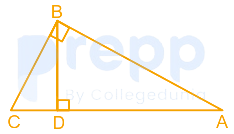
ABC is a triangle right angled at B. If AB = 5 cm and BC = 10 cm, then what is the length of the perpendicular drawn from the vertex B to the hypotenuse?
Which one of the following is correct in respect of a right-angled triangle?
Consider the following statements:
1. The perimeter of a triangle is greater than the sum of its three medians.
2. In any triangle ABC, if D is any point on BC, then AB + BC + CA > 2AD.
Which of the above statements is/are correct?
Important Questions from Triangles, Congruence and Similarity
G is the centroid of the equilateral triangle ABC. If AB = 8√ 3 cm, then the length of AG is equal to:
If sides of a triangle are 12 cm, 15 cm and 21 cm, then what is the inradius (in cm) of the triangle?
What is the area of quadrilateral ABCD?
It is given that ΔABC ~ ΔXYZ and Area ΔABC : Area ΔXYZ = 81 : 25. If AB = 18 cm, BC = 10 cm, CA = 15 cm, then what is the side XZ (in cm)?
Sides of two similar triangles are in the ratio 4 ∶ 9. Area of these triangles are in the ratio:



