
ABC is a triangle right angled at B. If AB = 5 cm and BC = 10 cm, then what is the length of the perpendicular drawn from the vertex B to the hypotenuse?
2√5 cm
Calculating the Perpendicular Length in a Right Triangle
This problem involves finding the length of the perpendicular drawn from the right-angled vertex to the hypotenuse in a right triangle. We are given a right triangle ABC, where the right angle is at vertex B. The lengths of the two sides forming the right angle (legs) are given: AB = 5 cm and BC = 10 cm. We need to calculate the length of the altitude from B to the hypotenuse AC.
Finding the Hypotenuse Length of Triangle ABC
First, we need to find the length of the hypotenuse AC. Since triangle ABC is a right triangle with the right angle at B, we can use the Pythagorean theorem. The Pythagorean theorem states that in a right triangle, the square of the length of the hypotenuse (the side opposite the right angle) is equal to the sum of the squares of the lengths of the other two sides (the legs).
Let AC be the hypotenuse. According to the Pythagorean theorem:
\(AC^2 = AB^2 + BC^2\)
Substitute the given values for AB and BC:
\(AC^2 = (5 \text{ cm})^2 + (10 \text{ cm})^2\)
\(AC^2 = 25 \text{ cm}^2 + 100 \text{ cm}^2\)
\(AC^2 = 125 \text{ cm}^2\)
To find AC, take the square root of 125:
\(AC = \sqrt{125} \text{ cm}\)
We can simplify \(\sqrt{125}\) by factoring out the perfect square 25:
\(AC = \sqrt{25 \times 5} \text{ cm}\)
\(AC = \sqrt{25} \times \sqrt{5} \text{ cm}\)
\(AC = 5\sqrt{5} \text{ cm}\)
So, the length of the hypotenuse AC is \(5\sqrt{5}\) cm.
Calculating the Area of Right Triangle ABC
We can calculate the area of the right triangle ABC in two ways:
- Using the two legs as base and height.
- Using the hypotenuse as the base and the perpendicular drawn from the right angle vertex to the hypotenuse as the height (altitude).
Let's calculate the area using the legs AB and BC. In a right triangle, the legs are perpendicular to each other, so one can be considered the base and the other the height.
Area of triangle = \(\frac{1}{2} \times \text{base} \times \text{height}\)
Using AB as base and BC as height:
Area \(= \frac{1}{2} \times AB \times BC\)
Area \(= \frac{1}{2} \times 5 \text{ cm} \times 10 \text{ cm}\)
Area \(= \frac{1}{2} \times 50 \text{ cm}^2\)
Area \(= 25 \text{ cm}^2\)
Determining the Perpendicular Length (Altitude)
Now, let 'h' be the length of the perpendicular drawn from vertex B to the hypotenuse AC. This perpendicular is the altitude of the triangle with respect to the base AC.
We can write the area of the triangle using AC as the base and 'h' as the height:
Area \(= \frac{1}{2} \times AC \times h\)
We already know the area is \(25 \text{ cm}^2\) and we found AC is \(5\sqrt{5}\) cm. We can equate the two expressions for the area:
\(25 = \frac{1}{2} \times (5\sqrt{5}) \times h\)
Now, we solve this equation for 'h':
Multiply both sides by 2:
\(2 \times 25 = (5\sqrt{5}) \times h\)
\(50 = (5\sqrt{5}) \times h\)
Divide both sides by \(5\sqrt{5}\):
\(h = \frac{50}{5\sqrt{5}}\)
Simplify the fraction:
\(h = \frac{10}{\sqrt{5}}\)
To rationalize the denominator, multiply the numerator and the denominator by \(\sqrt{5}\):
\(h = \frac{10}{\sqrt{5}} \times \frac{\sqrt{5}}{\sqrt{5}}\)
\(h = \frac{10\sqrt{5}}{5}\)
\(h = 2\sqrt{5} \text{ cm}\)
Therefore, the length of the perpendicular drawn from the vertex B to the hypotenuse AC is \(2\sqrt{5}\) cm.
Revision Table: Key Formulas Used in Right Triangle Problems
| Formula Name | Formula | Description |
|---|---|---|
| Pythagorean Theorem | \(a^2 + b^2 = c^2\) | In a right triangle, the sum of the squares of the legs (\(a, b\)) equals the square of the hypotenuse (\(c\)). |
| Area of a Triangle | Area \(= \frac{1}{2} \times \text{base} \times \text{height}\) | Calculates the area using a base and its corresponding altitude (perpendicular height). |
Additional Information: Properties of Right Triangles and Altitudes
- In any triangle, an altitude is a line segment from a vertex perpendicular to the opposite side (or its extension).
- In a right triangle, the two legs are also altitudes because they are perpendicular to each other.
- The altitude drawn from the right-angled vertex to the hypotenuse divides the original right triangle into two smaller right triangles that are similar to the original triangle and also similar to each other. This property is useful in solving many geometry problems involving right triangles and altitudes.
- There are geometric mean theorems related to the altitude from the right angle. For example, the square of the altitude from the right angle to the hypotenuse is equal to the product of the lengths of the two segments it divides the hypotenuse into. In our case, if the foot of the perpendicular from B to AC is D, then \(BD^2 = AD \times DC\). However, calculating AD and DC requires more steps than the area method used above, which is often simpler when the leg lengths are known.
Similar Questions
What is the area of quadrilateral ABCD?
ABC is a triangle right angled at A and AD is perpendicular to BC, If BD = 8 cm and DC = 12.5 cm, then what is AD equal to?
If ABC is a right-angled triangle with AC as its hypotenuse, then which one of the following is correct?
In the figure given below, ABC is a triangle with AB perpendicular to BC. Further BD is perpendicular to AC. If AD = 9 cm and DC = 4 cm, then what is the length of BD?
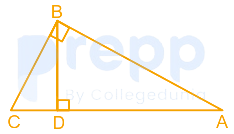
Which one of the following is correct in respect of a right-angled triangle?
Consider the following statements:
1. The perimeter of a triangle is greater than the sum of its three medians.
2. In any triangle ABC, if D is any point on BC, then AB + BC + CA > 2AD.
Which of the above statements is/are correct?Consider the following inequalities in respect of any triangle ABC:
1. AC - AB < BC
2. BC - AC < AB
3. AB - BC < AC
Which of the above are correct?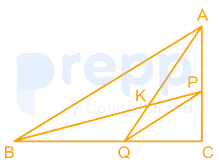
ABC is a triangle right angled at C as shown in the figure below. Which one of the following is correct?
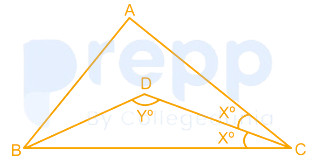
In the figure given below, ∠A = 80° and ∠ABC = 60°, BD and CD bisects angles B and C respectively. What are the values of x and y respectively?
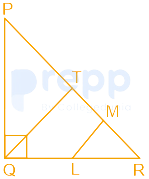
In the figure given below, PQR is a non-isosceles right-angles triangle, right angled at Q. If LM and QT are parallel and QT = PT, then what is ∠RLM equal to?
Important Questions from Triangles, Congruence and Similarity
G is the centroid of the equilateral triangle ABC. If AB = 8√ 3 cm, then the length of AG is equal to:
If sides of a triangle are 12 cm, 15 cm and 21 cm, then what is the inradius (in cm) of the triangle?
What is the area of quadrilateral ABCD?
It is given that ΔABC ~ ΔXYZ and Area ΔABC : Area ΔXYZ = 81 : 25. If AB = 18 cm, BC = 10 cm, CA = 15 cm, then what is the side XZ (in cm)?
Sides of two similar triangles are in the ratio 4 ∶ 9. Area of these triangles are in the ratio:



